
By Jheri Hardaway
Staff Writer
Raleigh, NC — If you take to the paved paths of Raleigh’s Capital Area Greenway network, you can journey more than 120 miles without ever leaving dedicated parkland, a distance that rivals traveling from downtown Raleigh straight to Wrightsville Beach, Concord, or across state lines to Dillon, South Carolina. It is a singular, nationally revered municipal footprint that has long established the City of Oaks as the cradle of the modern American greenway movement.
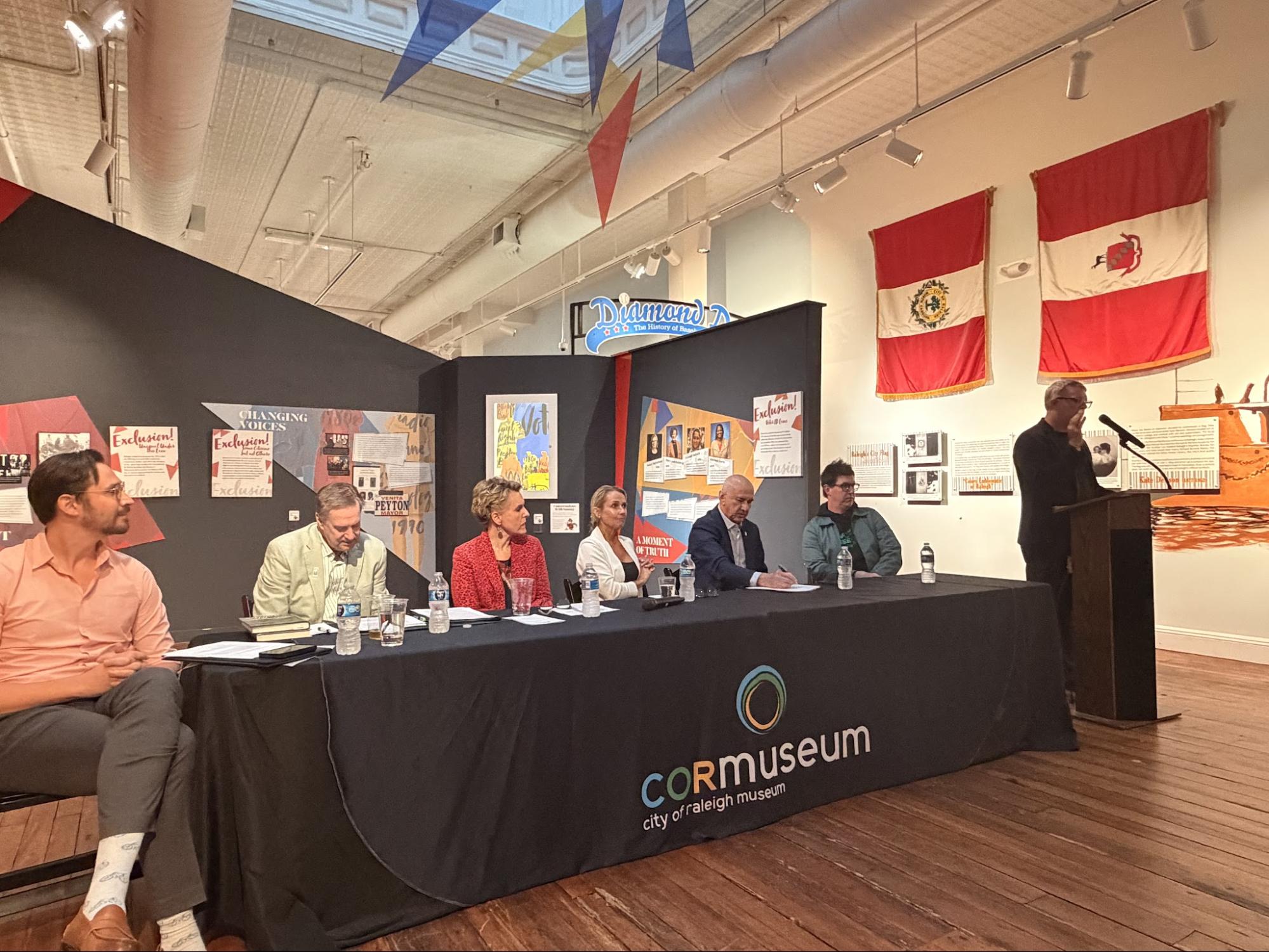
On Thursday, October 8th, civic champions, pioneering planners, trail designers, and everyday advocates gathered at the City of Raleigh Museum for a landmark milestone: the Raleigh Greenways 50th Anniversary Celebration. The evening opened with a reception for the museum’s archival exhibition, “The Park with a City in It: 50 Years of the Raleigh Greenway System,” followed by an in-depth retrospective panel entitled “Celebrating 50 Years of Raleigh Greenways: Past, Present, and Future”.
The gathering, framed by Mayor Janet Cowell’s official proclamation designating Raleigh Greenways Week, brought together the key voices who planned, built, and championed the trails across five decades. Their shared refrain was unmistakable: Raleigh’s trail system is not merely asphalt, wood, and concrete; it is the living legacy of an intentional, enduring “we mentality.”
“Whenever I tell folks I’m the parks director, seven out of ten times people immediately say, ‘I love your greenways,’” said Raleigh Parks, Recreation and Cultural Resources Director Stephen Bentley in his opening remarks. “We stand on the shoulders of so many men and women who got us here. It took an entire community and a whole city.”
Raleigh’s trail network, which now anchors a broader regional web of roughly 250 miles throughout Wake County, was born out of the restless civic activism of the late 1960s and early 1970s. As the environmental movement and civil rights organizing swept the country, local advocates sought concrete ways to put progressive ideas into practice on the ground. The conceptual spark ignited in 1967, when landscape architect Lewis Clarke proposed in the Raleigh Times that the city preserve its stream valleys as protective “green fingers” for recreation and vital flood mitigation along Crabtree Creek. The idea took functional form in 1972 through Bill Flournoy, then an N.C. State University graduate student, whose seminal master’s thesis provided the actionable blueprint showing how a municipality could acquire riparian floodplains and transform them into interconnected public park corridors. When author Charles Little penned his definitive work Greenways for America, he cited Flournoy’s groundbreaking framework and termed Raleigh the epicenter of the movement.
Translating lines on paper into continuous public trails required daring field decisions and innovative municipal policy. Panelist Chuck Flink, an award-winning planner, landscape architect, and author of The Greenway Imperative who served as a Raleigh greenway planner from 1984 to 1986, recalled the scrappy ingenuity of the early days. While engineering the Rocky Branch Trail near Western Boulevard, Flink recalled walking with survey flags directly ahead of clearing bulldozers. Later, after drafting field designs back in the office, he arrived on-site to find the construction crew had already finished paving the trail through their own resourcefulness. “The planners took on the hard work of taking this grand vision and going door-to-door, convincing skeptical landowners that a public trail in their backyard was an asset, not a detriment,” Flink shared.
The system's longevity was also secured by early municipal foresight under leaders like former Mayor Tom Bradshaw, whose administration established flood-prone easement dedications before dense subdivisions could hem in the waterways. Civic financing followed. Panelist Sig Hutchinson, former chair of the Wake County Board of Commissioners, recounted the crusade to move greenway funding from ad-hoc local efforts to large-scale public investment. Over his public career, Hutchinson helped lead eight successful bond referendums totaling more than $700 million across Wake County and the City of Raleigh for open space, transit, and parks—beginning with a $15 million open space bond in 2000 that passed with 76 percent voter approval.
Throughout the evening, panelists paid heartfelt tribute to the late Vic Lebsock, a revered city greenway planner and landscape architect who passed away in 2025. Lebsock was instrumental in expanding Raleigh’s network from roughly 30 miles to over 100 miles, including the completion of the 32-mile Neuse River Greenway Trail.
“Ribbon-cuttings are always bittersweet, because those of us who spend years doing the surveys, engineering the bridges, and securing the easements are so often forgotten once the trail opens,” reflected panelist Iona Thomas, AICP, Chief Strategy Officer at McAdams and co-founder of the Great Trails State Coalition. Thomas served as project manager for the Neuse River Trail, an effort stretching from the base of Falls Dam to Clayton that required eight bridges, including two dramatic suspension spans. Also, negotiations with over 100 private landowners! “Vic Lebsock was with us through that entire journey. What he taught us is still being passed down to every planner we mentor today.”
Lisa Schiffbauer, an engineering supervisor who has spent nearly two decades with Raleigh Parks guiding capital improvement projects, highlighted the quiet patience required behind every milestone. She pointed to long-horizon achievements like the Crabtree Creek West Trail connecting to William B. Umstead State Park, a corridor 15 years in the making before trail construction could even begin.
Moderated by Raleigh Parks Assistant Director Adam Forman, the discussion doubled down on the trail's human element. Panelist Jared Harmer, executive director of Oaks and Spokes and co-founder of Oak City Cycling, noted how the greenway transforms community life. Harmer created the popular “Neuse Goose”—a 200-kilometer self-supported cycling ride down and back along the Neuse River Trail that has drawn more than a thousand participants.
Yet for Harmer, the system’s true magic lies in everyday, unscripted moments: “Seeing a kid on the creek holding up a fresh catch with a huge smile, or watching wildlife along the stream banks on an afternoon commute. That’s what proves this infrastructure belongs to all of us.”
With anniversary walks, historic tours, and volunteer efforts underway throughout the month, Raleigh marks its golden greenway jubilee not just by looking back at the miles completed, but by celebrating the community dedication that built every foot of the journey.
