
By Jordan Meadows
Staff Writer
The Black Conservative Federation released its 2026 State of Black America Report on Wednesday afternoon, presenting what the organization's leaders described as an accounting of Black American life built entirely from federal, academic, and independently verified sources and data.
BCF President and founder Diante Johnson opened a press briefing on the report, a 72-page document produced through BCF's newly launched Center for American Opportunity & Excellence.
"This report tells the story, not the conservative story, not the Democratic story, but it tells the true story of what the state of Black America is," Johnson said.
Johnson walked reporters through what he called the report's good news:
Black poverty sits at a record low of 17.1%, down from 55% in 1959, and Black family wealth grew 61% from 2019 to 2022, the fastest growth of any group, according to the report.
"Black families are building wealth faster than anyone from a lower base," Johnson said.
He cited record-low Black unemployment, record prime-age employment, and more than a third of Black workers now holding management or professional jobs. Black-owned employer firms grew 29% to roughly 161,000 companies.
He highlighted the Black high school graduation rate, now at 81%, as one of his favorite statistics in the report.
"I know that many people say, ‘Is that something we should be celebrating’?" Johnson said. "But 81% of Black students graduating high school is a tremendous improvement."
He also pointed to two straight years of record declines in murder, a 33% drop in the Black imprisonment rate from 2013 to 2023, a roughly 75% decline in youth confinement, and a rise in the share of Black children living in two-parent households, from about 35% to 39%: "More fathers are in the home,” Johnson said.
Despite the record-low poverty rate, he called 17.1% "a number that is uncomfortable to us here at the Black Conservative Federation."
Black homeownership remains at 45.7%, with 52% of Black Americans still renting. Johnson stated that expanding ownership would be a major focus of the center's work going forward, including a push for first-time homeownership programs and HUD grants.
"Having property, being able to own something, having a deed—that's very important," Johnson said.
He also flagged a persistent gap in generational wealth, noting that roughly one in ten Black families report receiving an inheritance. "That's still not where we need to be," he said, "but thank God for Trump accounts”—a new tax-advantaged, hybrid investment and retirement account created for children under 18 that was authorized under the ‘One Big Beautiful Bill’ and launched in July.
Walter Blanks Jr., executive director of the Center for American Opportunity & Excellence, agreed:
“The fact that there are families across America who have made, never even talked about investing beforehand, are doing it, regardless of the account that they're using, is a massive plus," Blanks said regarding the Trump Accounts.
Blanks said the report was designed to give what he called a complete picture of Black America rather than a partisan one.
"It's not meant to be a celebration or an indictment in any kind of way," Blanks said. "It's really just meant to establish where we are currently, and what the Black Conservative Federation is doing over time to really address some of those issues."
He said the report's chapters are interconnected: education shapes earnings, earnings shape ownership, and family stability shapes the next generation. Blanks pointed to state-level school choice policies and the "success sequence" framework—graduating high school, finishing college, getting a job, and marrying before having children—as themes running through the report's education and family chapters.
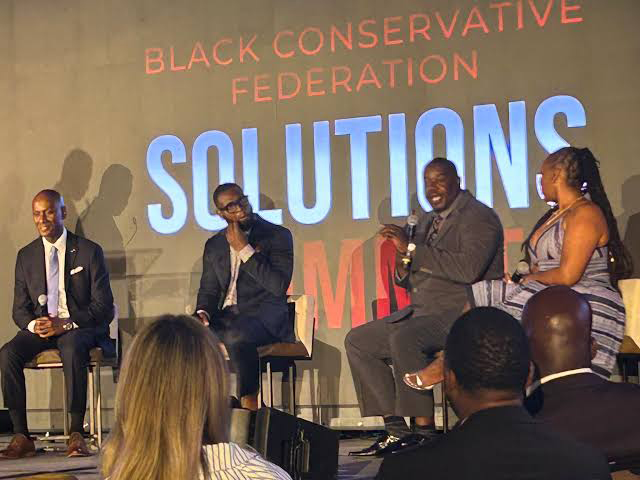
BCF unveiled the report in Chicago on July 18 during its 10th anniversary celebration. Johnson said the timing was tied to that anniversary rather than the midterm elections, though he said the findings could help explain election outcomes afterward.
"There was no rush, there was no major strategy behind releasing it this week that's tied to the midterms," Johnson said. "But I do think that it helps us understand the outcomes of the midterms a lot better, post-election."
When asked what role lawmakers should play in closing the Black homeownership gap, Johnson said he believes government programs already exist but that community awareness, not new legislation, is the bigger barrier. He also said BCF plans to run homeownership-focused campaigns similar to political get-out-the-vote efforts.
Asked about the group's grassroots focus ahead of the midterms, Johnson acknowledged the toll of current economic pressures on families.
"Yes, the gas prices are extremely high. Yes, the food costs are high. Yes, we're experiencing an affordability issue," he said, adding that BCF is pushing financial literacy and multiple streams of income as near-term strategies.
Many of the gains BCF highlighted as positive—including HBCU enrollment growth, declining murder rates and improvements in Black maternal health—occurred during multiple political administrations.
Johnson said the report does not strip credit from either party.
"Yes, there were some wins in the Biden administration, and there were wins in the Trump first administration," Johnson said. "Both parties have a play in that.”
