
By Jordan Meadows
Staff Writer
The Wake County Board of Commissioners voted 5-2 Monday evening to let the proposed $2 billion merger between WakeMed and Atrium Health move forward, capping a five-hour meeting that ended with sheriff's deputies clearing a packed chamber before the final vote was cast.
The vote would allow WakeMed to amend its articles of incorporation and governing documents, transferring control from the county's Board of Commissioners to a new 14-member board jointly selected by Atrium and county leaders.
Board Chair Don Mial asked deputies to clear the room after spectators, some of whom had been in the chamber for more than five hours, grew disruptive as commissioners began voting; commissioners then took a five-minute recess before resuming.
Commissioners Vickie Adamson and Tara Waters cast the two dissenting votes, both citing insufficient time to review revised legal documents that arrived just days before the meeting.
"In my eight years on this board, I don't think I've ever been handed this complicated of legal documents on Thursday night and had to vote on it on that day, and that's just normally not how we do business," Adamson said.
Waters, who represents District 5, home to WakeMed's Raleigh campus, said she'd heard extensive resident concerns and wanted to weigh the decision carefully.
"It's an important decision and one that I will do thoughtfully, prayerfully, and with the citizens of Wake County in mind," she said.
Commissioners who voted in favor pointed to a revised agreement WakeMed announced late last week that added protections beyond the original May proposal. That revision brought an additional $150 million to the county over the next decade for the county-controlled Wake County Whole Health Program, which will fund priorities including foster youth placement, homelessness, supportive housing, food security and senior services.
It also raised WakeMed's minimum indigent care requirement from 4.8% to 8% of annual adjusted revenue, gave commissioners more control over board appointees, limited Atrium's power to alter WakeMed's governing documents, and confirmed that Atrium—not WakeMed—would fully fund the $2 billion in capital investment, which includes roughly half a billion dollars for WakeMed's flagship Southeast Raleigh campus and a new Whole Health Campus in Garner featuring a 150-bed mental health hospital.
"I believe that this action will make WakeMed stronger in the face of growing demands, workforce pressures, rising costs, and the real headwinds facing healthcare today," Mial said.
Commissioner Safiyah Jackson said she saw the vote as protecting WakeMed's mission long-term.
"I believe my vote protects WakeMed's legacy," Jackson said. "It protects our most vulnerable neighbors, and it guarantees great care for our children and grandchildren."
Commissioner Cheryl Stallings credited weeks of negotiation for the improved terms.
"We have worked diligently over the past couple of weeks to secure a stronger agreement," Stallings said. "The $2 billion in capital investments will be coming from Atrium, and not WakeMed. There are sound financial assistance policies in place that have already been presented."
Adamson remained unconvinced and noted that a price-increase cap Gov. Josh Stein had announced with Atrium over the weekend wasn't actually included in the documents commissioners were voting on, meaning the county would still need to finalize that piece separately.
"Quite frankly, the plot twists have been nonstop," she said. "For residents, the questions are real: What will this mean for the cost of health care? What will it mean for access to care? What will it mean for the quality of care? Why give up so much local control to a sole member?"
She argued the board should reject the agreement outright and start over.
"The deal is much better than it was when it first came to county leaders," she said, but added the board should "send it back to WakeMed and get a new board that's willing to do the hard work, the due diligence, to look at hospitals, do a public process, because we're in no hurry."
A county attorney confirmed to Adamson during the meeting that the deal does represent a significant shift in control, with the current board no longer retaining the authority it holds today.
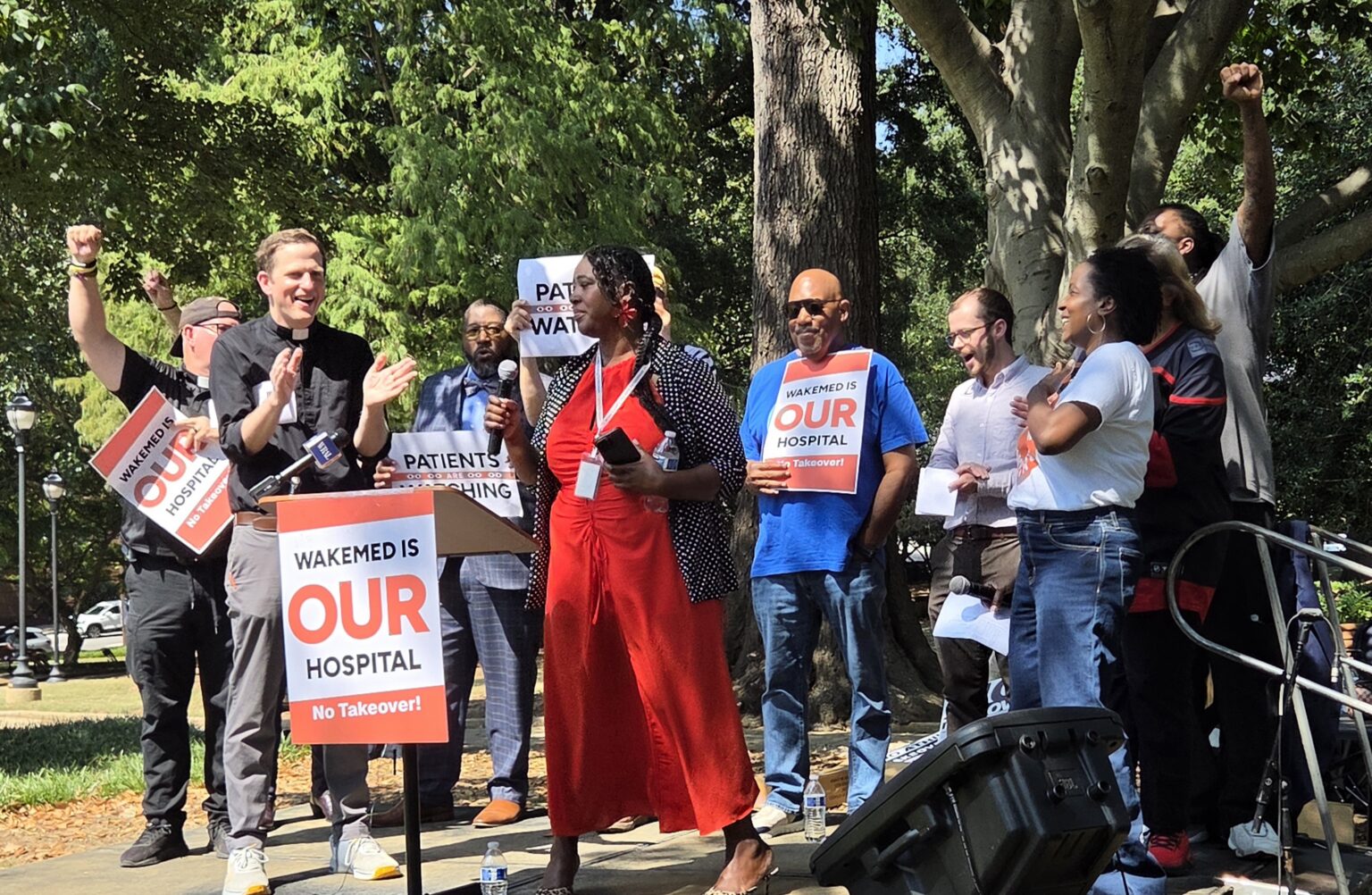
Around 50 people spoke during the meeting's public comment period, the majority opposed to the deal. Many in the packed chamber wore white T-shirts reading "Save WakeMed" and held signs declaring "We Will Remember Every November" and "Patients are Watching." Speakers described the arrangement as a corporate takeover and raised fears about rising health care costs, the loss of local accountability, and reduced transparency; several health care workers testified that mergers of this kind often bring higher patient-to-nurse ratios and declining care quality.
Monday's meeting capped months of public organizing against the deal, which began after it was quietly placed on the commissioners' consent agenda in May and removed following backlash. On July 27, hundreds of people packed Saint Ambrose Episcopal Church in Raleigh for a community town hall organized by The Patients Union, where residents pressed WakeMed and Atrium representatives for guarantees that costs wouldn't rise, and services wouldn't shrink.
Stein, who had raised concerns in a July letter to WakeMed leaders about county oversight of the proposed board, announced Sunday that he no longer opposed the merger after Atrium agreed to two of his requests: capping price increases at WakeMed to no more than 1.5 times the annual increase in Medicare costs for the next five years, and fully funding the $2 billion in capital investment itself rather than relying on WakeMed.
Stein noted he has pushed since his time as attorney general for the General Assembly to grant that office formal authority to review hospital transactions, an effort that included bipartisan legislation he helped draft in 2023 with Sens. Jim Burgin and Julie Mayfield that would let the attorney general block mergers found to raise costs, reduce care quality or harm local communities; that legislation has not yet passed.
The merger is not yet final. It still requires approval from the Federal Trade Commission and the U.S. Department of Justice before Atrium and WakeMed can complete the combination.
