
By Jordan Meadows
Staff Writer
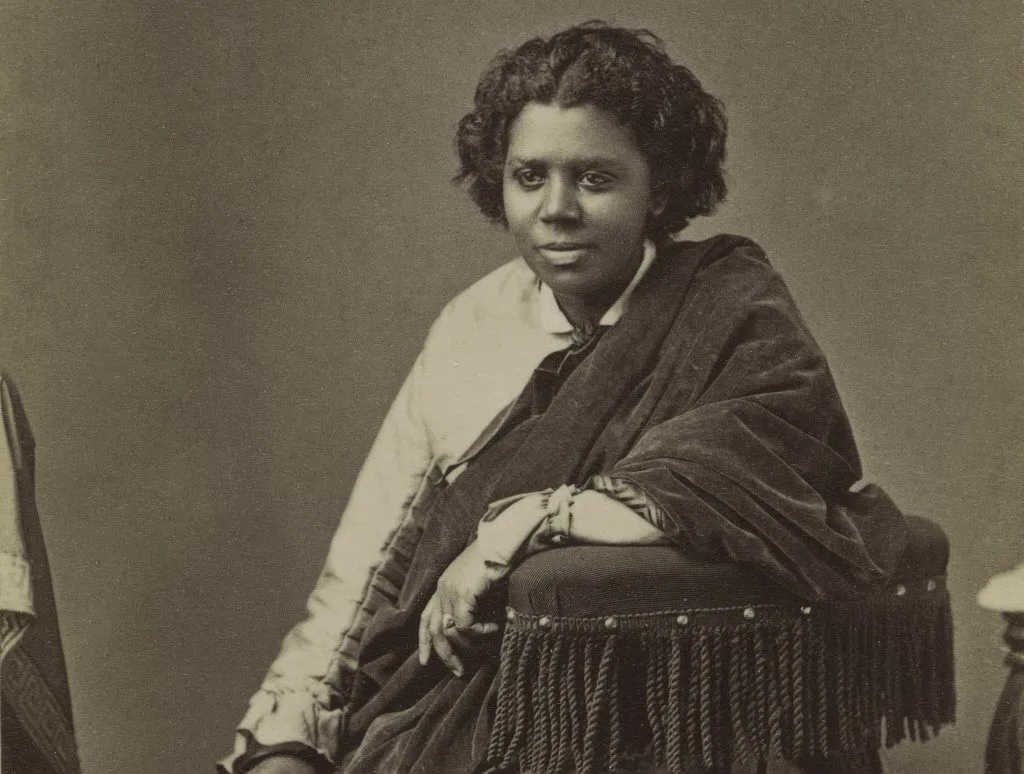
Edmonia Lewis, widely considered the first sculptor of African American descent to achieve international prominence, is receiving renewed attention more than a century after her death, following a pair of recognitions: a commemorative stamp issued by the United States Postal Service and a posthumous degree awarded by Oberlin College in Ohio.
Lewis, who was born on the Fourth of July 1844 near Albany, New York, built a career that spanned the Civil War era and the late 19th century, producing marble sculptures that drew on her dual African American and Mississauga Ojibwe Native American heritage at a time when Black women had virtually no foothold in the American art world.
Her father was of Afro-Caribbean descent, and her mother was of Ojibwe and African American heritage. Both parents died before Lewis reached the age of nine, and she was raised by maternal aunts near Niagara Falls, where she spent several years selling Ojibwe baskets, moccasins, and embroidered goods to tourists. With financial support from her older half-brother Samuel, who found success in the California gold rush, Lewis enrolled at Oberlin College in 1859, one of the first institutions in the country to admit both women and students of color.
Her time at Oberlin was marked by repeated racial hostility. In 1862, she was charged with poisoning two white classmates after they fell ill following a social outing. She was acquitted at trial for lack of evidence — the victims' stomachs had never been tested, leaving no proof of poisoning — but was beaten and left for dead by unknown assailants before the verdict was reached. She later faced additional accusations of theft and left the college without a degree.
Lewis moved to Boston in the midst of the Civil War, where she studied briefly under sculptor Edward Augustus Brackett after three other male sculptors refused to take her on.
She began producing portrait busts and medallions of prominent abolitionists, including William Lloyd Garrison and Charles Sumner, and later made a bust of Civil War Colonel Robert Gould Shaw that sold well enough in plaster reproduction — one hundred copies at fifteen dollars each — to fund a move to Rome in 1865.
In Rome, Lewis established a studio and spent the bulk of her career producing work in marble. Unlike most sculptors of the era, who hired craftsmen to execute the final carving, Lewis did all her own stonework, a deliberate choice she made to ensure her work could not be dismissed as someone else's.
Her Roman studio became a popular stop for Americans traveling in Europe, and she produced busts of Abraham Lincoln and Ulysses S. Grant alongside works rooted in her Native American heritage, including a series of figure group sculptures inspired by Henry Wadsworth Longfellow's epic poem The Song of Hiawatha, each depicting Native American life with care and specificity.
Her most ambitious piece, The Death of Cleopatra, was displayed at the 1876 Centennial Exhibition in Philadelphia. The three-thousand-pound marble sculpture was later lost for decades before being recovered in a Chicago suburb, covered in graffiti, and donated to the Smithsonian Institution in the early 1990s, where it remains on display today.
Lewis largely disappeared from the public record in the 1880s, and much of the latter part of her life remains undocumented.
She died on September 17, 1907, in London of chronic kidney failure and was buried at St. Mary's Catholic Cemetery, in a grave that fell into disrepair before a crowdfunding campaign in 2017 financed its restoration. Oberlin College's decision to award her a posthumous degree in 2022 acknowledged what the institution had denied her in life. And the U.S. Postal Service stamp marked the latest in a series of efforts to recover and formalize Lewis's place in American art history.
Her work is now held by the Metropolitan Museum of Art, the Detroit Institute of Arts, the Howard University Gallery of Art, the Smithsonian American Art Museum, and the Baltimore Museum of Art, among others.
