
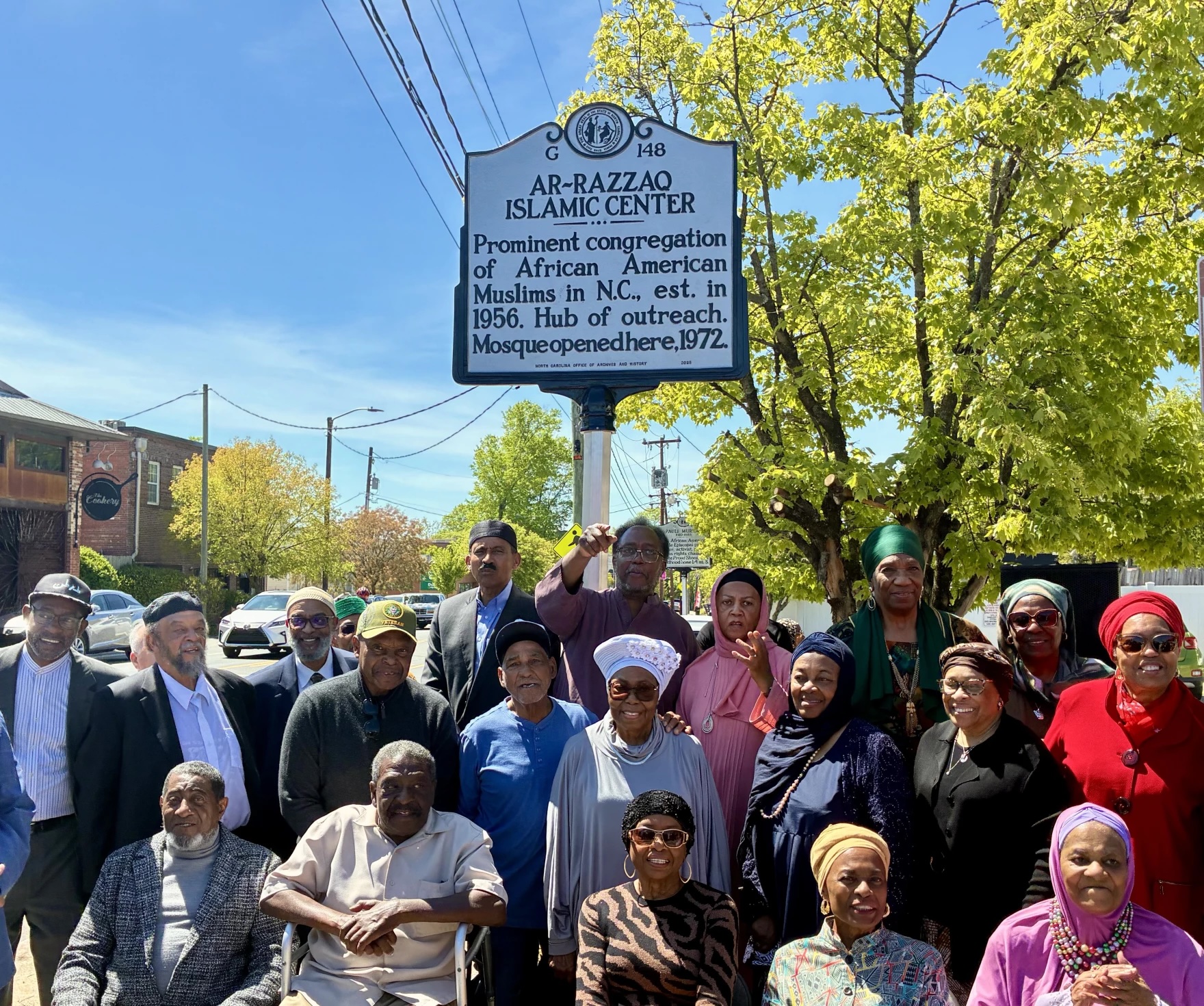
WUNC - More than 70 years since its founding, the Ar-Razzaq Islamic Center is officially being recognized by North Carolina with a Highway Historical Marker as the state's first mosque.
Cheers and yells of "Allahu akbar!", or "God is greater!" broke out when the marker was unveiled on Friday afternoon, commemorating state recognition of the historically Black mosque in Durham's West End.
Established in 1956 by Imam Kenny Muhammad from Baltimore, the Ar-Razzaq Islamic Center remains a centerpiece of Durham's African American Muslim community, playing a key role in the expansion of Islam in the state.
"It is heartwarming," said Rhonda Muhammad, daughter of Ar-Razzaq's founding imam. "It is a manifestation of devotion and dedication. My father did not live to see this, but he didn't work for any aggrandizement. That's not what he was here for. He was a man that loved people and he believed in the uplifting of humanity."
The N.C. Department of Natural and Cultural Resources recognized the mosque through its Historical Marker Program, which has registered more than 1,600 markers on historic sites statewide.
Ar-Razzaq was initially founded as a Nation of Islam organization before transitioning in the late 1970s to mainstream Sunni Islam, connecting a network of African American mosques to other American mosques.
Islam then became more religious than social for the mosque, said Muhammad.
"It broadened our horizons, it broadened our scope," Muhammad told WUNC. "We no longer saw white people as the devil. So it just broadened us. It created a whole new vista of thinking for us."
The South is underrepresented in the study of Black Muslim identity, according to the Department of Natural and Cultural Resources.
Ar-Razzaq is a rare example of a community that flourished since the 1950s, far from more recognized urban American Muslim centers like Detroit and Chicago.
The marker is located across from the mosque on Chapel Hill Street in downtown Durham, next to the Al-Taiba Halal Market storefront, a Muslim-owned business.
Ar-Razzaq's leaders also opened the first mosque and Muslim school in Raleigh in 1971.
Ar-Razzaq's civil rights history
The mosque first existed on West Pettigrew Street in the former Black Wall Street of Durham, before moving to its present Chapel Hill Street location in 1972.
Ar-Razzaq attracted prominent Black Muslims of history during the 1960s civil rights movement, such as the civil rights icon and writer Malcolm X and boxing legend Muhammad Ali.
Rhonda Muhammad says she remembers when Malcolm X visited and gave a speech in Durham.
"He was supposed to speak at Duke, and because of the controversy, they denied him access," she said. "My father tried to get him at UNC. They would not allow him to speak. We went to North Carolina Central University, and they would not allow him to speak."
Malcolm X eventually gave his speech in a building that was known as Page's Auditorium, on South Roxboro Street, according to state historical records.
As a teenager, she said, her family hosted him at their Fayetteville Street home in Raleigh, because segregated hotels would not receive Black people.
"Ar-Razzaq's marker ... gives proper visibility to this community's contribution to Durham's civil rights legacy and calls us to other homegrown histories," said Aleah Marrow, member of Ar-Razzaq and daughter of Greg Rashad, imam of the mosque.
"Historical markers educate the public, preserve shared memories and help communities understand and interpret their past."
