
By Jordan Meadows
Staff Writer
The only freedmen's schoolhouse known to remain standing in North Carolina was formally dedicated in Smithfield, capping nearly a decade of preservation work and drawing community leaders, historians and descendants of the formerly enslaved people who built and attended the school more than 150 years ago.
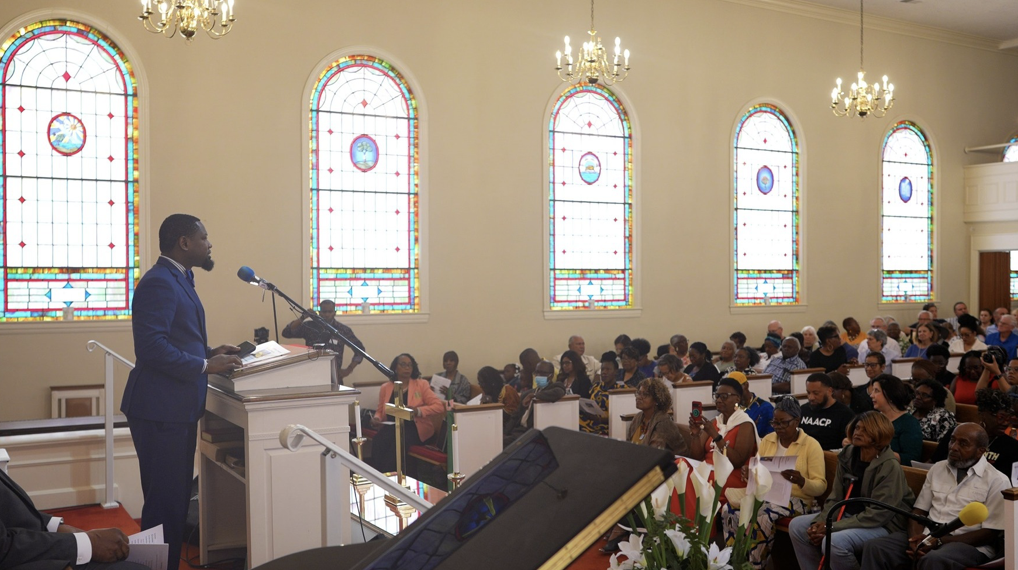
The ceremony was held on Juneteenth at First Missionary Baptist Church before a ribbon-cutting and public tours of the restored building, and was organized by the Historic Smithfield Foundation and the Johnston County Heritage Center. The keynote address was delivered by Dr. Crystal R. Sanders, a Johnston County native, Emory University associate professor of African American studies and a direct descendant of freedmen who attended the school.
Sanders used her remarks to trace the arc from the brutal legal suppression of Black literacy before the Civil War to the fierce determination with which formerly enslaved people pursued education the moment they were free.
"White people who violated the law could be fined or imprisoned," Sanders told the audience. "Free Black people who violated the law could be fined, imprisoned, or publicly whipped. Enslaved people could be punished with 39 lashes on their bare backs."
Yet some learned anyway, Sanders said. "They were willing to risk everything to gain what slavery had robbed them of."
After emancipation, that determination only intensified.
Sanders cited John Alvord, the national superintendent of schools for the Freedmen's Bureau, who observed at the time: "Throughout the entire South, an effort is being made by the colored people to educate themselves. In the absence of other teaching, they are determined to be self-taught."
That was true in Smithfield. In January 1866, three white women from the Boston-based New England Freedmen's Aid Society arrived to teach in a school that formerly enslaved people had already built themselves. Within four months, the school burned to the ground. There were documented 631 African American schoolhouses destroyed across the South between 1864 and 1876.
"The destruction of these places of learning could have discouraged Black educational efforts," Sanders said. "But Black people in and around Smithfield refused to give up. The day after the fire, classes resumed in private homes."
A new school was built on town property.
The Freedmen's Bureau arrived in 1868, and construction of the current schoolhouse began that fall and was completed in the spring of 1869. The simple two-room building featured sliding pocket doors separating its two classrooms. Between 1867 and 1871, several white teachers affiliated with the American Missionary Association taught there.
Their surviving letters offer a window into what education meant to the community. In one letter from September 1868, teacher Susan Haines described elderly men and women walking miles to attend classes and worship services, often bringing their children and grandchildren.
"As I enter my schoolroom Sabbath mornings and see the men, women, and children gathered there, so eager to learn the Word of God, and remember that I am the only one to whom they can look for instruction, I feel that the harvest truly is great, but the laborers still few," Haines wrote.
Sanders great-great-grandparents, Wesley and Constantia Bell, were both born into slavery; their four children were educated at the Smithfield school.
"Walking miles along muddy country roads, these children embodied the determination of African Americans to become an educated people."
The restoration was the result of nearly a decade of collaboration between the Historic Smithfield Foundation and the Johnston County Heritage Center. The foundation acquired the property in 2019 and began rehabilitation work in 2021. Funding came from private donors and a $250,000 grant from the North Carolina Department of Natural and Cultural Resources, which was strongly advocated for by Rep. Donna White, a Republican from Johnston County.
"Our Historic Smithfield Foundation was created in 2017, and in 2019, we were able to acquire the title to the property," said Tony Johnson, director of the Johnston County Heritage Center. "We started doing rehabilitation work in 2021, right in the middle of the pandemic, and it's taken us another five years to actually get the certificate of occupancy and get it finished."
Of the 169 freedmen's schoolhouses that once existed in North Carolina, the Smithfield building is the only one known to survive. Its history had been largely forgotten for decades—the building was converted to a private residence around 1913, and its origins were not rediscovered until research for a Black history exhibit at the Johnston County Heritage Center in 2002 revealed that the structure likely predated a later principal's tenure and had been built by the Freedmen's Bureau.
The NC State Preservation Office confirmed in 2010 that the building dated from the 1860s.
