
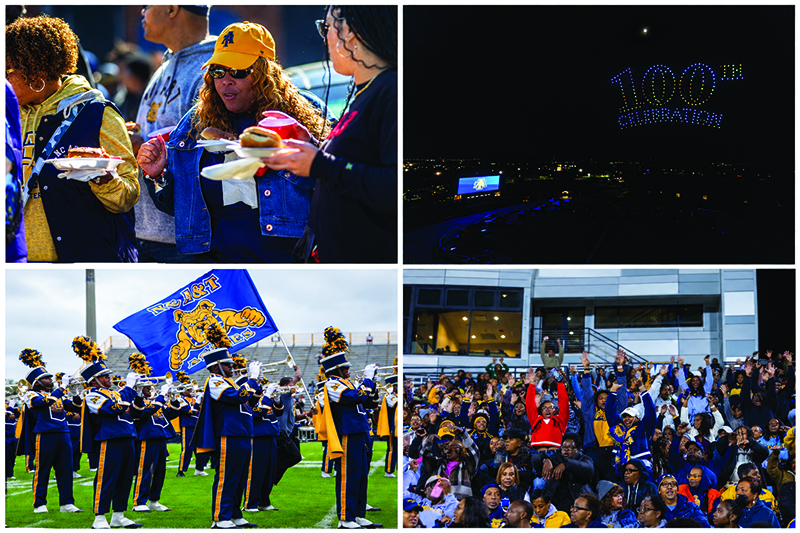
GREENSBORO, N.C. — Generations of Aggies returned to Greensboro last week for a celebration a century in the making as North Carolina Agricultural and Technical State University marked the 100th anniversary of its Greatest Homecoming on Earth.
The weeklong celebration, which began Oct. 25 and concluded Nov. 1, brought alumni, students, families and visitors from across the country to Greensboro. The milestone drew an estimated crowd of more than 300,000 people participating in festivities across the weekend, according to the Greensboro Police Department, making it one of the largest gatherings in the event's history.
For A&T, however, the centennial was about more than the size of the crowd. It was an opportunity to recognize a tradition that has connected generations of students and alumni since the university hosted its first homecoming in 1926.
What began as a university gathering has grown into one of the most recognizable homecoming celebrations among historically Black colleges and universities. The event now extends beyond campus, bringing thousands of visitors into Greensboro and creating an annual gathering centered on Aggie pride, Black culture and community.
The university's history was a central part of this year's celebration. A Centennial History Gallery at F.D. Bluford Library highlighted photographs, memorabilia and traditions that have shaped the institution's homecoming over the decades.
Among the traditions represented was the coronation of Mister and Miss A&T. According to University Archives and Special Collections Librarian James Stewart, Miss A&T has been a fixture since the 1930s, while Mister A&T has appeared periodically throughout the university's history.
The coronation themes have also reflected the cultural and political moments of their time. Stewart told WUNC that some ceremonies during the late 1960s and 1970s incorporated Afrocentric themes connected to the Black Student Movement. Other years reflected broader cultural periods, including a Camelot theme during the Kennedy era.
This year's coronation continued that tradition with a royal getaway theme, connecting current students to a ceremony that has remained part of the university's identity for generations.
The university's marching band also represents a significant part of that history. A&T's band program began in 1918, eight years before the first homecoming celebration. The group later became known as the Blue and Gold Marching Machine in the late 1970s or early 1980s.
Over time, the band developed into one of the university's most recognizable symbols, representing A&T at athletic events, parades and celebrations across the country.
In 1998, Kellye Worth Hall became the band's first female drum major. Hall told WUNC that she did not immediately understand the significance of the milestone while she was a college student. It was after graduating and reflecting on the limited representation of women in HBCU marching bands that she recognized the importance of her role.
Hall returned for the centennial celebration, marching with the alumni band and reconnecting with the traditions she helped shape.
The history gallery also offered students an opportunity to understand how their own experiences fit into the university's larger story. First-year student Kimani Noble told WUNC that her family's connection to A&T stretches across generations. Her grandparents met at the university, her father earned a master's degree there and other relatives also attended.
That generational connection is part of what has allowed GHOE to remain a significant gathering for alumni and current students alike.
This year's celebration also introduced new elements while maintaining familiar traditions. The week included the homecoming coronation, a drone show, the annual parade, tailgating and the highly anticipated football game. The events brought together campus organizations, alumni groups, local businesses and visitors who traveled to Greensboro for the centennial.
The economic impact extended beyond the university. Greensboro business leaders and an A&T economics professor projected that the celebration could generate approximately $57 million in economic activity for the region. That figure is a projection rather than a final accounting of revenue. Local hotels reportedly sold out, while restaurants and businesses adjusted their operations to accommodate the influx of visitors.
The weekend also delivered a homecoming victory for the Aggies.
A&T defeated Elon University 13-10 on Oct. 31 at Truist Stadium before a sellout crowd of 22,401. Freshman kicker Asher Holland connected on a 34-yard field goal with 2:18 remaining to give the Aggies the lead.
The defense secured the victory in the final minute when sophomore Tyrek Brown forced a fumble and junior Cadricus Stanley recovered it. The win marked A&T's first homecoming football victory since 2022.
The Greensboro Police Department's estimate of more than 300,000 people participating in the weekend festivities reflected the scale of the centennial. Greensboro Mayor Marikay Abuzuaiter separately estimated approximately 200,000 visitors in a statement to WXII, thanking city employees, first responders, university staff and community partners for helping coordinate the celebration.
As the university closes the chapter on its 100th homecoming, the milestone also provides an opportunity to consider what the next century will look like.
The traditions have changed, the crowds have grown and the celebration has expanded beyond the university's campus. But the connections between students, alumni and the broader HBCU community remain central to what makes GHOE meaningful.
For a university that first welcomed homecoming crowds in 1926, the centennial was not simply a celebration of how far the event has grown. It was a recognition of the generations who built the tradition and continue to carry it forward.
