
WUNC - It was a scene that might be familiar to others across the country, but it was new to the Triangle.
On the night of July 4, in several neighborhoods throughout Raleigh, there was an influx of violence. Nine people were shot overnight in a surge that was otherwise atypical.
 They stemmed from two "teen takeovers." About 3,000 people that the Raleigh Police Department classified as teenagers gathered at a Brier Creek shopping center where fights broke out and gunshots rang out. Across town, police said similar events took place on opposite sides of Glenwood South. Police responded at 1:34 a.m., and later estimated a total 5,000 teens were present.
There was a swift response. On July 7, Raleigh City Council met with Police Chief Rico Boyce, Director of Community Engagement Tiesha Mosley, and Director of Parks, Recreation and Cultural Resources Stephen Bentley.
Raleigh Mayor Janet Cowell called for a youth curfew. Boyce pointed the finger at an increased number of juveniles having access to guns; on laws implemented in 2019 that police say reduce accountability for juveniles charged with crimes; on the nationwide trend of teen takeovers, and an influx of "outside agitators" present in Raleigh for the holiday weekend.
"Unruly, undisciplined, unsupervised juveniles is what we were dealing with after the first shooting," Police Chief Rico Boyce told the council.
Mosley, however, took a different tone. Instead of blaming teens for violent behavior, the
director of Community Engagement noted the lack of spaces for teens to hang out with each other, what sociologists sometimes refer to as "third spaces."
"That's somewhere outside of school, work, and home for young people to gather," Mosley told Raleigh City Council members in that July 7 afternoon meeting.
In short: The number of third spaces in America are shrinking. That number is particularly bleak for young people in the Triangle. With fewer places to go for regular entertainment, some young people turn to more reckless behavior, at times escalating to violence.
Where did all the kids go?
In a 2025 essay for the American Enterprise Institute published in December, Samuel Abrams wrote about the vibrant casual restaurants and gathering spots he would frequent while growing up in Philadelphia. When he returned with his family years later, he said the changes were unsettling.
"This is not just a cultural loss; it is a civic one," he wrote. "The decline of third places contributes to rising loneliness, weaker social trust, and declining engagement with neighbors."
In preparation for this story, WUNC News put a call out on Reddit's R/Triangle channel asking where teenagers hang out. The responses varied. Several Redditors mentioned the Cook Out parking lot.
However, during the middle of the week at the Cook Out along Capital Boulevard, as a parade of cars stretched long around the drive-through, two reporters were the only ones eating their burgers and loitering outside the restaurant.
At least two factors get in the way of third spaces for young people. The first is an ongoing issue: Everything costs more. A trip to the movies can be unattainable for young people without decent-paying jobs. A cup of coffee is around $6.
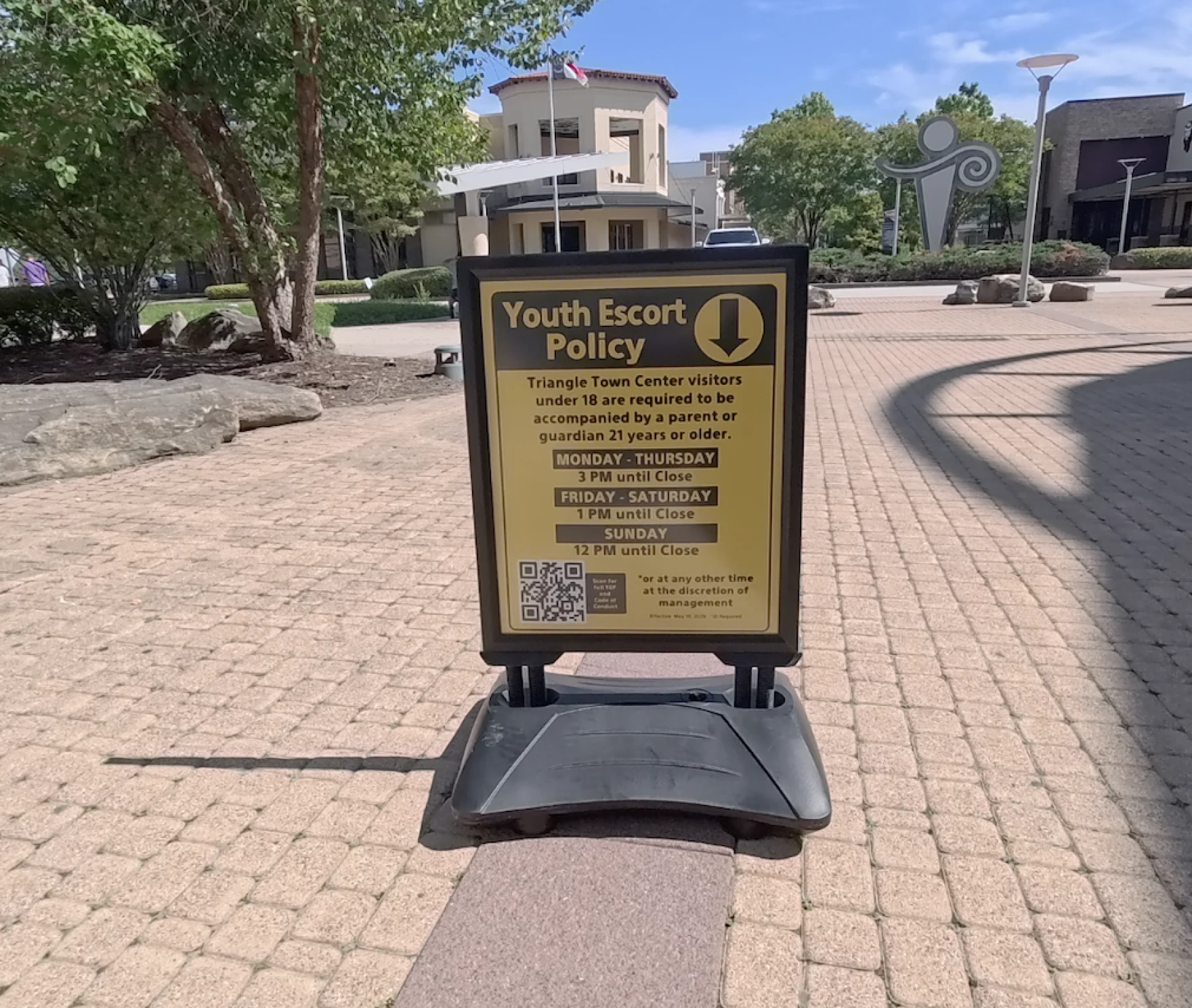
Second, some private businesses actively shun teenagers. Shopping malls have age restrictions. The Streets at Southpoint in Durham no longer allows anyone under the age of 17 at the mall on Saturdays or Sundays without a parent or guardian present after 4 p.m. At Triangle Town Center, the age restriction is 18. Frankie's Fun Park, a business with arcades and go-karts, requires a parent or guardian to accompany anyone under 18 at all times, and after 5:30 p.m. on Saturdays, no one under 18 is permitted in at all.
"Regardless of day or time, individuals under the age of 18 must remain with a parent or legal guardian at all times," the website reads. "Anyone under the age of 18 that is not with a parent or legal guardian will be asked to leave. These efforts are being made to provide a safe and enjoyable environment from disruptive teenagers."
Lisa Pearce is a sociologist with the University of North Carolina-Chapel Hill. She says restrictions like this directly contradict what young people want the most: Chances to spend time with their peers with minimal adult presence.
"A variety of people have noted that younger teens or even preteens are increasingly looking for autonomy," she said.
There's a balance between providing space for that to happen and allowing teens the opportunity to make the wrong decisions. Businesses tend to operate on the conservative end of that tension and put strict rules like curfews in place.
Even religious institutions, historically a safe haven for adolescents, are on the decline.
"It's just a challenge to figure out how to correctly place that scaffolding so that we're providing great opportunities for youths and a chance for them to really show their autonomy and their maturing and whatnot," Pearce said. "But also just making sure they're safe."
What's already being done
Events like what happened on the Fourth of July reinforce the importance of programs like Raleigh Teen Connect, Stephen Bentley said.
As the director of the City of Raleigh's Parks, Recreation and Cultural Resources Department, Bentley said traditional parks departments usually have a teen focus. But in Raleigh, multiple full-time staff are connected to the city's youth programs, which include "Teen Connect."
Teen Connect is a free membership program that gives middle and high school students access to community centers, pools, events, field trips, and workshops across the city.
From a mobile video game trailer to kayaking and free swim lessons, Bentley said the program hopes to offer third spaces for teens who might not have access to them. Those barriers can include financial obstacles, lack of transportation, or a fear of overcoming new things. He said he's heard from local teens that they're feeling squeezed out of privately owned spaces.
"Parks wants to make sure that there is these safe, accessible, positive locations in which we can really have spaces where people and young adults can be who they want to be, and that they don't have to be out on the street," he said.
Adolescents are pulled in many different directions, from decisions over college to self-expression. Bentley said what he hears from teens most is that they want freedom.
That's why Teen Connect develops its programming in partnership with local teens. They're trying to find a happy balance between learning, discussion and freedom with curated instructors, who vary from workshop leaders to an ear young folks can bend.
Every generation has challenges, and it seems that this generation was especially impacted by the years of isolation and uncertainty brought about by the COVID-19 pandemic, Bentley said, on top of being born into an increasingly digital world. But young people are aware of the pressures of social media, he said, with some opting out of a digital lifestyle where possible.
State officials across the U.S. are discussing how to respond to teen takeovers. So far, everywhere from Washington, D.C. to Raleigh to Chicago, the response has been split between increasing enforcement and better youth infrastructure. Mayor Janet Cowell says she knows there is no one-size-fits-all solution to this problem.
"Clearly Raleigh is not exempt from the incidents of youth violence that are occurring across the country," she said in an email to WUNC. "We need to talk with the youth, their parents, schools and the broader community to understand the root causes and to better coordinate strategies."
