
By Jordan Meadows
Staff Writer
North Carolina Central University cut the ribbon on Monday morning on a new $7.2 million building for its Institute for Artificial Intelligence and Emerging Research, making it the first historically Black college or university in the country to establish a dedicated AI institute and the first North Carolina college to build a facility devoted specifically to the technology.
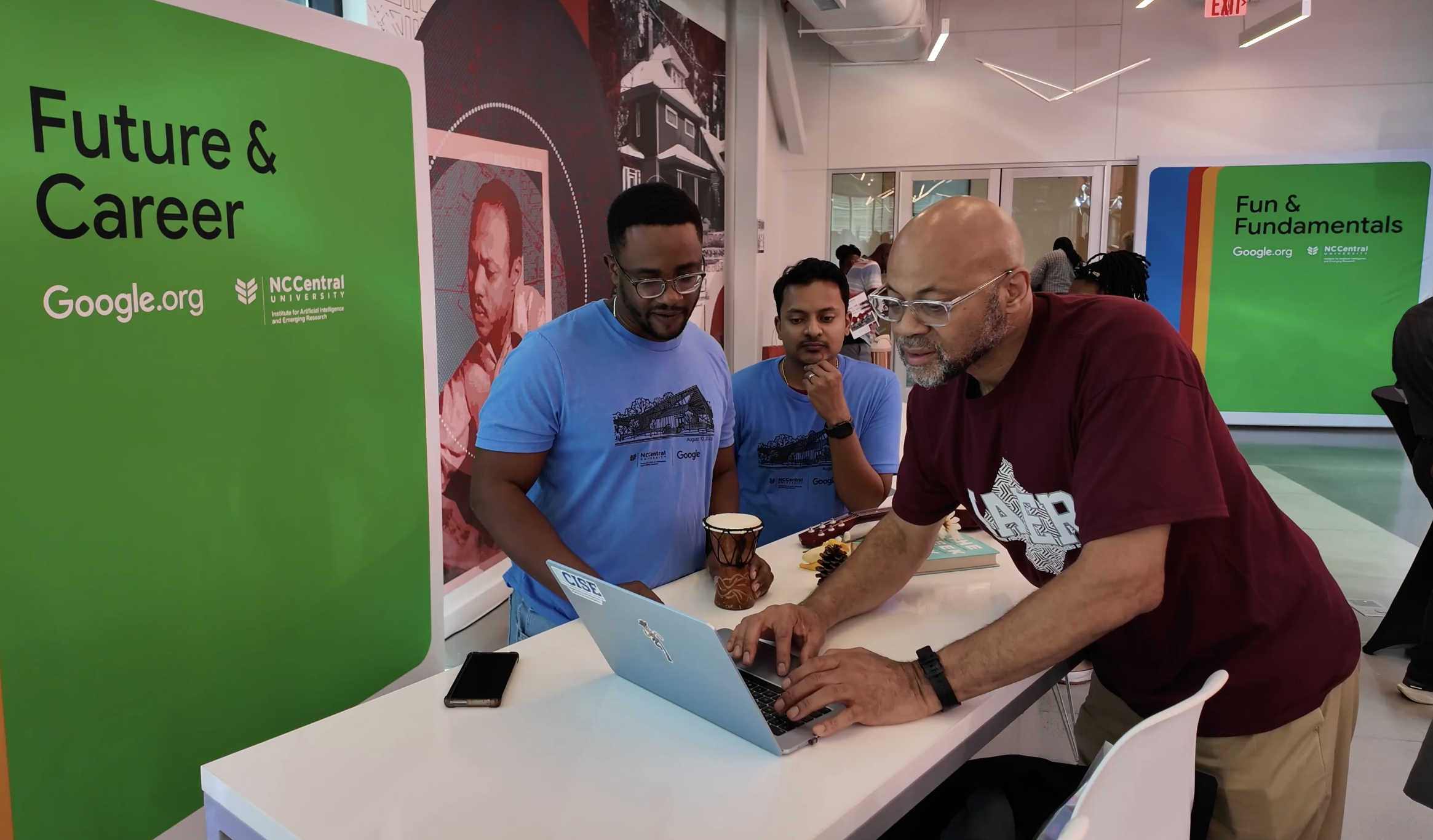
The roughly 5,000-square-foot building, at the corner of Fayetteville and Lawson streets in Durham, was funded through a mix of federal Title III grant funding and NCCU trust funds. Inside, a central collaboration space is surrounded by an AI Literacy Studio, a Machine Learning and Data Science Studio, a Robotics and Emerging Tech Lab, an XR Innovation Sandbox, an Ethics and Governance Classroom and an Innovation Atrium.
The institute itself opened in January 2025 with $1 million in funding from Google.org and was formally approved by the NCCU Board of Trustees in December 2025, after a lengthy institutional review process.
"Today, we are establishing a framework, a blueprint and a launching point for what ethical, responsible and human-centered artificial intelligence can look like in higher education and beyond," said Siobahn Grady, the institute's founding director, who holds a Ph.D. and whose academic path runs through three of North Carolina's HBCUs—undergraduate study in computer science at Winston-Salem State, a graduate degree in information science at NCCU, and a history-making stint at N.C. A&T before returning to Central to help build the institute.
"AI used to be something specifically just for computer scientists, but with AI tools now it's accessible to everyone," Grady said. "We want our campus community to have access to these tools, but also understand how they're developed, the biases involved in them; the pros, but also the harms that it may cause too."
NCCU Chancellor Karrie G. Dixon, who also holds a Ph.D., told the crowd of faculty, students, alumni and community members that the university's goal extends beyond simply teaching students to use AI tools.
"Artificial intelligence is transforming nearly every industry," Dixon said. "We want to not only prepare students but help them shape AI."
Dixon added that the pace of the technology's adoption creates its own obligation for the university.
"Technology moves faster than trust," she said. "What we have to do strategically and intentionally is to educate our campus community on usage of AI in a responsible and ethical way… it shouldn't replace human judgment, creativity, or critical thinking skills."
Her comment referenced a recent study by the American Association of Colleges and Universities and Elon University, which found faculty worry AI could weaken students' critical thinking and erode academic integrity.
U.S. Rep. Valerie Foushee, D-N.C., was among several local and state officials on hand, alongside Durham Mayor Leo Williams and state Treasurer Brad Briner. Foushee framed the institute as a corrective to who typically drives technological innovation.
"Our future cannot be built by a few tech moguls and billionaires," she said. "The breakthroughs of tomorrow will not just be from Silicon Valley and the largest universities."
She added that the institute would prepare students for high-demand careers, strengthen research partnerships, support entrepreneurs and expand access to emerging technology for communities she said have too often been left out of the innovation economy.
Starting in fall 2025, NCCU added an AI module to its mandatory Introduction to University Education course for incoming freshmen, requiring all first-year students to complete introductory AI coursework. Beginning this fall, the university will offer a new AI minor through its Department of Mathematics and Physics, and faculty have access to seed grant funding to pursue AI-related research.
According to figures cited at the event, 208 programs nationally now offer a bachelor's degree in artificial intelligence.
