
NC NEWSLINE - When the heat index tops 105°F, as it has this week in central North Carolina, the National Weather Service issues a heat advisory. Meteorologists warn people to limit their time in the sun and advise that hot temperatures and high humidity may cause heat-related illness.
But for many workers, taking a break from summer’s extreme conditions is not an option.
Andressia Ramirez, an advocacy and civic engagement manager at Casa Azul de Wilson, said farmworkers in North Carolina are expected to work long hours even in triple-digit conditions.
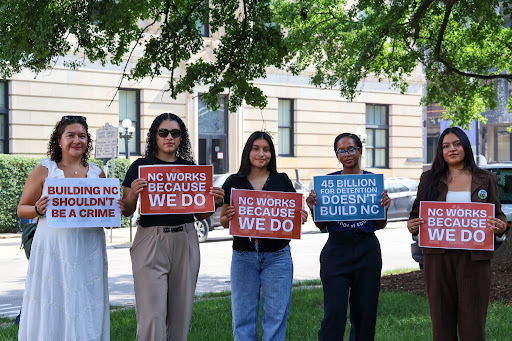
Ramirez was joined by a group of Latine agricultural workers at the state capitol Thursday to highlight the contributions of immigrant farmworkers and the workplace dangers they face.
Ramirez, who grew up in rural Wilson County, said she was recently visiting a farmworker camp when she noticed a young man sitting alone on a bucket underneath a tree.
The man told Ramirez he had a fever. He should have been resting inside the mobile home, but the coolest place he could find on the 95-degree day was outdoors underneath a tree.
In North Carolina, farmworker housing is still not required to have air conditioning.
“This isn’t just about one young man. It is about the conditions we have allowed to become normal,” said Ramirez.
The federal Occupational Safety and Health Administration offers guidelines for prevention of heat illness, but it has not yet implemented any specific heat standards for workers apart from its general duty clause.
Seven states have enacted their own specific occupational heat safety standards designed to protect workers when temperatures become hazardous. North Carolina is not among those states. State lawmakers have said requiring farmers to follow heat safety rules would hurt them economically.
The National Institute for Occupational Safety and Health (NIOSH), which is under the CDC, recommends limiting worker heat stress, enforcing work-rest cycles, rotating tasks, and encouraging hydration during moderate work, but those are not legal requirements.
Esmeralda Juarez was never offered those protections.
Juarez, who works for the Kinston nonprofit NC Field, told reporters Thursday that she began working in the tobacco fields at age 13.
Juarez said many farmworker families endure pain and unbearable heat without complaint out of need.
“Many people would tell me, if you don’t feel well, don’t go,” said Juarez. “But poverty does not give families that kind of choice.”
Juarez said agriculture is one of the most dangerous industries in the U.S. and North Carolina lawmakers must do more to protect farmworkers and child laborers from extreme conditions.
“Water alone is not enough. Workers need shade. We need training that we can actually understand, and time to adjust to extreme heat,” said Juarez.
Immigrant workers make up 12% of North Carolina’s workforce, and by conservative estimates contribute $60 billion annually to the state’s economy, according to the left-leaning N.C. Budget and Tax Center.
Ramirez said she often hears lawmakers talk about struggles that farmers are facing, with higher input costs, tariffs, and this summer’s punishing drought.
“I agree, our farmers deserve support, but why must one lose for the other to gain?” Ramirez said. “We can support our farmers without sacrificing the people who work in their fields.”
