
By Jheri Hardaway
Staff Writer
As we approach the tail end of our America 250 celebrations, we have a ripe opportunity to explore our founding documents and ideals. Thomas Jefferson, a man of many perspectives, shared one in particular that has been glossed over yet remains relevant now more than ever. Jefferson was a staunch proponent of the idea that constitutions should not be treated as permanent, untouchable scripture. Our celebrated founding father intended our legal frameworks to flow with the generations. While serving as minister to France during the outbreak of the French Revolution, Jefferson sent a letter to James Madison proposing that every constitution, law, and public debt should naturally expire after 19 years. Jefferson calculated this using mortality tables as the lifespan of a single generation of adults. According to /AskHistorians Reddit, “In the 1700s and 1800s, overall average life expectancy at birth was only about 30 to 40 years. This low number was heavily skewed by extremely high infant and childhood mortality. If a person survived childhood, their chances of living into their 60s, 70s, or even 80s were quite reasonable.”
Jefferson wrote to James Madison on September 6, 1789, “The question, Whether one generation of men has a right to bind another, seems never to have been started either on this or our side of the water... But it is a question of such consequences as not only to merit decision, but place also, among the fundamental principles of every government... I set out on this ground, which I suppose to be self-evident, 'that the earth belongs in usufruct to the living'; that the dead have neither powers nor rights over it."
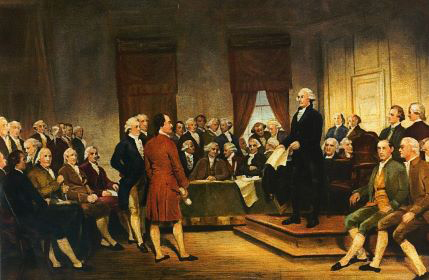
Jefferson’s 19 Year Rule, housed in The Papers of Thomas Jefferson, Princeton University Press / National Archives Founders Online, states simply, "Every constitution, then, and every law, naturally expires at the end of 19 years. If it be enforced longer, it is an act of force, and not of right." Written plainly, the intention of the writer of our Declaration of Independence is clear. The United States Constitution, at 238 years old since it was signed, or 237 years old since it went into operation, should have lived 12.5 lives by now; yet it is still the archaic document signed by slave owners, lawyers, merchants, planters, and public officials who did not reflect the wider society's perspectives and experiences.
Decades later, in his retirement, Jefferson reiterated this philosophy to Virginia lawyer Samuel Kercheval. He explicitly criticized "sanctimonious reverence" for the Constitution and advocated for periodic revision conventions roughly every generation. In Jefferson to Samuel Kercheval July 12, 1816, “Laws and institutions must go hand in hand with the progress of the human mind... As new discoveries are made, new truths disclosed, and manners and opinions change with the change of circumstances, institutions must advance also, and keep pace with the times. We might as well require a man to wear still the coat which fitted him when a boy, as civilized society to remain ever under the regimen of their barbarous ancestors." An excerpt of this quote is engraved directly onto the wall of the Jefferson Memorial in Washington, D.C.
Well, here we are with an old raggedy coat. Modern legal scholars argue about the founders' intentions. In February 1790, James Madison argued that periodic constitutional overhauls would breed severe instability, encourage bitter factional fighting every two decades, and destroy public confidence in the rule of law. This contrasted with the fact that the primary author of the Declaration of Independence never wanted future generations bound to 18th-century rules. This is a concept that ‘We The People’ should reckon with. Amendments are rare in modern times, the 27th Amendment was ratified in 1992, but proposed in 1789! Learning of Jefferson’s vision has me ready for new clothes.
