
By Jordan Meadows
Staff Writer
Dan Bullock was 15 years old when he was killed in Vietnam on June 7, 1969, making the Goldsboro native the youngest American service member to die in the war.
Bullock was born Dec. 21, 1953, in Goldsboro and lived in North Carolina until he was about 12, when his mother died, and he moved to Brooklyn to live with his father.
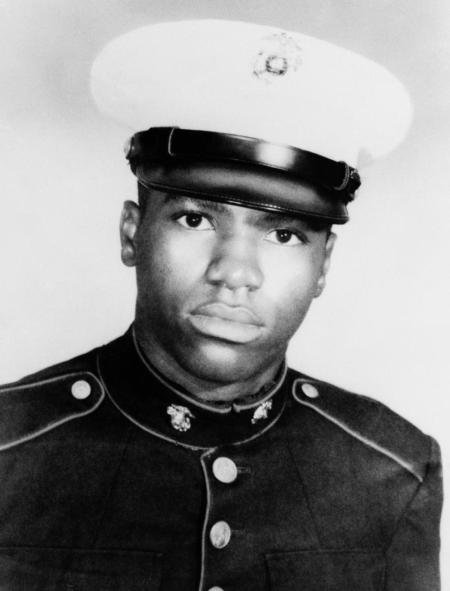 Family members later said he'd talked about wanting to become a pilot, a police officer, a firefighter or a Marine. Unsatisfied with his living situation in New York and discouraged by the lack of opportunity he saw around him, Bullock went looking for a faster path forward—and told his father that enlisting seemed like the quickest way to get an education.
In September 1968, at 14 years old, Bullock walked into the Marine Corps recruiting station at Albee Square in downtown Brooklyn. At 5-foot-9 and roughly 160 pounds, he was big enough to pass for 18, and he had altered the year on his birth certificate from 1953 to 1949.
Recruiters never questioned it. He enlisted on Sept. 18, 1968, and his family found out only when he came home with the signed paperwork in his hand.
Bullock reported to Parris Island, South Carolina, assigned to Platoon 3039, and struggled through parts of the 13-week training regimen before fellow recruits helped pull him through. He graduated from boot camp on Dec. 10, 1968, eleven days before his 15th birthday.
Private First Class Bullock arrived in South Vietnam on May 18, 1969, assigned as a rifleman in 2nd Squad, 2nd Platoon, Fox Company, 2nd Battalion, 5th Marines, 1st Marine Division. His posting was An Hoa Combat Base in Quang Nam Province, a forward hub surrounded by some of the most contested terrain in the country. Bullock kept largely to himself, and while his fellow Marines didn't know his real age, several sensed something was different about him.
On the evening of June 6, Bullock had been assigned cleaning duty, but took another Marine's place on the night watch near the airstrip after that Marine was wounded. Shortly after midnight, North Vietnamese Army sappers breached the perimeter wire and launched a coordinated assault with rockets, mortars, and small arms. Accounts of exactly what happened next differ.
Fox Company accounts hold that sappers crawled beneath the wire and hurled a satchel charge through the firing slot of Bullock's bunker, an explosion that killed Bullock; other accounts describe Bullock being killed by small arms fire on the perimeter.
Bullock's company commander, Capt. Robert Kingrey, described the young Marine's actions during the attack in a letter home.
"Dan immediately realized that the attack was stronger than usual and that the ammunition supply was becoming depleted," Kingrey wrote. "He rushed to get more ammunition for his unit. He constantly exposed himself to enemy fire in order to keep the company supplied with the ammunition needed to hold off the attack."
Bullock had been in Vietnam for 21 days.
A week after his death, the New York Times broke the story of his real age, and the Defense Department subsequently confirmed Bullock was the youngest of the roughly 58,000 Americans killed during the war.
His remains were returned to Goldsboro and buried at Elmwood Cemetery with full military honors, but no headstone marked the grave. It stayed that way for 31 years, until television talk show host Sally Jessy Raphael learned of the unmarked plot in 2000 and purchased a headstone. NYPD officers, state troopers from four states, and two veteran motorcycle groups escorted a 600-mile caravan from Brooklyn to Goldsboro for the dedication ceremony.
In 2003, the New York City Council renamed a stretch of Lee Avenue in Brooklyn—the street where Bullock had lived—as PFC Dan Bullock Way.
North Carolina dedicated a state highway historical marker near his childhood home on West Ash Street in Goldsboro, and the entrance to Elmwood Cemetery in southwest Goldsboro was also named PFC Dan Bullock Way.
His name is inscribed on Panel 23W, Line 96 of the Vietnam Veterans Memorial Wall in Washington.
