
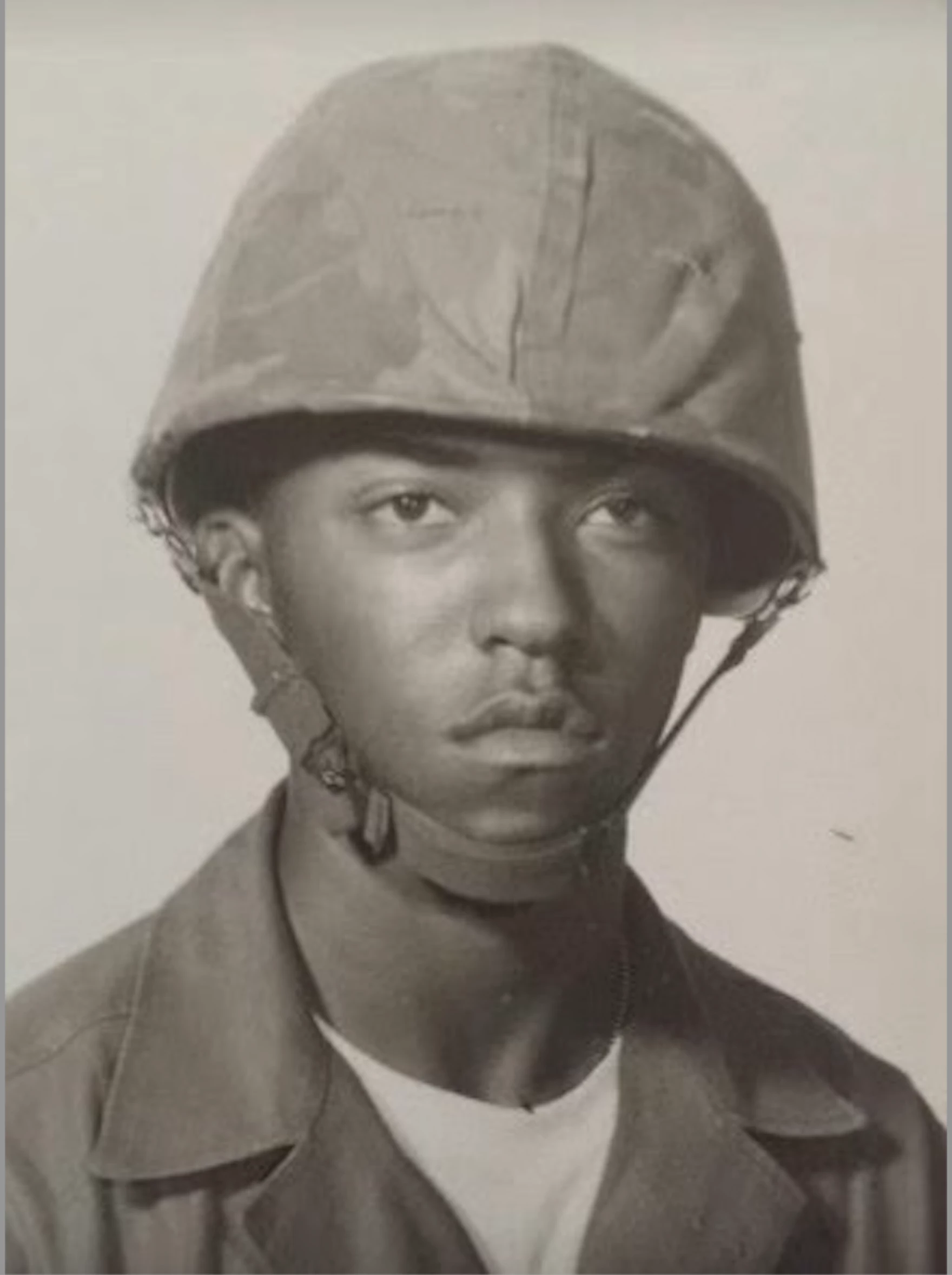
 WUNC - For more than half a century, his bad-conduct discharge made it hard for Vietnam veteran Raymond Dick to find work doing anything but manual labor and prevented him from getting VA health care.
More than that, it kept the Greensboro native from officially being a retired Marine, said John Brooker, director of UNC-Chapel Hill Law School's Military and Veterans Law Clinic.
Marines are famously proud of their ties to the service, and Dick was no exception, Brooker said.
Now, though, after years of work led by the law clinic's students, the Navy and the Department of Veterans Affairs have agreed that Dick's bad-conduct discharge was improper and upgraded it.
The change is too late for Dick to enjoy. He died in 2024 of a heart condition Brooker believes was connected to Dick's exposure to Agent Orange in Vietnam. But it does mean that Dick's widow can begin receiving VA survivor's benefits.
"Those are enough to remove her food and housing insecurity," Brooker said. "She has her own apartment in a senior living community now, and along with her Social Security, that will be enough for her to live on for the rest of her life."
A UNC law school graduate who was involved in the case helped the family organize a ceremony Friday to mark Dick's official change in status back to an official part of the Marine Corps family. Several of the other students who worked on the case attended, too.
The story of Dick's discharge began in June 1969. He was back at Camp Lejeune after a hard combat tour in Central Vietnam, where he had distinguished himself so much he was put in a special, hand-picked unit tasked with unusually dangerous counterinsurgency assignments in rural villages.
At Lejeune, he wasn't at war anymore, but the base had its own perils. Especially that summer. Tensions were high between Black troops like Dick and white Marines, fueled by the institutional racism in the Corps, the assassination of Martin Luther King Jr. the year before, and general unhappiness about the draft.
A former Marine drill sergeant, Willie Robert Robertson of Clayton, N.C., also was stationed at Lejeune then. He told WUNC in a 2019 interview that Black Marines often faced demeaning treatment from white troops.
"They wouldn't call you Private Robertson," he said. "With a Black, they might say, 'Hey, splib, come here!' And I'm like, what's a splib? But the guys from up North, they knew what it was. They would say 'They're calling you an N-word.'"
One day Dick, walking across the base with a friend, heard a group of white military police officers yelling at them. And not bothering to use an euphemism for the N-word.
The details after that are scarce, said Brooker, but a fistfight broke out, and Dick and other Black Marines were thrown in the brig on various charges.
He was court-martialled later that year and initially convicted not only of charges related to the assault, but also robbery, despite no robbery having occurred, Brooker said. On appeal, the robbery conviction was overturned, reducing his sentence from seven years of confinement to one, which he then served.
He also was given a bad conduct discharge, which in some ways is a life-long sentence.
Which is where Brooker and the clinic come in.
His team of law students, working on the case for three years, were able to develop and present evidence to the Navy and to the Department of Veterans Affairs that Dick's court martial was racially motivated and legally flawed, and that there were mitigating factors, including his PTSD.
"So it wasn't any one thing, because the wrongs to Mr. Dick were so numerous and so significant," Brooker said. "They all contributed to the result."
Hanging over the court proceedings was a notorious incident had happened just weeks after Dick was arrested, and not long before his court martial began.
Various small incidents at an on-base nightclub exploded into an outbreak of several fights involving gangs of white Marines and Black Marines. By the end of the night, one was dead and 15 injured, some of them badly. Dozens were charged with crimes, including homicide.
"And as a result, there was Congressional attention and significant pressure placed on military leadership and the leadership at Camp Lejeune to get a hold of this situation," Brooker said. "So the tool they used to do that was a Uniform Code of Military Justice, and when you only have one tool, kind of like a hammer, every problem looks like a nail."
Dick's trial was scheduled after the riot and after those pressures came to bear. So it's reasonable, Brooker said, to assume that affected how Dick was treated, given the array of charges and heavy punishment for what at the end of the day was just a fistfight. Nobody was injured in the brawl except Dick, who hurt his hand.
"Even the military judge, who's supposed to be neutral," Brooker said. "No one's immune from that. They all see the news. They all see what is happening."
But his students didn't rely on that for their appeals — one to the VA to change Dick's status for benefits, and the other to the Navy to change the discharge in the service's records.
One issue they pointed to was racist pressure during the trial. A white bailiff had loudly closed a set of handcuffs even after being told to stop in an apparent attempt to intimidate the Black defendants.
Also, the same military lawyer had been appointed to represent several defendants.
"The reason you cannot usually represent multiple folks involved in an incident like this is you may have to call into question the behavior of another client to protect the other client," Brooker said. "It may have been that Mr. Dick could have been better served if his attorney called into question one of the other men involved in the fight and, for lack of a better term, blame them for many of the events."
He described Dick as a gentle and sweet man with a perpetually positive outlook and glint in his eye.
But Dick also struggled till the day he died with his post traumatic stress disorder. He was hypervigilant, had trust issues sometimes, and wanted people to call their names out before they entered a room he was in.
"So he was much like many other veterans from that era of the Vietnam War, who are wonderful souls," Brooker said. "However, they're also struggling mightily with the internal demons and the symptoms of their mental health condition."
Dick was a landscaper for most of his life and never had access to mental health care for his PTSD, Brooker said. "He told us he just wanted to feel better."
Kim Tran, a clinical psychologist at the law school who works with the clinic, said that desire wasn't just about him.
"He knew that he would be better available to his family, to the people who love him, and not to have to spend so much of his life self-managing the symptoms," she said. "He wanted his wife and his children and his family to experience him without the untreated (PTSD) interfering."
