
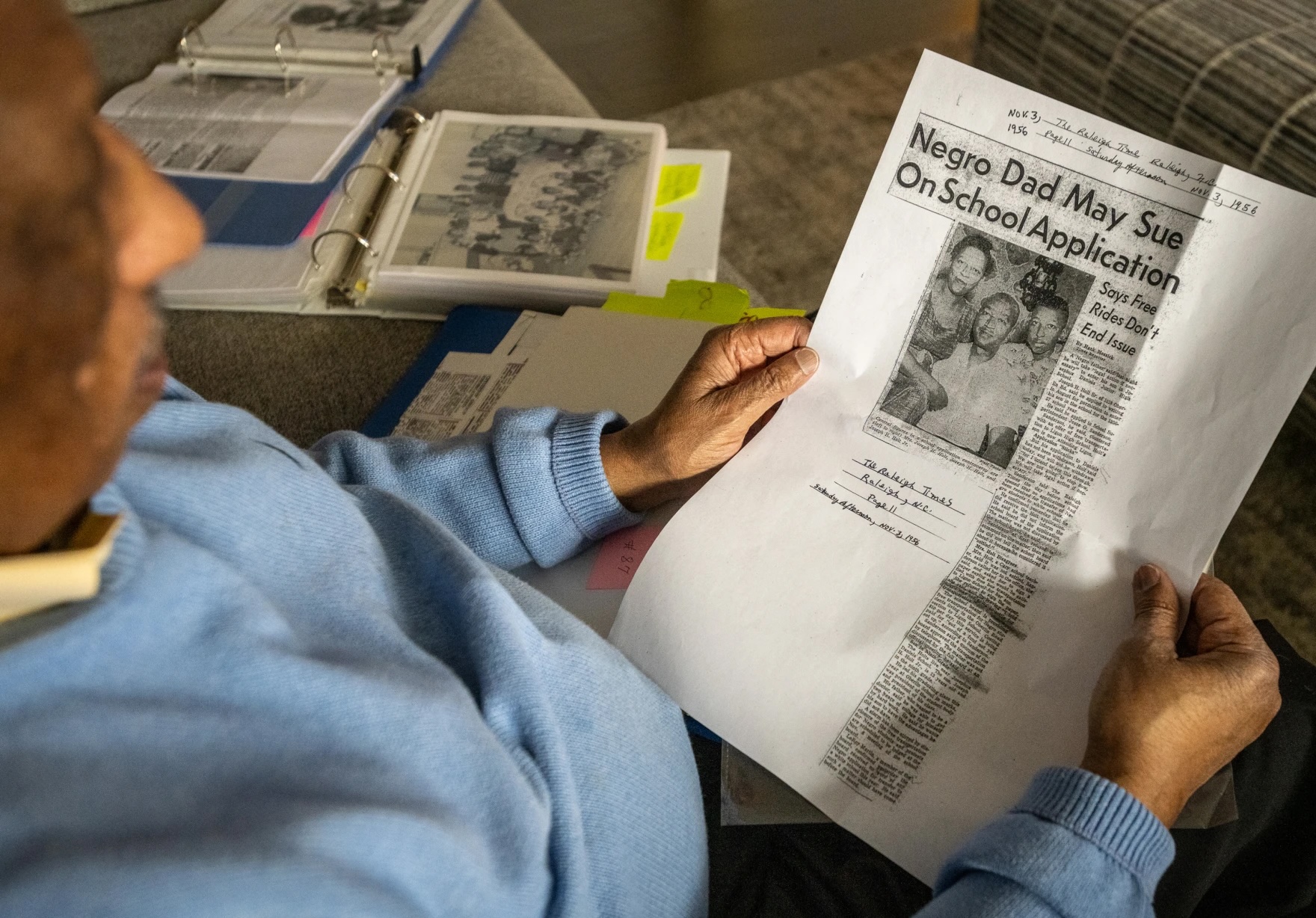
WUNC - The story of school integration in Wake County begins with a young boy who was not the first to desegregate a local school. But he was the first Black student to try.
Now 83, Joseph H. Holt, Jr. remembers first hearing about the Brown vs. Board of Education ruling in a current events class at the all-Black Oberlin Elementary in 1954. In that landmark decision, the U.S. Supreme Court ruled that school segregation for white and Black Americans was unconstitutional.
"I think I was 11 years old, or coming up on 11 years old, and I didn't have any awareness of what my parents were thinking at that time," Holt said in an interview with WUNC News. "But I knew something was going on, and it had to do with us going to white schools."
Optimistic about the ruling, his mother Elwyna Holt handwrote a letter requesting her son's acceptance to Josephus Daniels Junior High. Superintendent Jesse O. Sanderson responded by requesting to meet with her. When they met, he asked her why she wanted to have her son attend a white school.
"How in the world is she going to answer that to a white official?" Holt said. "To try to explain to him the stigma associated with – the humiliation associated with – being told that you cannot go to a certain school."
So rather than explain racism, Holt’s mother said that it was inconvenient for students in the Oberlin Village neighborhood to take a city bus across town to attend the only Black high school in Raleigh.
Sanderson responded that he would provide free bus transportation for the students in their neighborhood if Mrs. Holt agreed to withdraw the application.
But she did not back down. Mrs. Holt said she'd accept the free bus, but the application would stand. Eventually, news of the Holt family's bold action hit the local newspapers.
'Catching hell'
"Integration didn't take place in Raleigh without somebody catching a lot of hell, and we were the ones who caught the hell," Holt said.
Holt remembers the first threatening phone call, a man screaming at him and shouting profanities. That was just the beginning.
"Threats on our lives, threats to bomb the home, mean telephone calls all through the night – that kind of a thing went on for about 3.5 years," Holt recalled. "My father was fired from his job. My whole high school career was a fight. It was stressful."
After the Raleigh City Board of Education denied Holt's admission to the junior high, his parents applied to Needham Broughton High School, attended by the children of wealthy business owners and state lawmakers.
When that attempt also failed, the family filed a lawsuit against the Raleigh City Board of Education. That had never been done before in North Carolina: A family suing a school board because their child's request to transfer schools was denied.
"Here's a Black family suing a white school board. A Black family with the audacity, so to speak, to challenge in court powerful whites," Holt said.
North Carolina's Pearsall Plan and Pupil Assignment Act sought to resist desegregation
As soon as the Brown decision was announced, state lawmakers put up a concerted effort to resist school integration, forming a legislative committee designed to uphold segregation, and passing a law called the North Carolina Pupil Assignment Act. The law gave school boards the power to reject Black students who sought to transfer to white schools. A pamphlet promoting these policies – named the "Pearsall Plan" – said it would ensure that "no child in North Carolina will be forced to attend a school with a child of another race."
The North Carolina Pupil Assignment Act placed administrative requirements on families seeking transfers.
"Even if you satisfied every one of them, a school board could still say you are denied," Holt explained.
The law created hoops to jump through. If a student was denied admission, they could appeal to the school board.
"I knew there was no way that I, as a 14-year-old standing in front of a hostile adult white school board that was segregationist-minded, there's no way I'm going to convince them to overturn a decision they'd already made. That was a no-win situation," Holt recalled.
Concerned for the harassment Holt might face, his family's lawyers advised him to skip the school board meeting. They went to represent him instead. Meanwhile, the court case proceeded, with Holt and his parents testifying in court.
'I really don't feel that we lost.'
The judge ultimately ruled against them, denying Holt admission to Broughton High because the family had failed to exhaust all administrative remedies before the law prior to filing suit, according to the judge, because Holt had not attended the school board's appeal hearing in person.
"Well, the Black community picked up on that, thinking that we had let them down because I hadn't gone to that hearing," Holt said.
Holt says that ate at him for decades. Until, he found that he wasn't alone.
"I didn't learn this until a few years ago, that this kind of thing happened throughout North Carolina," Holt said in 2026.
Some school districts denied dozens of transfer requests, finding issues with every one of them.
The Holts appealed their case to the U.S. Supreme Court, but the court never heard it. At the time, the Supreme Court wasn't hearing any more cases like his.
"I really don't feel that we lost," Holt said.
"People need to understand, Black and white, when the decision was finally made to 'integrate' the schools, it was because of the pressure that was applied," Holt said. "It wasn't out of the goodness of somebody's heart, or the Raleigh Board of Education thinking that, 'Well, we want to do the right thing,' or comply with the thinking of the U.S. Supreme Court. They fought against it tooth and nail."
