
By Jordan Meadows
Staff Writer
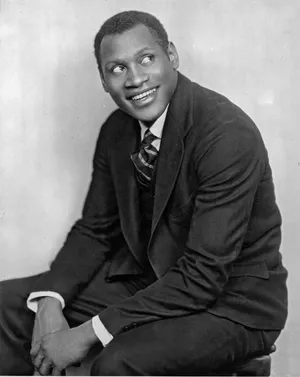 He won 15 varsity letters in four sports. He graduated valedictorian from Rutgers. He earned a law degree from Columbia while playing professional football on weekends to pay tuition. He performed before sold-out crowds on stages from Carnegie Hall to London's West End, and could sing in more than 25 languages. He petitioned the President of the United States, fought for independence movements on multiple continents, and stood before the House Un-American Activities Committee without flinching.
Paul Robeson did all of this—and was then largely written out of American history.
Born on April 9, 1898, in Princeton, New Jersey, the son of a former slave, Robeson came of age during an era of open segregation, lynching, and institutionalized racism.
In 1915, Robeson won a four-year academic scholarship to Rutgers University, making him only the third African American ever admitted to the school and, for a time, its only Black student. He played four varsity sports (baseball, football, basketball, and track). He was twice named a consensus All-American in football. He won speech and debate tournaments. He was inducted into the Cap and Skull Honor Society and earned a Phi Beta Kappa key in his junior year. He graduated valedictorian of the class of 1919.
From there, Robeson enrolled at Columbia Law School, where he met Eslanda Cordoza Goode, whom he married in 1921. Eslanda, who would go on to become the first Black woman to head a pathology laboratory, eventually became his manager and an enduring influence on his career. To pay his tuition at Columbia, Robeson taught Latin and played professional football on weekends, eventually earning his law degree in 1923 while playing in the National Football League.
Robeson's artistic life was profound: he was a bass-baritone of uncommon power and range, and he built a concert career that took him to Vienna, Prague, Budapest, Berlin, Paris, Amsterdam, London, Moscow, New York, and Nairobi. Between 1925 and 1961, he recorded some 276 songs spanning spirituals, classical music, European folk songs, popular standards, and political anthems. He performed his signature tune, "Ol' Man River," in the 1928 London premiere of Show Boat.
On stage, he earned international critical acclaim for his lead role in Shakespeare's Othello, winning the Donaldson Award for Best Acting Performance in 1944. He starred in Eugene O'Neill's The Emperor Jones and All God's Chillun Got Wings, and his film career included eleven pictures, among them Body and Soul (1924), Jericho (1937), and Proud Valley (1939).
He was among the top-earning performers of his era, making more money than many white entertainers at a time when that was nearly unheard of for a Black artist. He was also among the first performers in America to refuse to play to segregated audiences.
Robeson's travels across Europe, Africa, and the Soviet Union convinced him that his fame carried an obligation.
"The artist must elect to fight for freedom or slavery. I have made my choice," he said.
That choice drove him to Spain during the Civil War to support the Republican cause, to Africa to advocate for self-determination, to India to support the independence movement, and to Britain to fight for labor rights.
In 1949, rioters attacked his concert at Peekskill, New York—smashing the stage, torching chairs, assaulting concertgoers, and threatening Robeson's life. The following year, the U.S. State Department revoked his passport, stripping him not only of his right to travel but of his primary source of income. The FBI had been monitoring him for years. Robeson fought back through the courts, filing suits and appeals that were repeatedly denied.
He waited eight years for vindication. It came in 1958, when the U.S. Supreme Court ruled in Kent v. Dulles that the State Department could not deny citizens the right to travel based on their political beliefs or affiliations. To mark the occasion, Robeson performed his first New York concert in a decade at a sold-out Carnegie Hall.
Once named "Man of the Year" by the NAACP, Robeson had been systematically marginalized by the country he had spent his life trying to improve. He retired from public life in 1963 and died on January 23, 1976, at age 77, in Philadelphia.
