
By Jheri Hardaway
Staff Writer
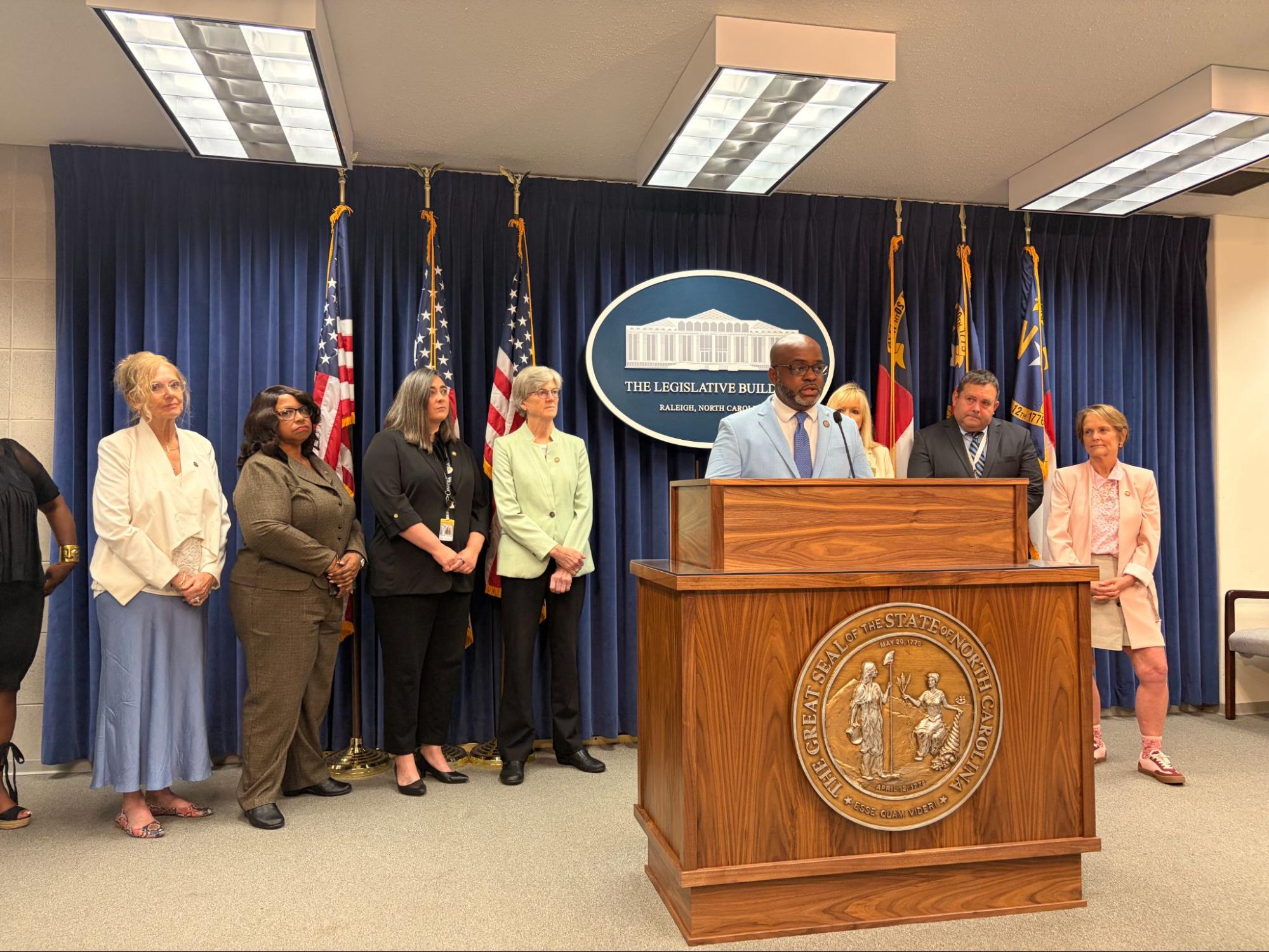
Raleigh, NC — In an effort to shield the state’s electoral process from constant partisan shifting, State Representative Rodney Pierce (D-Halifax, Northampton, Warren) hosted a press conference to introduce House Bill 1240, a landmark legislation proposing a constitutional amendment to permanently guarantee North Carolinians the right to vote early in person.
The bill, primarily sponsored by Pierce alongside Representatives Marcia Morey (D-Durham), Renee Price (D-Caswell, Orange), and Zack Hawkins (D-Durham), seeks to lock in the core features of North Carolina's widely used early voting system before partisan maneuvers can erode them. If passed by a three-fifths majority in both chambers, the historic amendment will head directly to the ballot for final approval by voters statewide.
The proposed constitutional amendment establishes strict baseline protections for voters:
Constitutional Minimum guarantees a baseline right to a minimum of 14 days of in-person early voting for primary and general elections. Same-Day Registration explicitly preserves and protects a voter's right to register and cast a ballot on the same day during the early voting window. Weekday Operational Standards mandates that weekday polling sites remain open continuously until at least 6:00 P.M. or 7:30 P.M. to accommodate working schedules. Local Board Autonomy preserves the complete authority of local county boards to determine exact polling locations, resource allotment, and optional Sunday operations. State Funding Authority maintains the General Assembly's constitutional authority to appropriate matching funds to help counties cover election administration costs.
"Early voting isn't a partisan issue, it's how North Carolinians vote," Rep. Pierce stated during the press briefing, noting that voters across urban, rural, and suburban communities have fully embraced the system.
Pierce backed his constitutional push with staggering data from the State Board of Elections. During the most recent primary election, more than 712,000 North Carolinians cast their ballots during the early window, marking the highest voter turnout ever recorded for a midterm primary in state history. Furthermore, Pierce cited historical data where early and mail-in engagement reached an average of 71% statewide. "If this is the way that people have chosen to engage in our democracy, then we should try to make sure that we keep it in place and that we protect it," Pierce urged.
Co-sponsor Representative Marcia Morey emphasized that the constitutional amendment shouldn't even have to be a battle, but it has become necessary given the state's recent history of voter suppression efforts. Morey pointed out that standard state primary turnout frequently hovers around a dismal 20%.
"There’s something wrong," Morey said, arguing that the legislature's focus should be on making it easier for eligible voters to choose their leaders. Morey also referenced a recent U.S. Supreme Court ruling affirming that ballots postmarked before Election Day but arriving afterward should legally be counted, signaling that the state must continually build outward transparency rather than restricting access.
Voters rely on the stability of early voting windows to plan around their work schedules and family responsibilities. HB 1240 seeks to provide long-term certainty by explicitly establishing a constitutional minimum of 14 days of in-person early voting for both primary and general elections while firmly protecting same-day voter registration. Pierce revealed that the 14-day timeline was born out of extensive collaboration with the North Carolina Association of Directors of Elections. While local election directors desired some reduction from the typical 17-day stretch to alleviate local county budget and staffing burdens, their primary focus was on permanent, structural stability.
As a former educator who taught for a decade, Pierce expressed deep frustration with the General Assembly’s habit of altering election procedures without consulting the professionals who actually run them. "Too often, here in Raleigh, we change laws without including the input of the people who actually are going to be responsible for carrying out the laws," Pierce said, calling the trend an insult to professionalism.
Crucially, the bill doesn't mandate costly new burdens; it does not force Sunday voting, dictate a minimum number of physical sites, or mandate new state appropriations, leaving local control intact. The push for voter protections occurred amidst a chaotic backdrop in the General Assembly, as legislative leaders dropped a massive, 600-plus-page state budget bill just 45 minutes prior to the press conference. While Democratic leaders admitted they had not yet had the opportunity to fully parse the fine print, Representative Cynthia Ball (D-Wake), the deputy leader of House Democrats, noted that early reviews of the text revealed unexpected structural changes. Most notably, the proposed budget strips a substantial number of vital positions away from the North Carolina Department of Commerce. Ball called the cuts highly unexpected and indicated they would likely draw severe opposition as the budget positions for a floor vote.
