
By Jordan Meadows
Staff Writer
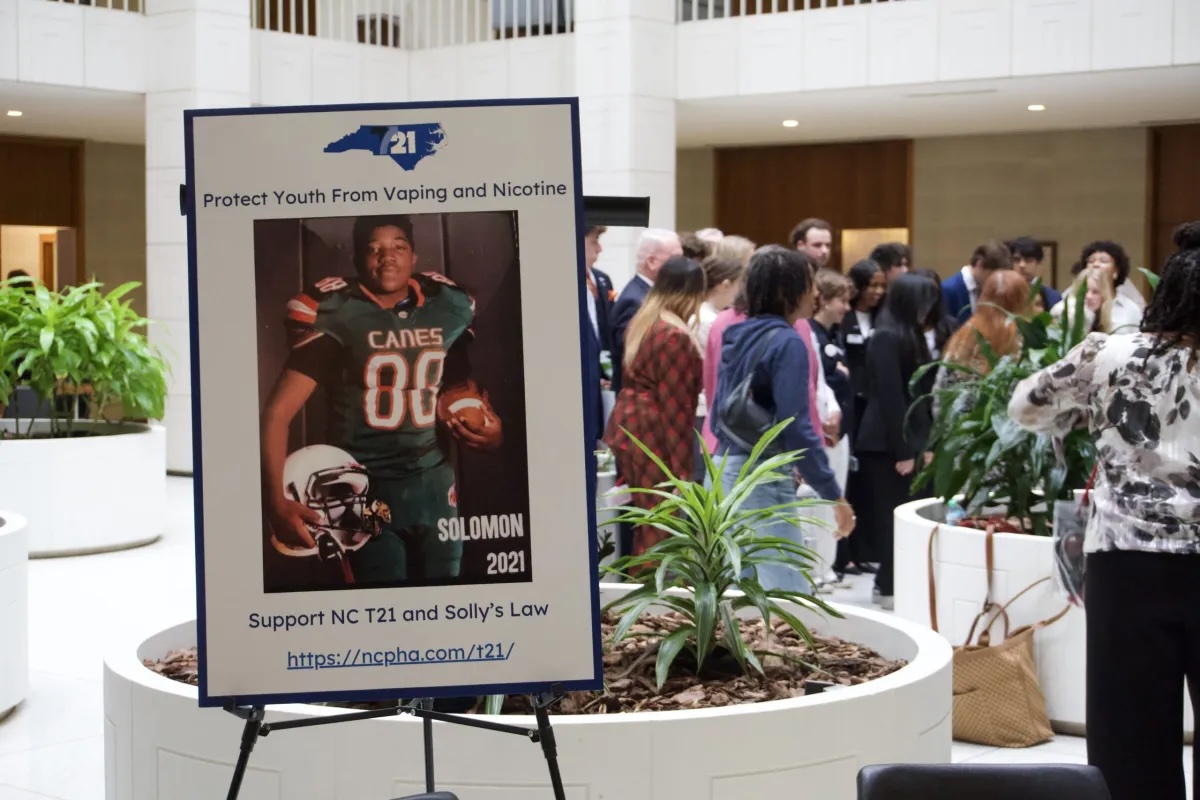
More than 30 students from 14 counties across North Carolina gathered at the North Carolina General Assembly on Wednesday as part of the Tobacco 21 (T21) Coalition. Their goal was to press lawmakers into adopting stricter nicotine regulations and advance House Bill 430, known as “Solly’s Law.”
The legislation is named after Solomon Wynn, a New Hanover County high school student who died in 2023 from complications related to vaping. His stepmother, Charlene Zorn, has since become a leading advocate for tighter restrictions and joined students at the legislature.
The bill would raise the legal age for purchasing tobacco and vaping products to 21, establish a statewide permitting system for retailers to allow stronger local enforcement.
North Carolina remains one of only six states where individuals can legally purchase nicotine products at age 18, and one of just eight states that does not require retailers to obtain a permit to sell them. Without licensing, there is no comprehensive list of vape shops operating in the state.
At the same time, youth usage remains high: 21.4% of North Carolina high school students use e-cigarettes, a rate roughly double the national average. Nearly 23,000 high school students smoke, and nearly one million adults in the state are smokers, most of whom began before age 18. Tobacco use is linked to 14,200 deaths annually in North Carolina, accounting for nearly one-third of cancer deaths, while smoking-related health care costs total $4.42 billion each year, including about $1 billion in Medicaid expenses paid by taxpayers. Meanwhile, the tobacco industry spends $429.6 million annually marketing its products in the state—more than $1 million per day.
Students who traveled to Raleigh described firsthand the normalization of vaping among their peers.
“Unfortunately, this seems to be the new norm, and there are countless cases where kids are introduced to vaping in early middle school or even elementary school in some circumstances. People around me want to quit but feel like they can’t because of the extremely addictive nature of nicotine products,” said Be Lanier, a member of the Tobacco 21 Teen Council.
Another student advocate, Pranika Senthil of Cabarrus County, questioned whether lawmakers are responding to the issue with enough urgency:
“Young people aren’t just making careless choices. We’re being constantly exposed in ways that make these products feel harmless and easy to access, which means we really need adult help.”
Lawmakers supporting the bill, including Rep. Donnie Loftis (R-Gaston) and Rep. Grant Campbell (R-Cabarrus), tied youth vaping to broader public safety concerns.
Loftis pointed to a December 2025 incident in Winston-Salem in which a fight over a vape pen between teenagers resulted in a fatal stabbing, as well as other cases involving robberies of vape and THC products.
“We’ve now progressed from just a simple vaping issue among teenagers. This is a deadly game among young people,” Loftis said. “It is way past time for this bill to be moved into the committee process so that North Carolina can feel good about protecting these young teenagers.”
He also cited a North Carolina Department of Revenue report that found nearly 25,000 illegal vape and tobacco products being sold in the state, along with evidence that some vape shops are acting as distribution hubs for more dangerous substances.
Recent law enforcement investigations across the state have underscored those concerns. In Union County, authorities seized over five pounds of tianeptine—sometimes referred to as “gas station heroin”—along with more than 10 pounds of marijuana and approximately $100,000 in counterfeit THC products. In Johnston County, arrests were made after six minors became sick from THC-infused gummies purchased at a vape shop; testing showed some products exceeded the state’s legal THC limit. In Stokes County, a multi-month investigation known as “Operation Found Out” led to the seizure of 53 pounds of marijuana, psilocybin products, and over $18,000 in cash, with several store managers facing trafficking charges. Additional cases in Garner and Apex involved THC products marketed as legal CBD but containing far higher concentrations than permitted by law.
Law enforcement officials say the lack of a permitting system complicates their ability to monitor and regulate these businesses.
“There is no body that has any administrative control or sanctioning authority against these businesses,” said North Carolina Alcohol Law Enforcement Director Bryan House.
“Criminal vaping is becoming an epidemic in this country,” said Rich Marianos, former assistant director of the Bureau of Alcohol, Tobacco, Firearms and Explosives. He pointed to the rise of unregulated vape products entering the U.S. market and argued that some retailers are involved in wider criminal activity.
Marianos also highlighted youth-targeted marketing strategies, noting, “It’s marketed as something that’s cool, flavorful — more like a treat.” He added that enforcement cases are widespread and measurable: “It’s not anecdotal. You can point to specific seizures, specific arrests, specific quantities.”
However, critics say that raising the legal age to 21 won’t meaningfully stop youth access; underage users already obtain vaping products through informal networks—friends, older peers, or illicit sellers. Some also raise concerns about overregulation and the burden on small businesses. Requiring permits, inspections, and stricter enforcement could disproportionately affect independent vape shops and convenience stores, especially in rural areas.
Advocates have called for policy changes including stricter licensing requirements, better product registries, and increased funding for local enforcement. With widespread access, aggressive marketing, and limited oversight, they argue that stronger laws are necessary to curb youth nicotine use and prevent further harm.
