By Jheri Hardaway
Staff Writer
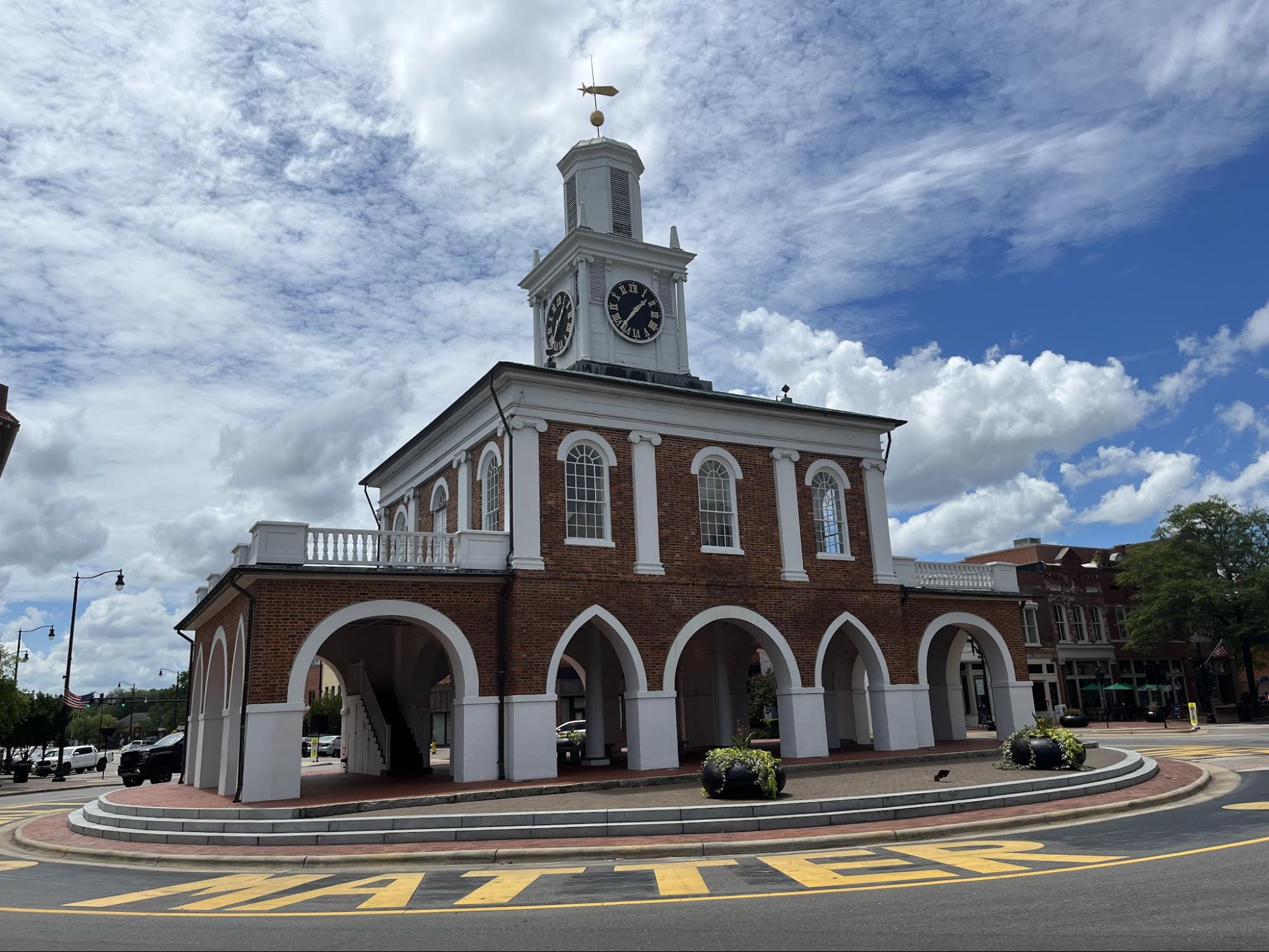
Fayetteville, NC - Stepping through the historic corridors of Fayetteville during Preservation North Carolina’s recent Ramble offered a rare, intimate lens into a city often defined by its military footprint, revealing a side of the community I had never seen before. Over an afternoon that spanned 16 curated stops, followed by a reception at The MacPherson House, the tour peeled back centuries of architectural innovation, Civil War resilience, and quiet domestic artistry. Every detail, from hand-hewn attic trusses to hidden holes in plaster walls, added profound depth to an already impactful North Carolina city. Initially settled by Scottish Highlanders in the mid-eighteenth century, Fayetteville was named in honor of the Marquis de Lafayette in 1783 and emerged as a primary trading center for the backcountry. By the 1810s and 1820s, the village’s wealth attracted commissions by architect William Nichols and engineer Ithiel Town, and traces of their contributions to our state’s architectural legacy remain today.
At the First Presbyterian Church at 102 Ann Street, the tour began with stories of survival and engineering ingenuity. Organized in 1800, the congregation saw its original 1817 structure destroyed in Fayetteville’s devastating 1831 fire. Yet, among the treasures that endured were four pieces of early church silver engraved with the dates 1818 and 1826. When Union General William T. Sherman’s troops marched into Fayetteville in March 1865, the silver was packed in a wooden box and hidden at the home of church member Mrs. Newring. When Union soldiers discovered the box and began dividing the pieces, Mrs. Newring negotiated to keep at least one piece; seconds later, an officer summoned the troops outside, allowing her to stash the silver inside a hole in the plaster wall behind a piece of furniture, a hiding spot the soldiers never returned to search. Above the sanctuary, the church holds an equally remarkable architectural claim to fame: designed by the premier New York firm Town and Davis, architects of the State Capitol in Raleigh. The building features what is believed to be the first roof application of Ithiel Town’s patented lattice truss system. Built from slow-growth, old-country pine cut at a local water-powered sash sawmill and fastened with original wooden pegs, the truss remains intact nearly two centuries later, standing as the sole surviving Town lattice truss in the state.
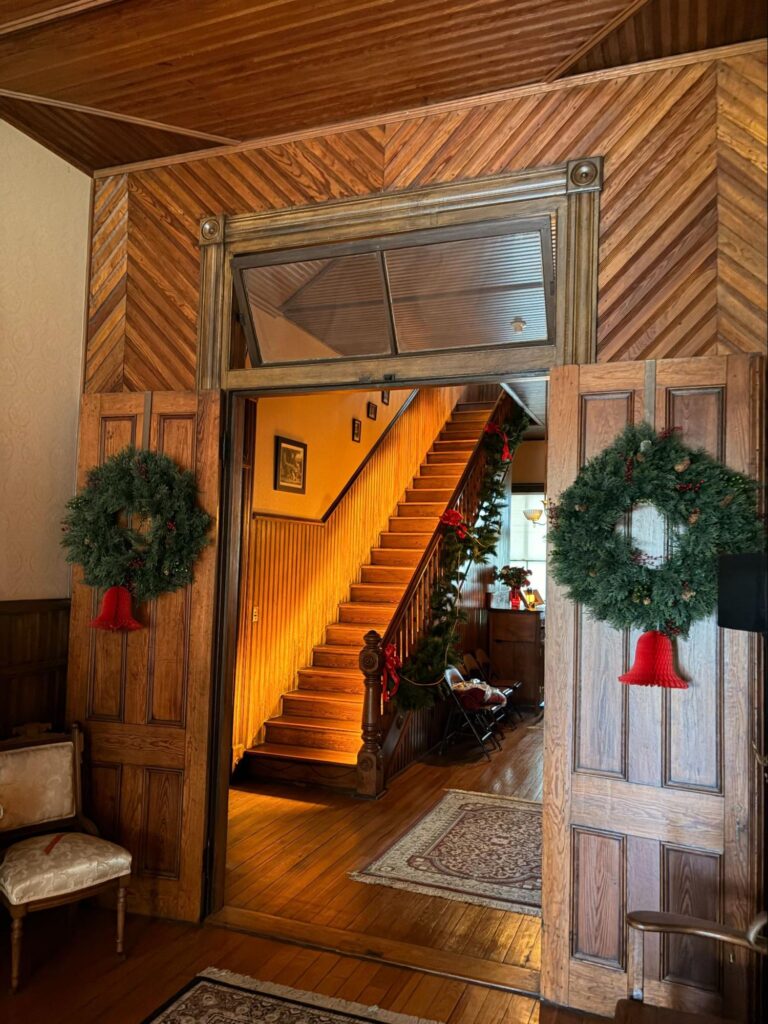
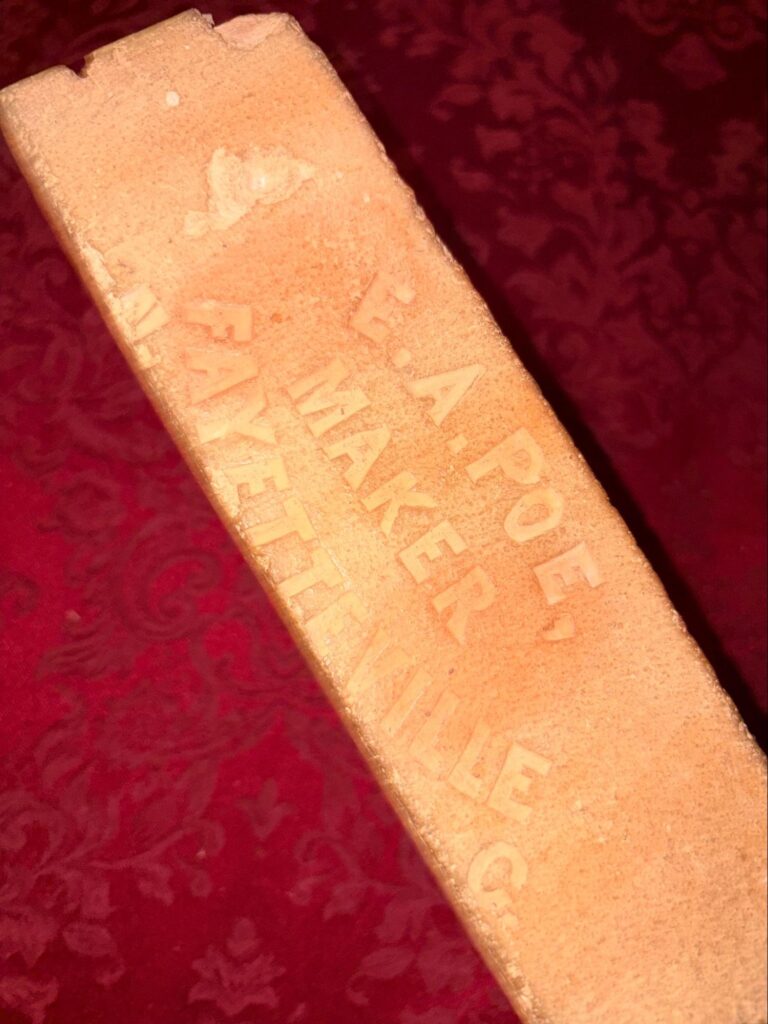
Just west of downtown at 206 Bradford Avenue, the 1897 Poe House offered an intimate look at Victorian ambition and everyday life in the Cape Fear region. Built by brickmaker and pottery manufacturer Edgar Allan Poe (no relation) who sourced clay from a nearby pit near Cross Creek and Ann Street and even supplied bricks for the back of Hay Street Methodist Church—the Eastlake-style residence was constructed entirely of hard pine rather than brick as a deliberate projection of wealth. Planned over 20 years and outfitted with combination gas-and-electric fixtures in anticipation of electricity reaching Fayetteville, the home reflects both Victorian etiquette and practical ingenuity. Guests were once received in the formal parlor, a space with soaring ceilings tempered by wood paneling that hosted everything from music recitals to weddings and wakes, while pocket doors sealed off a private family sitting room that doubled as a quarantine ward with a separate exterior doctor’s entrance during a scarlet fever outbreak. Upstairs, the tour highlighted the strict social customs of the era, including young boys wearing shorts year-round until deemed men in high school, alongside the story of Poe’s daughter Lily, who lived in the home until 1988 and sold it to the state of North Carolina for $70,000 so it could be preserved as a museum. Stepping into the backyard, visitors also glimpsed the edge of the former federal arsenal site, burned by Sherman in 1865, where foundations of the western wall remain visible ahead of the planned 2028 opening of the North Carolina Civil War & Reconstruction History Center.
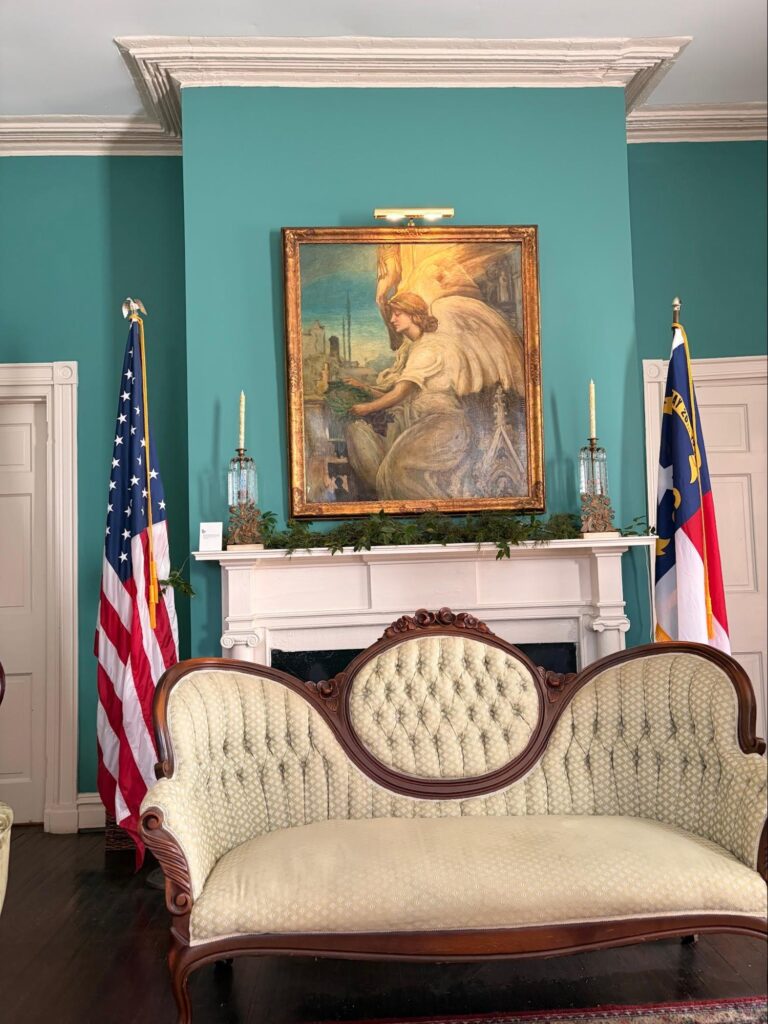
The journey concluded at Heritage Square on 229 Dick Street, a trio of historic structures the Sanford House, the Oval Ballroom, and the Baker Haigh Nimocks House, that wove together banking history, fine art, and North Carolina craftsmanship. Originally built in 1797 by Scottish merchant and attorney John McLaren and later expanded in the 1820s to house the Bank of the United States, complete with double porches and a dumbwaiter used to lower money into the basement vault, the Baker Haigh Nimocks House bears physical scars of the Civil War. These scars include a repaired bullet hole in its Italian marble fireplace left when a Union officer rode his horse into the home and fired his weapon. Inside the Dangerfield Room, the house celebrates Fayetteville-born artist Elliott Daingerfield, whose father commanded the local arsenal and whose early training painting china and signs evolved into acclaimed works like The Angel of Victory. Nearby stands a veneered cabinet crafted by Thomas Day, the renowned free Black cabinetmaker from Milton, North Carolina, whose furniture graces the Governor’s Mansion and the North Carolina Museum of History.
Next door, the Oval Ballroom, moved to the property in 1956 after its original residence was slated for demolition and meticulously restored in 1997 with guidance from Preservation North Carolina, showcases intricate hand-done plasterwork attributed to architect William Nichols.
Events like the Fayetteville Ramble underscore the vital mission of Preservation North Carolina, which has protected more than 900 historic properties across over 4,000 acres in 84 of the state’s 100 counties. Walking through these spaces—where architectural marvels, personal artifacts, and pivotal moments in Southern history coexist—transforms how one experiences Fayetteville, proving that the city’s richest stories are often tucked just behind its historic facades.