
By Jordan Meadows
Staff Writer
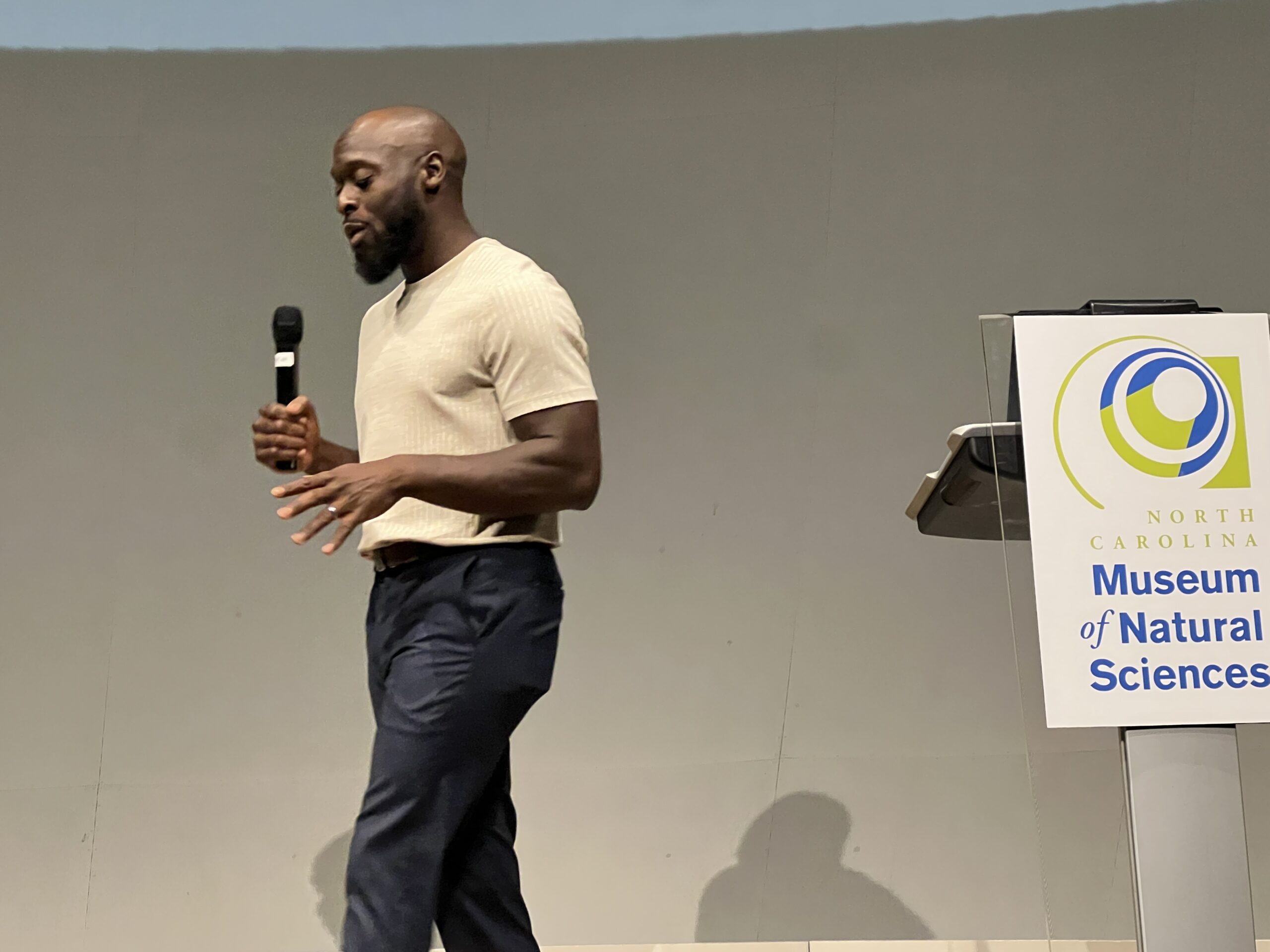
Kamal Bell, a North Carolina farmer, educator and founder of Sankofa Farms, delivered a talk Tuesday at the North Carolina Museum of Natural Sciences in Raleigh, offering a personal and historically grounded look at agriculture, food systems and the future of farming.
Bell, who describes himself as a “Food Systems Architect,” spoke about his journey into agriculture, the structural challenges facing farmers today, and the cultural and historical significance of land ownership—particularly within Black communities.
“One of the questions that I had was: how can I always be in a position to help my family and then my community?” Bell said during the talk. “And that question ended up coming out to be to become a farmer.”
Founded while Bell was a student at North Carolina Agricultural and Technical State University, Sankofa Farms in Efland, NC—roughly a half hour drive NW of Durham—has grown into an agricultural and educational hub focused on food access, environmental stewardship and youth development.
Bell emphasized that modern farming requires far more than traditional labor:
“Now that it’s 2026, I use the word farmer, but I think a proper title would be Food Systems Architect,” he said. “Because now you just can’t be on the tractor and produce food… you have to be more diverse as a farmer.”
Throughout the event, Bell tied his personal story to broader historical trends, particularly the dramatic loss of Black-owned farmland over the past century. He pointed to U.S. Department of Agriculture data showing that Black farmers once owned millions of acres of land that have since largely disappeared.
“Something happened to 17 million acres of land,” Bell said. “And when you think about freedom and struggle and progression of the people… you have to have land.”
Bell also discussed systemic barriers within agriculture, including his own experience fighting for access to land through federal programs.
“I actually ended up having to go and battle the USDA because I was denied my farm… I ended up winning,” he said. “But there’s a policy piece here… there’s a land loss piece here… all these different systems here that made me think about why farming would be so important.”
A former middle school agricultural teacher, Bell stressed the role of education in reshaping how younger generations view farming. He described working with students who had been written off by society and seeing them thrive through hands-on agricultural programs.
“These young men would come to my class, they would learn about agriculture… and we ended up seeing some great results,” he said.
Bell emphasized that one of the biggest challenges facing the industry is a lack of youth engagement and a limited pipeline into agricultural careers. He also warned that larger structural changes—including market instability, climate variability and shifts in global trade—are reshaping the food system in ways many Americans are not prepared for.
Bell encouraged attendees to think more critically about where their food comes from and whether current systems are sustainable.
“I think the first thing could be for us to start identifying where our food is coming from,” he said. “I don’t think Walmart and large chains will always be the simple answer.”
In discussing his own path, Bell traced his decision to become a farmer back to his college years, when he studied Black history and philosophy and was moved by Elijah Muhammad's question, “What can you do for your people?”
That decision came despite skepticism from peers.
“One of the things I heard whenever I told somebody I wanted to be a farmer was that you’re going to be a poor farmer,” Bell said.
Bell also spoke about the steep learning curve involved in agriculture, noting that it took nearly a decade for him to feel confident in his work.
“I think it’s taken me like 10 years to be like, ‘I know what I’m doing’,” he said. “If a person was really seriously committed… I think they can do it in about three years.”
In addition to farming, Bell has expanded his work into cultural storytelling and education. He co-authored a children’s book with his son, “Akeem Keeps Bees,” which highlights Black youth engagement in agriculture and science.
“It debunks a lot of the ideals of us not being present in our children’s lives,” Bell said. “Our whole family is in the book… our interest in science and nature.”
The book has sold more than 10,000 copies and received national recognition.
“My introduction to agriculture and farming was slavery and sharecropping. It’s a huge turnoff,” he said. “So now we want to rewrite that history for the next generation.”
