
By Jordan Meadows
Staff Writer
Tensions between Southeast Raleigh residents and city officials over the implementation of long-planned parks bond projects have resurfaced, as community members argue that years of grassroots planning are being overshadowed by a lack of transparency and limited public input, according to documents from the South Park–East Raleigh Neighborhood Association (SPERNA) obtained by The Carolinian.
The concerns center on several initiatives tied to the historic South Park–East Raleigh neighborhood—including the John P. “Top” Greene African American Cultural Center, Heritage Plaza, the South Park Heritage Trail, and Phase II of the John Chavis Memorial Park master plan—projects that residents say are drifting from the community-driven vision.
The South Park–East Raleigh area, Raleigh’s largest historic African American neighborhood and a National Historic District designated in 1991, has long served as a cultural and educational hub for Black residents dating back to the late 19th century.
According to SPERNA documents obtained by The Carolinian, the neighborhood’s modern organizing structure began in 2006 when the South Park–East Raleigh Neighborhood Association was formally established at the recommendation of the City of Raleigh’s Neighborhood Services Department to ensure more focused advocacy for issues specific to the community. The organization, which represents residents within the historic district, centered its mission on preserving the cultural and historical legacy of the neighborhood.
That advocacy intensified in the mid-2000s as residents pushed back against redevelopment practices they believed threatened displacement.
According to the documents, community members raised concerns that traditional redevelopment models—particularly those tied to federal housing funds—prioritized demolition and new construction that would not be financially accessible to longtime residents. In response, SPERNA partnered with North Carolina State University’s College of Design around 2007–2008 to develop a community-led revitalization strategy focused instead on preservation, cultural storytelling, and improving quality of life for existing residents.
The resulting South Park Heritage Walk Revitalization Strategy, developed through extensive community engagement, oral histories, and asset mapping, became the foundation for many of the projects now funded under the city’s 2022 parks bond.
Those projects include the Historic John Chavis Memorial Park master plan, the renovation and expansion of the John P. “Top” Greene African American Cultural Center, Heritage Plaza, and the South Park Heritage Trail. The documents describe the strategy as a direct response to resident concerns about displacement, cultural erasure, and a lack of investment in preserving Black history in Southeast Raleigh.
Efforts to document and elevate that history were extensive. The organization helped launch archives and preservation initiatives as early as 2005 at the Top Greene Center, organized public history events like the Historic Chavis Park Festival in 2008, and collaborated with academic partners to produce oral history projects, visual “knowledge maps,” and educational programming. These efforts were largely volunteer-driven and, in some cases, funded through private donations and small grants—described as years of community-led work preceding formal city investment.
Momentum appeared to build when Raleigh voters approved a $275 million parks bond referendum in November 2022, which included funding for several Southeast Raleigh projects that originated from the SPERNA-led strategy.
However, residents now say the transition from planning to implementation has created a growing disconnect between the community and city staff. According to residents, and supported by SPERNA documents obtained by The Carolinian, communication has largely been routed through staff channels, limiting direct engagement with decision-makers and, in some cases, resulting in project changes that were not part of the original community recommendations.
“The staff decided how the money would be spent to implement these projects without any community input,” one resident said.
Among the concerns raised are proposed changes to the interior use of the Top Greene Cultural Center, including converting key community space into a recording studio—an idea residents say was never part of the original plan and could limit the building’s use for exhibitions and public gatherings.
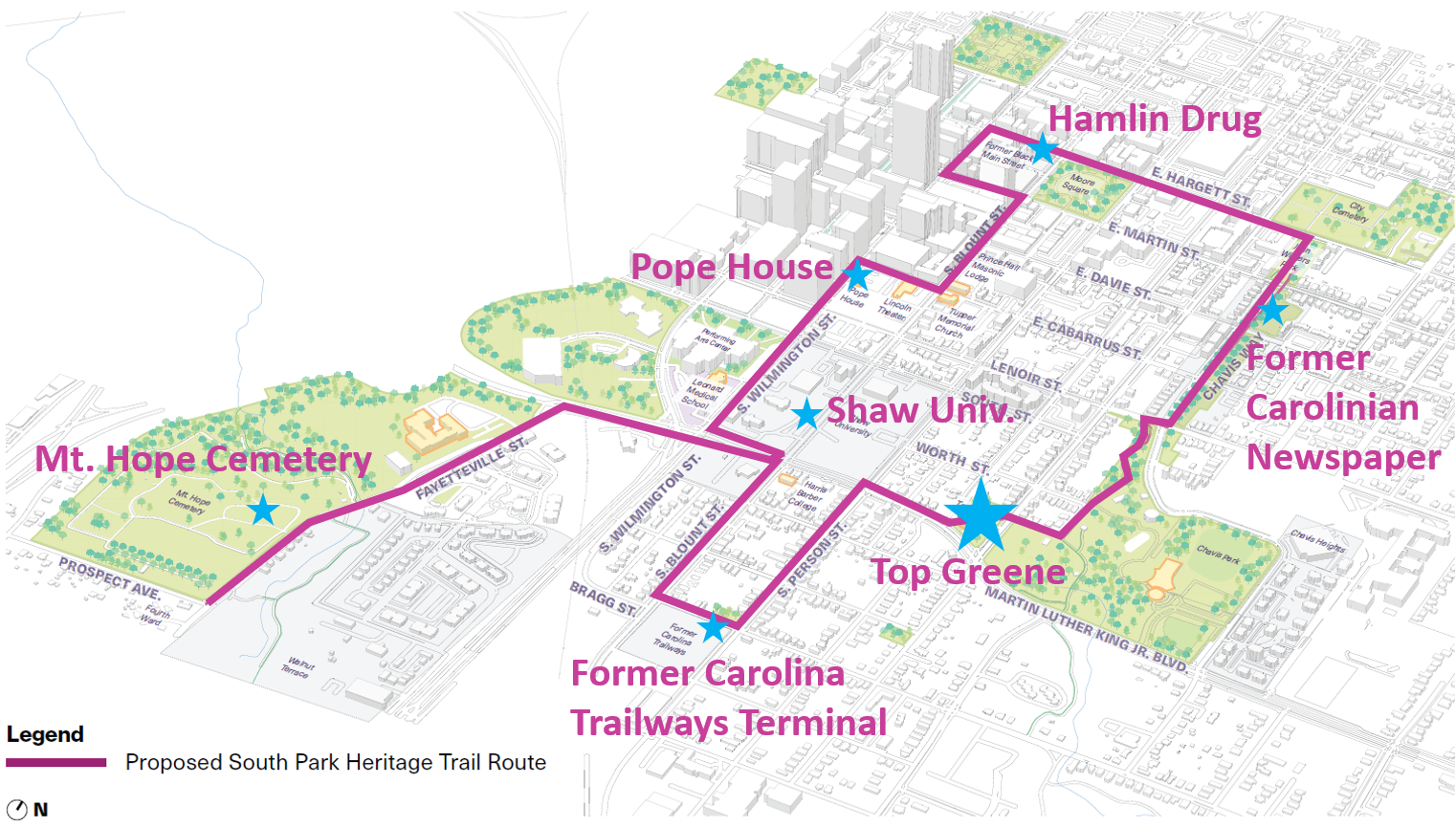
Despite these concerns, at least one major component of the original vision continues to move forward: the South Park Heritage Trail. The approximately two-mile trail will connect historically significant sites throughout the South Park–East Raleigh neighborhood, including Shaw University, the former Hamlin Drug Store, the John P. “Top” Greene African American Cultural Center, Mount Hope Cemetery, the Lincoln Theatre, and the Pope House Museum. Designed with interpretive signage, public art, and storytelling elements drawn from community archives, the project aims to preserve and share the history of one of Raleigh’s most significant Black neighborhoods.
Funded through a combination of parks bond dollars and a $1.5 million federal grant, the trail is currently in the design and environmental review phase, with construction expected to begin in fall 2027 and conclude by spring 2029. According to SPERNA documents obtained by The Carolinian, the concept of a heritage trail was always intended as part of a broader cultural district vision.
Still, broader frustrations remain about other projects tied to the bond, with residents pointing to delays, incomplete plans, and what they describe as a shift away from the community’s original intent. Some have even questioned whether developments should continue to carry the names of figures like John P. “Top” Greene and John Chavis if the projects do not reflect the values and historical context those names represent.
Those tensions were again evident last Saturday, when residents gathered at the John P. “Top” Greene African American Cultural Center for a meeting with city staff to receive updates on the park's bond projects.
The meeting included presentations on the South Park Heritage Trail, the cultural center’s renovation and expansion, and associated public art initiatives, as well as discussion about reestablishing the Central Citizens Advisory Council. According to attendees, the meeting was both an opportunity to hear updates and a continuation of long-standing concerns about community input and accountability in the process.
While the continued advancement of the South Park Heritage Trail signals that key elements of a decades-long community vision are being realized, residents believe the depth of that vision—and the extent to which residents believe it must remain community-driven—is a primary concern.
