
By Jordan Meadows
Staff Writer
Justice Anita Earls, the North Carolina Supreme Court's senior associate justice, is asking voters to keep her on the bench for another eight-year term, arguing that the court's decisions reach everyone from public school students to ratepayers, whether or not they ever set foot in a courtroom.
Earls, a Democrat, faces Republican Sarah Stevens, a longtime state legislator, in a race that will decide whether Republicans keep their 5-2 majority on the state's highest court.
In an interview with The Carolinian, Earls laid out how she introduces herself to voters.
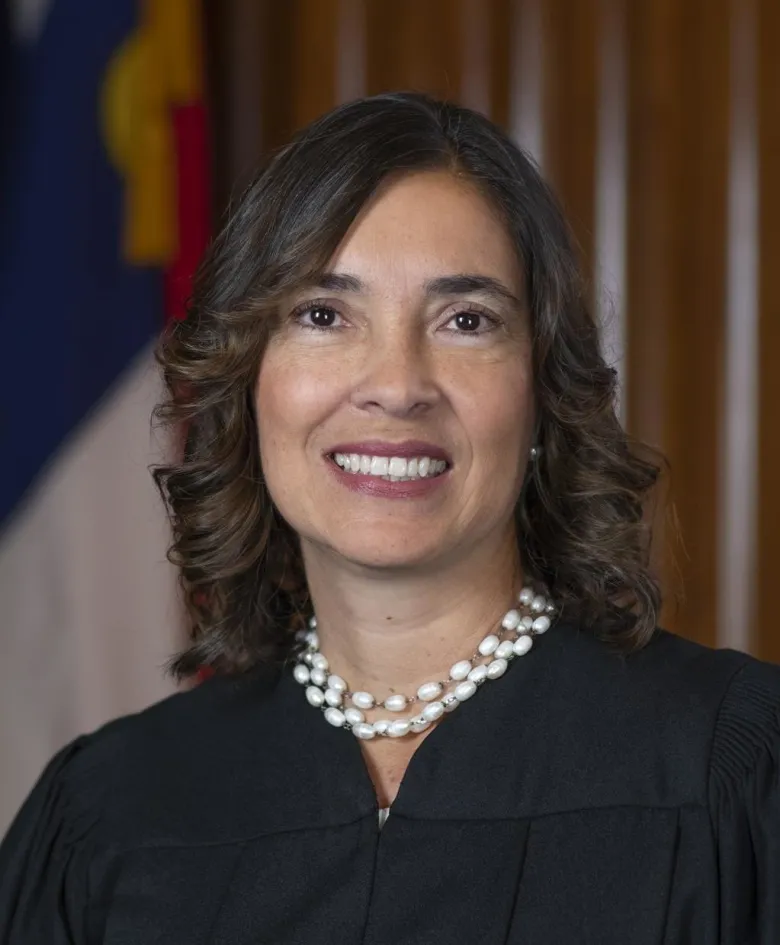 "I was first elected in 2018 after 30 years as a civil rights attorney. I wanted to be on the court because I understand that our state constitution is actually a very rich source of protection of our rights, and it seemed like federal courts were not going to be as open to the claims of the clients and communities that I had spent my career representing."
She said the court's reach is broad: "Everything from whether we will adequately fund public education to whether your vote will count and count equally. And even how much you pay for electricity is decided by our court."
President Bill Clinton appointed Earls as deputy assistant attorney general in the U.S. Justice Department's Civil Rights Division before her first term. In 2007, she and other organizers founded the Southern Coalition for Social Justice, a nonprofit legal advocacy group. She argued criminal and civil cases before juries and judges in federal appellate courts, the North Carolina Court of Appeals and the state Supreme Court.
Stevens, a family law attorney, served in the North Carolina House from 2009 until she resigned earlier this year to focus on her campaign. She was speaker pro tempore from 2017 to 2025 and most recently sat on the House's Justice and Public Safety, Election Law and Helene Recovery committees.
Earls contrasted her experience with her opponent's.
"My opponent, Sarah Stevens, is a career politician, and has never argued a case in our court," Earls said.
She said Stevens voted for or sponsored more than 15 laws that state and federal courts have found unconstitutional.
The race matters in part because of how close recent contests have been. In 2020, Republican Paul Newby beat Democrat Cheri Beasley by 401 votes, the closest statewide race in modern North Carolina history. Earls noted that was out of more than 5.4 million ballots cast.
"You've got to believe that every vote counts," she said. "That is like four votes per county."
In 2024, just 734 votes separated Democrat Allison Riggs and Republican Jefferson Griffin, sparking a six-month legal fight before Griffin conceded.
The court flipped from a Democratic majority in January 2023. Earls said the next opening is coming.
"In two years, three seats on our court are up, three Republican seats," she said. "That's an opportunity to change the direction that our court is taking."
Redistricting is a central issue in the state. The state Supreme Court has the final say on state-law challenges to electoral maps, and North Carolina has become a battleground in the Republican push for mid-decade redistricting to protect a narrow U.S. House majority. Earls was among the justices who dissented in 2023 when the court effectively returned redistricting power to the legislature and allowed partisan gerrymandering.
"Unchecked partisan gerrymandering allows the controlling party of the General Assembly to draw legislative redistricting plans in a way that dilutes the voting power of voters in the disfavored party," she wrote in that dissent. "In so doing, those who hold political power can guarantee that they remain in office for decades, making them impervious to the popular will."
On the Voting Rights Act, she said the law did not aim to change how people vote.
"We should have structures in place that make sure that everyone gets representation," she said. For justices, she said, the duty is to "apply the law fairly and equally to everyone without fear or favor," without "preferring one partisan group over another" or "one race over another, one gender over another."
Earls also spoke about the court's handling of the 2024 dispute between Riggs and Griffin. She said the court never held oral argument in the case, which she compared to the "shadow docket" at the U.S. Supreme Court, where major questions are decided without full briefing or argument. After a Court of Appeals panel split 2-1 in Griffin's favor, she said the state Supreme Court's majority modified that ruling and ordered that ballots of military and overseas voters be thrown out unless they took additional steps.
"A federal court found it violated due process and equal protection under the U.S. Constitution," she said. "There was never an oral argument in that case. So people couldn't watch the parties make their arguments."
She said the court has continued live-streaming arguments on YouTube since the pandemic, though "I don't think very many people watch our oral arguments," and said media coverage of the court is often thin.
On recusals, a topic that has come up in cases involving her own court, Earls described North Carolina's system as one of self-policing under the Code of Judicial Conduct, enforced by the Judicial Standards Commission. She said the Supreme Court is different from lower courts because all seven justices hear every case and there is no mechanism to appoint a substitute. She cited a case over retired teachers' health benefits in which five of seven justices had relatives in the affected class, forcing the court to invoke the "rule of necessity." She questioned whether the commission remains independent.
"The real question is whether that commission is truly independent or whether it's under the control of partisan interests," she said, noting its composition has changed recently and was once structured so that no single entity controlled a majority.
Earls often sits in the minority on the bench, but she said she must say what she thinks about the law and how it applies to a case.
Adding that she has sometimes parted ways with Democratic Justice Allison Riggs: "We are independent thinkers."
When confronted with the realities of everyday NC residents seeking legal assistance without requisite knowledge, she presented pathways to access legal help, saying many people cannot afford an attorney in an adversarial system built on two represented parties.
She recalled an electrician in Harnett County who told her he could wire a building but did not know how to issue a subpoena in a dispute with a merchant who owed him money.
"That is where our legal system is failing ordinary people," she said. "As justices, we have an obligation to try to make our legal system work the way it's supposed to."
She pointed residents to legal aid, a pro bono resource center and a legal support center at the Wake County courthouse, which people across the state can call and which was funded in part by Wake County commissioners.
Earls said representation on the court is part of what she is asking voters to weigh.
"When I joined the court, I was the third African American on the court, but now I'm the only one," she said. "If I lose, our court will no longer reflect the diversity of the state."
"I understand why people get discouraged. I appreciate that it might seem like you vote and nothing changes," she said. "I'm asking people to believe in our democracy and let their voice be heard."
