By Jordan Meadows
Staff Writer
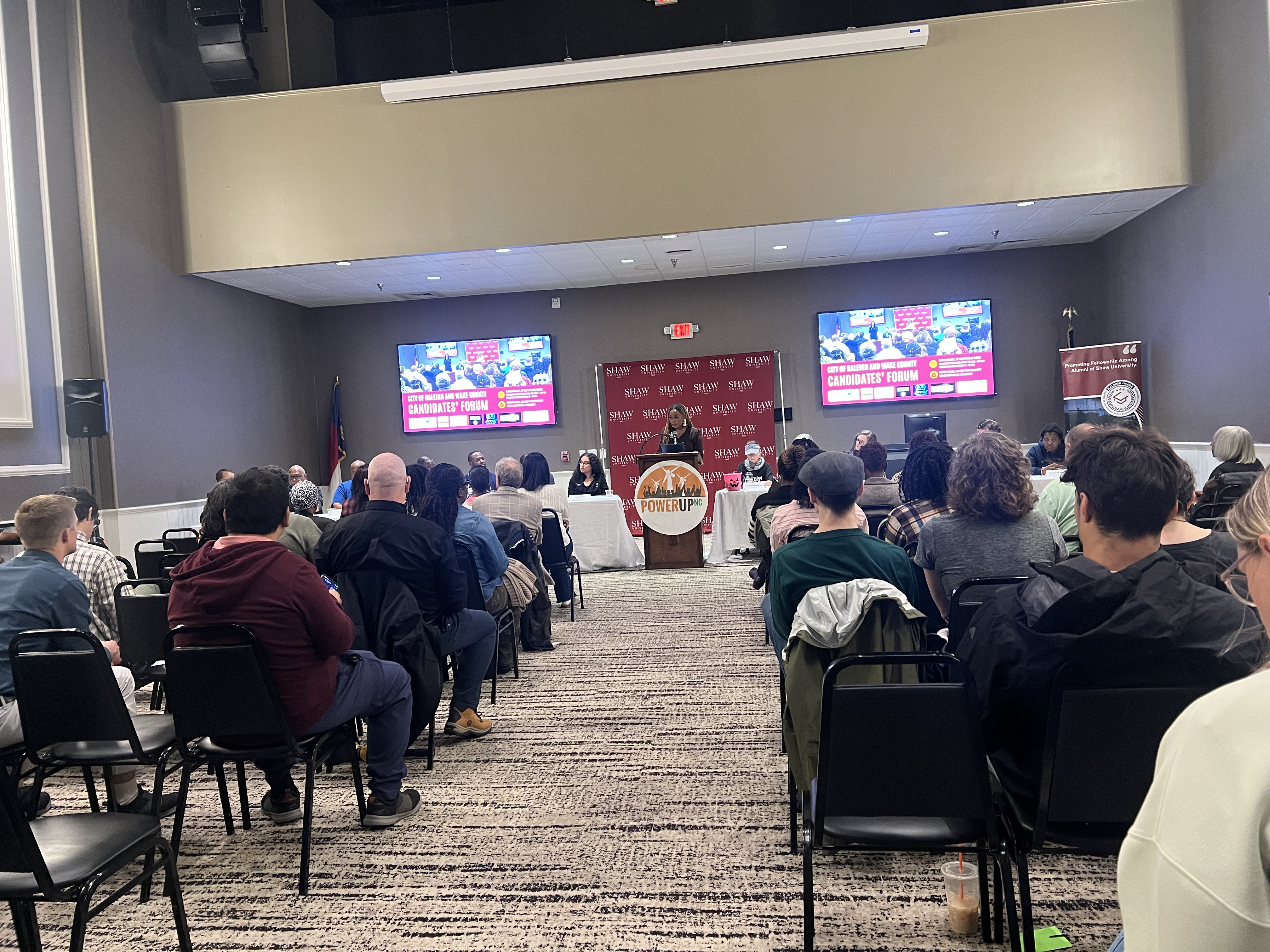
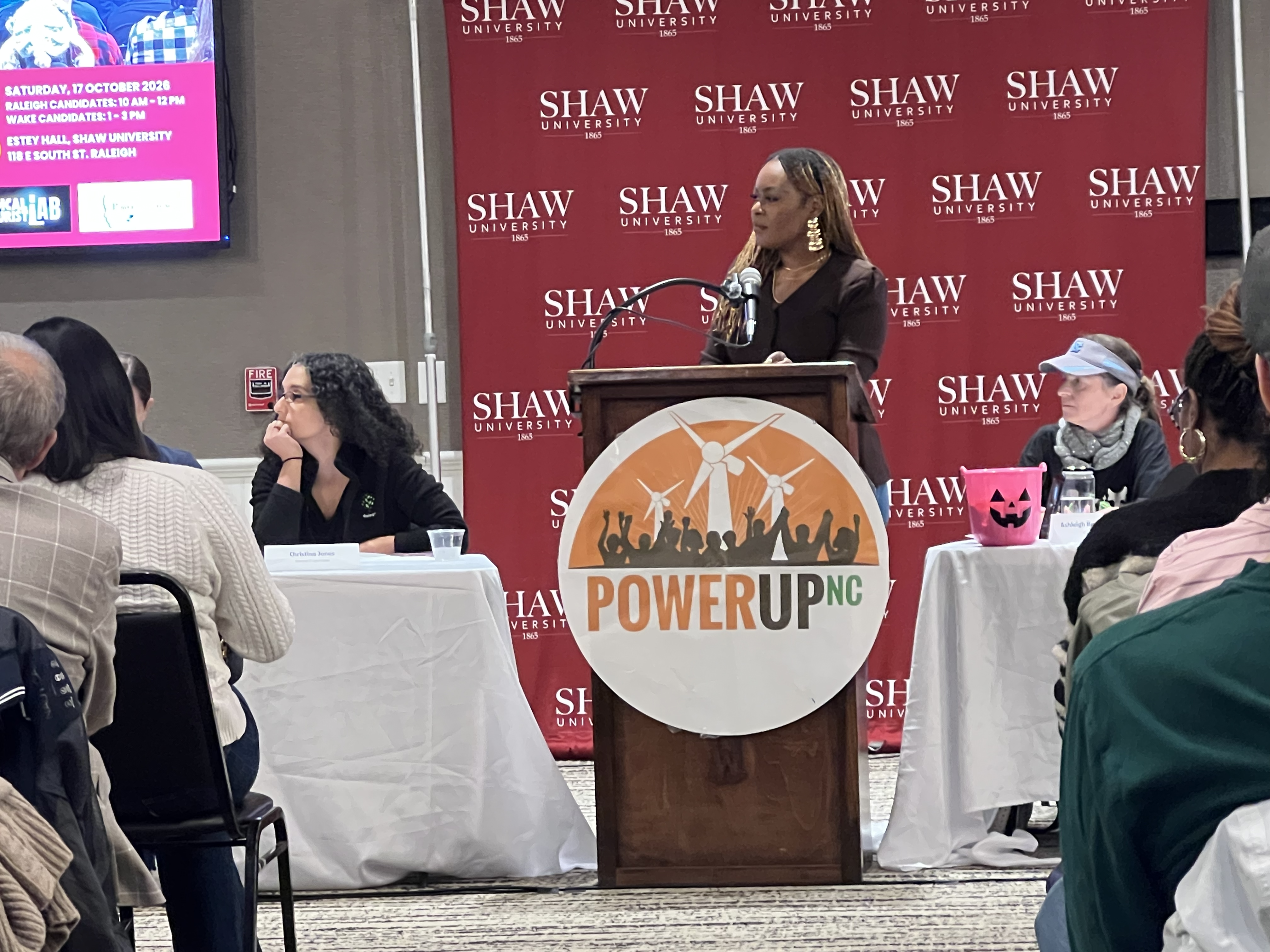
On Saturday, the 2026 City of Raleigh and Wake County Candidate Forum took place in Shaw University’s Estey Hall, bringing together mayoral and City Council candidates for a morning session, followed by an afternoon session featuring candidates for Wake County commissioner, soil and water conservation district supervisor, and the Wake County Board of Education.
The forum gave residents an opportunity to hear candidates address local policy questions, compare their positions and discuss how they would respond to the challenges facing Raleigh as the city continues to grow.
Dr. LaShonda Lucas, a Shaw University social work faculty member and community advocate, moderated the morning session. She outlined the forum’s rules, giving candidates 60 seconds to answer each question and requiring them to respond directly without rebuttals or exchanges with opponents. Audience members submitted written questions, which organizers reviewed and grouped by topic before presenting them.
Lucas began by identifying the concerns driving the discussion.
“People across Raleigh and Wake County are really concerned with housing costs, wages, public safety, schools, taxes, flooding, growth, and the environment,” she said.
Those issues shaped three rounds of questions covering infrastructure funding, public participation, affordable housing, homelessness, data centers, traffic, environmental standards, and youth engagement.
The first question to mayoral candidates focused on how Raleigh should distribute the cost of growth-related infrastructure among taxpayers, developers, and other funding sources.
Current Mayor Janet Cowell argued that concentrating development in areas where infrastructure already exists would help the city accommodate new residents without taking on unnecessary expenses.
“Growing and targeting densities where we already have infrastructure is the key to being able to afford the growth,” Cowell said.
She pointed to Raleigh’s comprehensive plan and designated growth centers as examples of how the city could direct development toward areas better equipped to handle it.
Ashleigh Heath Armstrong, an independent candidate for mayor of Raleigh, challenged the city’s approach to planning, arguing that officials must examine the financial implications of development rather than overlook basic infrastructure and accounting concerns.
Candidates also debated how City Council should balance public comment with the need to conduct municipal business efficiently.
At-large candidate Sana Siddiqui said community engagement should remain central to the council’s work. She said officials should explain decisions when they differ from residents’ preferences and ensure people understand the reasoning behind municipal policies.
Joshua Bradley, a Green Party candidate for City Council at-large, argued that elected officials must prioritize the people they represent over the interests of business organizations and other influential groups.
“We have a responsibility to listen to everybody,” Bradley said. “We are here to protect our people.”
Stormie Forte, an at-large candidate and incumbent, offered a different perspective, saying Raleigh already provides several ways for residents to communicate with their representatives. Forte pointed to public comment at City Council meetings, emails, and community events as opportunities for residents to raise concerns.
“We actually offer more public comment opportunities than the county commission and the school board,” Forte said. “People see us out frequently in the community at a number of community events.”
Clark Rinehart, a Democratic candidate for City Council at-large, argued that public comment, while important, represents only a small part of the work required to understand residents’ needs. He said elected officials must also listen outside formal council meetings, including in neighborhoods and informal community settings.
Housing was another dominant issue, with candidates asked how they would help longtime residents remain in their homes as costs rise and new development reshapes neighborhoods.
Jared Olsen, a District C candidate for Raleigh City Council, emphasized preserving existing affordable housing and helping residents remain in their homes. He discussed rehabilitation assistance and the importance of maintaining existing affordable properties rather than relying exclusively on new construction.
Corey Branch, the current District C council member seeking reelection, also pointed to home rehabilitation programs and assistance for seniors who need help with major repairs. Branch discussed efforts to maintain affordable rental housing through long-term agreements where permitted by state law, arguing that preserving existing housing is an important part of keeping residents in their communities.
Candidates were also asked how the city should measure the success of public spending on homelessness services, including whether success should be defined by shelter availability or by the number of people who achieve stable housing over time.
Other candidates emphasized the importance of increasing the supply of affordable housing, partnering with nonprofit organizations and strengthening cooperation between Raleigh and Wake County. Their responses pointed to the need for a range of housing options, from rental units to homeownership opportunities, as well as services that help people experiencing homelessness move into stable housing.
The growth of large data centers emerged as another contentious issue, particularly because of their potential demands on water, electricity and local infrastructure.
Candidates were asked what authority Raleigh has to regulate data centers and where responsibility should rest with the state or county.
Cowell said the city could influence aspects of development through land-use regulations, noise restrictions and water-related policies but acknowledged that municipal authority does not extend to every part of the issue. She argued that coordination with state officials and other stakeholders would be necessary to address the broader implications of data-center development.
Armstrong took a more forceful position, arguing that additional facilities would be inappropriate in areas where resources are insufficient. She also said Raleigh should not necessarily wait for state or county action before addressing residents’ concerns.
“Additional data centers are flatly inappropriate because we do not have enough water and space. Period,” Armstrong said. “We do not need to wait for the state or the county.”
Branch said the city must operate within the limits imposed by state law while using the tools available to it, including decisions involving annexation and development within municipal jurisdiction. He said city staff had been working on approaches to address the issue before a moratorium was considered.
Jane Harrison, a Democratic incumbent representing District D, emphasized the importance of incorporating environmental considerations into development decisions, particularly when projects could increase flooding downstream or affect drinking water. She said officials should establish clearer standards rather than relying on individual negotiations for each project, arguing that developers should understand the city’s expectations before proposals reach the approval stage.
Mitchell Silver, a Republican candidate for City Council in District A, discussed Raleigh’s existing process for evaluating traffic-calming requests through the transportation division, with assessments that can be brought before City Council. Silver said residents should have opportunities to challenge decisions when they disagree with the city’s assessment and that officials must be willing to reconsider requests.
The gathering at Shaw University reinforced the message that voting is only one part of civic participation and that accountability continues after ballots are cast. Residents, organizers said, have a role in monitoring public decisions, asking questions, and ensuring elected officials follow through on their commitments.
The event was organized by PowerUp NC, a program of the North Carolina League of Conservation Voters Foundation, alongside Shaw University and several community partners.