
By Jheri Hardaway
Staff Writer
When was the last time you read a book that made you feel like you were there? The type of text where you felt the energy of those in the story and walked in their shoes? Invisible Generals by Doug Melville takes you there. This American story follows the lives of Louis Patrick Henry Davis, Benjamin “Ollie” Oliver Davis Sr., Benjamin Oliver Davis Jr., Lawrence “Larry” Scott Melville, and author Doug Melville. From the late 1800s to today, this Black American family's five generations have impacted our world, our government, and our American military in ways we still feel today.
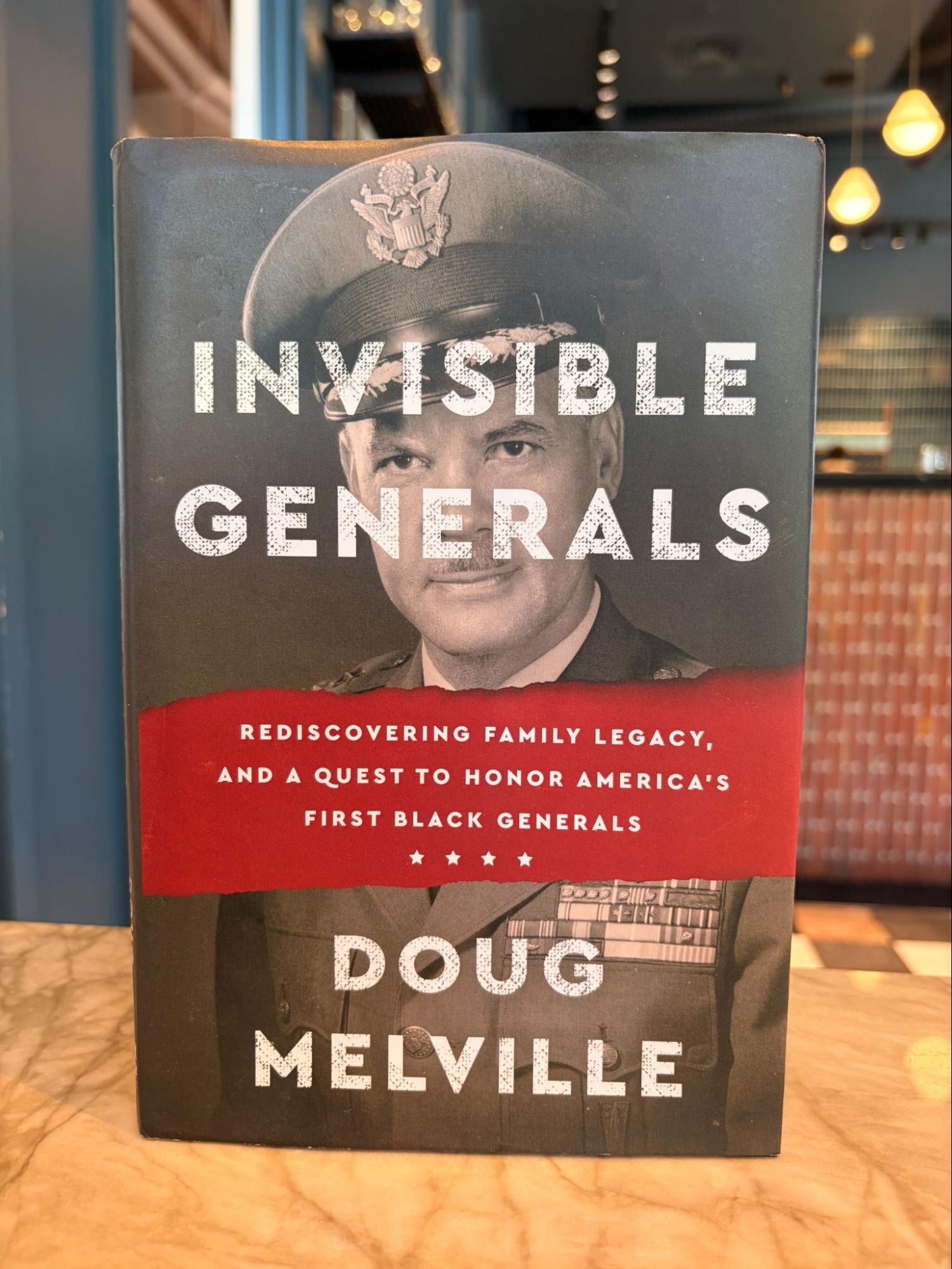 A recurring theme of the book is that many of us come from impactful legacies, but the frustrating element is that our stories aren’t told. As a matter of fact, our histories are often hidden. At times, it is even invisible in plain sight. Invisible Generals articulates this sentiment as the author asks, “How many stories like that of the victorious, ‘Top Gun’ pilots remain lost to the past? How many heroes are we lacking, whose example could inspire and improve us as individuals, and as a nation?” Invisible Generals stands in that gap and explains not only the experience of the father-and-son military Dynasty, but also the story of the author, Doug Melville, who has made major waves in advertising and DEI initiatives on a global scale.
The story of the invisible Generals Ben Davis Sr. and Ben Davis Jr. makes the read worthwhile and deserves much more attention in popular culture. From the Buffalo Soldiers to the Tuskegee Airmen, even the national speed limit, and TSA. There is so much to explore about the contributions of these great men. One of the highlights of the story was when Ben Sr., known affectionately in the text as Ollie, returned from deployment in 1920 to teach military science and tactics at Tuskegee Institute. Ollie and his second wife, whom his children called “Mother Sadie,” made their way to Tuskegee, which was an educational oasis in a sea of Alabama’s hotbed of racism.
The family was informed that the Ku Klux Klan planned to march past the institute, which had advised employees to stay inside with the lights off to avoid confrontation. Ben Jr. recalled the incident from his childhood, “But as a Regular Army officer, my father refused to cower behind closed doors. Furthermore, he believed that the entire Davis family should make known its opinions of the Klan by staying visible and not hiding in the shadows. On the night of the Klan, therefore, Mother Sadie, my two sisters, and I sat quietly on our porch, my father resplendent in his white dress uniform, and the rest of us viewing the parade with some concern about what might happen when the Klansmen marched by. Our porch light was the only light to be seen for miles around except for the flaming torches of the Klansmen, who passed by on the street only a few feet from where we sat. Also resplendent in white robes, masks, and hoods-they passed by without incident.”
The thoughtful and intentional imagery of Invisible Generals is truly timely as we face renewed hate and bigotry in our current embattled political climate. What Melville writes of his ancestors’ time in the classroom you also find from the author in this book, “Both Ollie and Ben were experienced teachers and had much to offer in the way of information. But what their students received was above and beyond the required instruction: they received inspiration and encouragement from two men they considered heroes … the students needed this interaction to understand what had elevated these two strong, smart men.” Very much inspiring and insightful, the book Invisible Generals packs the same punch as the men who influenced Melville. He got it honest.
As Ben Jr. grew up, he continued to model the steadfastness of his father. General Davis Jr attended West Point and famously was not spoken to by a soul on campus for four years. When he was accepted to study at West Point, they were not aware he was Black and ostracized him for his entire matriculation. He excelled regardless, only receiving negative marks in classes that required a partner because no one would talk or work with him.
Buried Black achievement is nothing new, but to read about it in Invisible Generals gives life to our hidden heroes and inspires perseverance in our everyday experiences.
There are many key takeaways for people to process from this book, but I’d like to focus on two. One, after a distinguished military and government career, General Ben Davis was not promoted to a four-star general (retired) until 1998 by President Bill Clinton. The author explains, “Unfortunately, I don't have the income amounts for a three-or four-star general during Ben's years of service, but we can look at current Air Force pensions, which are typically based on years of experience and other criteria. Retired three-star generals' annual pension is about $189,792, versus the $215,104 of four-star generals, a $25,312 difference. One can surmise the gap was similar back then. If you multiply these amounts by the number of years Ben would've been paid that money in retirement, thirty-four years, this totals an extra $860,608. When you factor in other benefits—medical coverage, a housing allowance, and so forth—this is why I refer to it as the "million-dollar star." It represents the financial compensation Ben should've received if he'd been promoted back in the 1960s, until his death in 2002. That income increase would have changed not only Ben and Agatha's lifestyle and retirement but also the financial freedom of the whole family.”
The final takeaway is in “Part II: Becoming a Visible General,” where the author outlines “Strategies to Seize Your Destiny.” These tangible tips are largely timeless action steps to help people find their way in family research as well as career.
I highly recommend Invisible Generals for anyone interested in American history, family history, and naturally, military history. This read is an adventure you can feel and respect. Fortunately, there is more to come. Doug Melville has another book coming out in January about the Invisible Senators who led the South during America Reconstruction.
The only thing that really bothered me as I read this story is the difficulty the author outlined in accessing information and artifacts from his own family. Ben Jr’s wife, Agatha, allowed the National Air and Space Museum of the Smithsonian to house the Davis archives. If you visit AirandSpace.Si.Edu you’ll be treated to the information the organization chooses to share. Melville has researched these files extensively, but they are unavailable to the public. I wonder what I would find if I were able to take a look. The lens of the people that institutions tend to hire is very different from the perspectives and opinions of many readers of Invisible Generals, proving the point that buried Black achievement continues to be a burden and a blessing. We may never know or see all of the things our people have overcome and achieved; it might remain invisible, regardless, we persist.
