
By Jheri Hardaway
Staff Writer
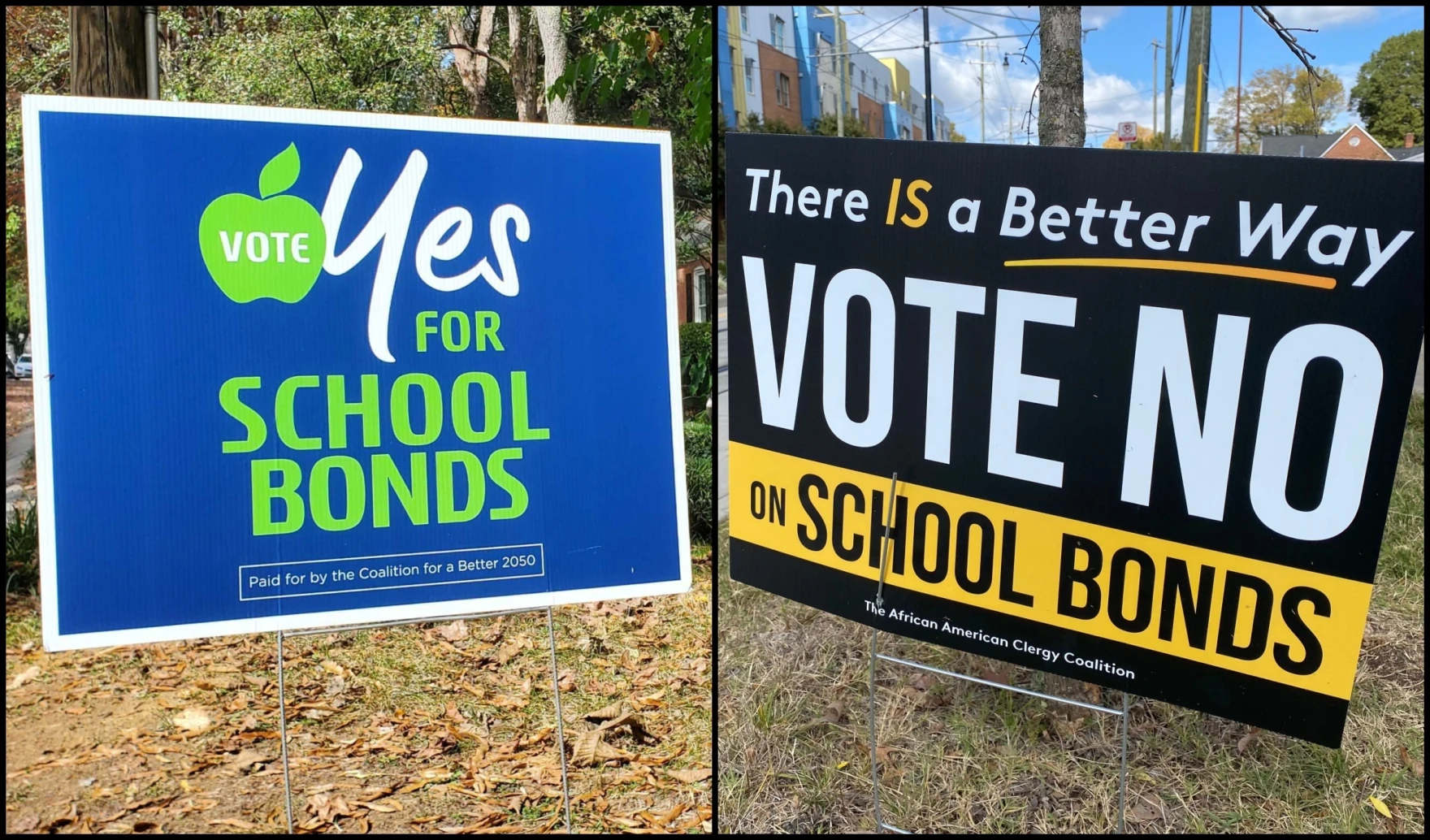
As a mobile notary public, my seal often grants me an intimate window into our community’s quietest moments. Recently, as mail-in absentee ballots began arriving at kitchen tables across our state, I sat with several elderly neighbors and seniors. Several of these Wake County-based voters experienced the challenges of school integration, affirmative action, and made sacrifices so their children and grandchildren could receive an equitable education. When it came time to vote on the school bonds, I fully expected an automatic “Yes.” After all, who understands the sacred value of public education more than the generation that had to fight state troopers and courtroom battles just to enter the front doors?
Instead, my pen paused. One after another, they voted “NO.” I was stunned. Why would our elders living on fixed incomes, but fiercely protective of our youth, refuse a marginal tax rate increase of a few dollars per month to upgrade crumbling classrooms, modernize aging HVAC systems, and expand community colleges?
Their answer was swift, unified, and deeply piercing despite not knowing each other:“Why should we pay out of our pockets to patch the holes when the General Assembly is funneling hundreds of millions out of our public schools and giving it to private academies?”
Our seniors aren't abandoning our children. But they are acutely aware of state spending, especially after it took a year to pass the state budget. They are staging a quiet, desperate rebellion against the systematic dismantling of public education.
To understand their anger, one must understand how school funding functions in North Carolina. Local school boards possess zero taxing authority. Under state law, counties bear the sole legal burden of building, repairing, and modernizing physical educational facilities. When roofs leak in older neighborhoods, when science labs lag decades behind modern technology, or when explosive growth requires new classrooms, counties must turn to General Obligation (GO) bonds. These voter-approved municipal loans allow local governments to borrow capital at favorable interest rates, repaying them through modest property tax adjustments over twenty or thirty years. It is the most cost-effective tool local communities have to build schools. Without bonds, growth halts, facilities decay, and children suffer.
Yet our elders are asking the hard question our state lawmakers continue to dodge: How can local homeowners be asked to bail out a leaking ship while the state legislature continues to drill holes in the hull? The resentment at the kitchen table is aimed directly at North Carolina’s rapidly expanding Opportunity Scholarship voucher program. First enacted under Governor Pat McCrory in 2013 with a modest $10.8 million budget, the program was originally sold to the public as a targeted rescue lifeline: a means-tested voucher intended strictly to help low-income families escape underperforming public schools. Fast-forward a decade, and the mask has fallen off.
Beginning in the 2024–25 academic year, the General Assembly completely eliminated income caps. Millionaires and affluent households whose children had never spent a single day in a public school classroom are now eligible for taxpayer-funded subsidies to cover private school tuition. According to advocacy group Public Schools First NC:
The program transfers state tuition subsidies ranging up to 100% of the average state per-pupil allocation (over $6,400 per child) straight into private and religious school coffers.
Through the companion Personal Education Student Accounts (PESA/ESA+) program, vouchers for students with disabilities can divert up to $17,000 per student annually into private hands with minimal state curriculum oversight.
The legislative funding pipeline is staggering: by 2031–32, annual voucher allocations will surpass $500 million per year, totaling nearly $5 billion diverted away from the public trust over the next decade.
All of this occurs while North Carolina ranks near the bottom nationwide in per-pupil funding, while veteran teachers flee the classroom over stagnating pay, and while the state remains in perpetual defiance of the landmark Leandro ruling, which constitutionally mandates a sound, basic education for every child. Our voting elders and many others see the playbook clearly because they have seen it before. They remember the "Pearsall Plan" of the late 1950s, North Carolina’s historic resistance strategy to Brown v. Board of Education, where the state offered taxpayer-funded tuition grants so white students could flee integrated public schools and attend private, segregated academies.
To those who lived that history, the unlimited expansion of modern private vouchers feels painfully familiar: an intentional disinvestment from common spaces in favor of privatized privilege. When a 75-year-old voter looks at their property tax bill, they do not see an isolated bond measure for air conditioners or brick-and-mortar classrooms. They see things for what they are. They see a state legislature that starves the public school system, forces county commissioners to beg local taxpayers to fill the void, and redirects public tax dollars to subsidize wealthy private school tuition.
The protest of our elders is rooted in righteous indignation, but it presents a tragic paradox. Voting down local school bonds will not stop the General Assembly from sending hundreds of millions to private schools. The voucher pipeline will continue to flow from Raleigh untouched. What a "No" vote will do is ensure that the neighborhood school down the street remains overcrowded, that the mold in the aging elementary school classroom goes unmitigated, and that our community colleges lack the technical labs required to prepare the next generation for the modern economy. The children who pay the price for a defeated bond will not be the families cashing voucher checks; it will be the working-class children who remain in public classrooms.
Our elders have sounded a necessary alarm. Their refusal to rubber-stamp school bonds is a warning to every elected leader in North Carolina: the public is waking up to the voucher heist. The real solution cannot be to starve our local schools from both ends. The true solution is to continue to vote to elect lawmakers who will stop using public tax dollars to fund private school tuition.
