
By Jordan Meadows
Staff Writer
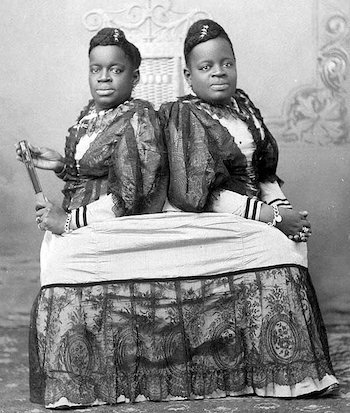
Millie and Christine McKoy were twins born conjoined at the lower spine in Whiteville, North Carolina, in 1851, enslaved on a farm.
Millie and Christine shared a pelvis and stood at roughly a 90-degree angle to one another, though each had a full, independent set of limbs; they were raised to think of themselves as a single person and referred to themselves as "Millie-Christine."
As enslaved children, they could be bought and sold without any say in the matter, and at just 10 months old, McKay sold them to South Carolina showman John C. Pervis for $1,000, retaining a quarter share of future exhibition proceeds and resale value. Roughly 14 months later, they were sold again to a showman named Brower.
Brower exhibited the twins at North Carolina's inaugural State Fair in October 1853, advertised under the era's common, dehumanizing label as "freaks of nature"; the fair drew 4,000 to 6,000 visitors daily. After the fair, Brower took the twins to New Orleans, where local doctors verified their conjoined anatomy, while their mother, Monemia, was sent back to the plantation where she remained enslaved.
While in New Orleans, the twins were kidnapped and vanished from public view for roughly a year, briefly resurfacing at a Philadelphia museum run by a former P.T. Barnum associate before reappearing under new captors at Barnum's American Museum in Manhattan, where they performed alongside other Black sideshow entertainers of the era, including William Henry Johnson and George and Willie Muse.
From there, the twins were taken through Canada to England, further from home than they'd ever been.
A private investigator eventually traced the girls to Europe, and Monemia and Joseph Smith, who had by then acquired legal claim to the twins after Brower's finances collapsed, traveled to Liverpool and were reunited with them on New Year's Day 1857. The twins were about 5 and a half years old. They were displayed publicly alongside their mother while still in the United Kingdom.
Smith arranged for the twins to receive a formal education once reunited; his wife taught them to read, write, sing, dance and play piano, and the twins became fluent enough in French and German to perform recitations in both languages.
On Jan. 1, 1863, when Millie and Christine were 11, the Emancipation Proclamation ended their legal status as enslaved people, though they continued performing professionally, now billed as "The Two-Headed Nightingale," with Millie singing alto and Christine soprano. After emancipation, the twins chose to remain with the Smith family rather than leave, a decision they later described in explicitly devotional terms in their own writing, likening their loyalty to Mrs. Smith to the biblical relationship between Ruth and Naomi.
The twins toured extensively across the U.S., Canada, and Europe for the following three decades, performing in Baltimore, Washington, Philadelphia, and New York, where they again appeared at Barnum's museum. They played New England in 1869 and swept through the Midwest in 1870.
Their fame brought them before Queen Victoria and the British royal family during their time in the U.K., who gifted them diamond-studded hair combs. They performed in England through the end of 1872 before touring St. Petersburg, Russia, with Hinné's Circus.
Their celebrity did not spare them from being treated as medical curiosities even as adults; while in Philadelphia, they were subjected to a medical examination and photographed by Dr. William Pancoast for his textbook on medicine and surgery.
Millie and Christine also became published authors, producing an autobiographical account, "History and Medical Description of the Two-Headed Girl," sold at their performances beginning around 1869.
In their own writing, the twins directly addressed the public's fixation on whether they were one person or two:
"Although we speak of ourselves in the plural we feel as but one person," they wrote, adding that they would not wish to be surgically separated even if it were possible, because they had "but one heart, one feeling in common, one desire, one purpose."
By the second half of the 1880s, the twins were touring less, and they built a 14-room house in Columbus County, North Carolina, on land their father had purchased from their former enslaver and later left to them. They eventually retired to Whiteville, and throughout their career and into retirement, gave financial support to Black schools and churches in the area.
Millie died of tuberculosis on Oct. 8, 1912, at age 61; accounts vary on exactly how long Christine survived her sister, ranging from about 12 to 17 hours. The two were buried together in an unmarked grave, and their remains were later moved to a Whiteville cemetery in 1969.
Their shared tombstone reads: "A soul with two thoughts. Two hearts that beat as one."
