

By Jheri Hardaway
Staff Writer
Our world is entangled in conflict. Across the globe, geopolitical warfare claims lives and destabilizes regions. Closer to home, a tech battle for our attention wages constantly in the palms of our hands. Algorithms are engineered to capture our attention, commodify our time, and distract us from our presence. Yet perhaps the quietest, most destructive conflict is taking place within the human spirit: the internal war on self-love, contentment, and gratitude for how we were made by our creator.
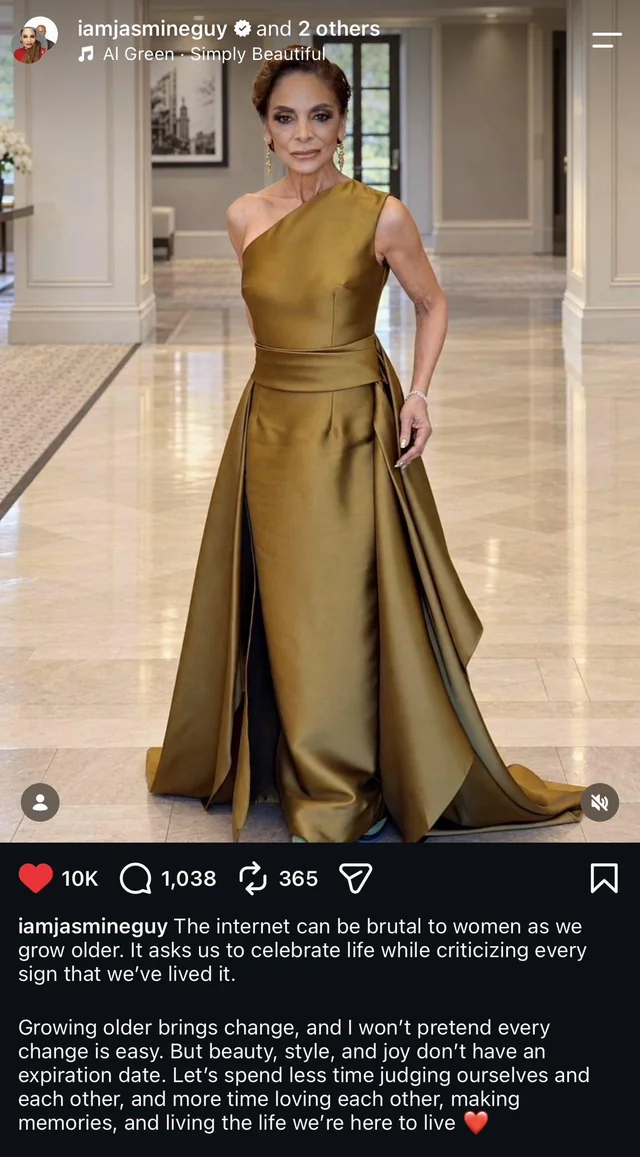
Jasmine Guy, the 64-year-old 'A Different World' star, recently addressed online comments criticizing her looks as she reprises her iconic Whitley Gilbert-Wayne in the Netflix sequel, which premiered September 24. In her post, she noted how the internet pushes women to live fully yet judges signs of aging, calling instead for love, memories, and joy without expiration dates. Guy expressed via Instagram, “The internet can be brutal to women as we grow older. It asks us to celebrate life while criticizing every sign that we've lived it. Growing older brings change, and I won't pretend every change is easy. But beauty, style, and joy don't have an expiration date. Let's spend less time judging ourselves and each other, and more time loving each other, making memories, and living the life we're here to live.”
Jasmine’s words are timely. When internal peace erodes, the conflict can often migrate to the surface. A quiet dissatisfaction has been sown by modern media telling everyday people that their natural bodies are not enough. While this battle manifests in countless ways, three specific physical trends have accelerated this cultural shift: the surge of GLP-1 weight loss drugs, invasive dangerous cosmetic procedures like the Brazilian Butt Lift (BBL), and daily reliance on artificial enhancements like false eyelashes and hair weaves. Beneath the media and marketing lies an escalating public health crisis and an urgent spiritual reminder to reclaim who we were made to be and embrace who we are.
Originally developed as lifesaving interventions for Type 2 diabetes, GLP-1 receptor agonists (such as semaglutide and tirzepatide) have been rebranded by pop culture as miracle slimming tools. The New England Journal of Medicine outlines that “GLP-1 receptor agonists were fundamentally engineered to mimic gut hormones to stimulate insulin secretion and regulate blood sugar.” Celebrities, influencers, and med-spas now peddle weekly injections to individuals chasing an aesthetic ideal rather than managing clinical disease. These quick fixes carry severe financial and physical costs. Health experts from the National Institutes of Health continue to warn us about the dangerous side effects stemming from dramatic, pharmaceutical-driven weight loss: Sarcopenia and Muscle Atrophy, Gastrointestinal Complications, Nutritional and Structural Depletion. When individuals who are otherwise healthy turn to prescription medications to achieve an unattainable body standard, they gamble their long-term organ health for short-term cultural approval.
While previous generations navigated pressures of fashion and makeup, today’s youth are pushed toward surgical reconstruction. The Brazilian Butt Lift, or BBL, a procedure where fat is harvested via liposuction and reinjected into the gluteal area, has become a fixture of modern social media culture. The primary danger is a pulmonary fat embolism: if a cannula accidentally penetrates the deep gluteal veins, fat globules enter the bloodstream and travel directly to the heart and lungs, causing sudden, irreversible cardiovascular collapse. The Kardashian Family and hip-hop stars like Cardi B have championed these body structures that are unrealistic and often require multiple surgeries to maintain. Former Wild 'N Out star Jacky Oh (Jacklyn Marie Smith) died on May 31, 2023, at the age of 32 from complications due to cosmetic surgery. Even successful surgeries often lead to chronic pain, permanent nerve damage, and severe scar tissue.
Gluteal fat grafting remains one of the most dangerous elective cosmetic procedures in modern medicine. Dr. Donda West, mother of Kanye West, died on November 10, 2007, at the age of 58, due to a combination of pre-existing coronary artery disease and post-operative factors following cosmetic surgery. As a culture, we’ve experienced massive loss from these invasive and dangerous procedures. The tragic reality is that lives are being cut short on operating tables to pursue an exaggerated silhouette popularized by digital filters and photo-editing software.
At first glance, cosmetic lashes might seem minor compared to prescription drugs or surgical knives. However, their universal adoption represents the gateway through which routine self-rejection becomes normalized. What was once reserved for theatrical performance or special occasions has become an everyday obligation for some. This constant physical alteration carries real, tangible risks. Chemical adhesives contain formaldehyde, cyanoacrylates, and harsh resins that frequently trigger severe contact dermatitis, corneal abrasions, and chronic eye infections. Repeated application and heavy extension weights destroy the natural lash follicle, resulting in permanent thinning of the natural lashes.
The deeper danger is mental. When people condition themselves to believe they look tired, unpresentable, or unfinished without aspiring to artificial beauty standards, they lose the ability to look in the mirror and recognize their own innate beauty. When cosmetic perfectionism becomes the baseline expectation, society suffers. Communities divert immense amounts of money that could build homes, seed generational businesses, or fund educational advancements into consumer-driven beauty industries. Nails, hair weaves, and eyelashes will not help us build better futures for the generations to come. More critically, our young daughters and sons grow up watching adults mutilate and medicate their God-given temples, the inherent toxic message that natural beauty is an error that needs fixing. I reject this notion. We must, as a people, recognize that every insecurity is a revenue stream for a pharmaceutical supplier, a surgical clinic, or a cosmetic brand, and instead see ourselves as God’s creation.
Ending the war on self does not mean abandoning personal wellness or healthy discipline. True stewardship of the body honors nutrition, movement, rest, and vitality. It treats the physical vessel as sacred. The Creator did not make mistakes. Every natural contour, texture, and feature carries heritage, character, and dignity. To step away from the scalpel, the needle, and the mask is not a concession; it is an act of spiritual and cultural rebellion. True peace begins when we lay down our arms against our own reflection, reject the industry of inadequacy, and embrace the truth that we are already wonderfully and completely made.
