
By Jheri Hardaway
Staff Writer
Mollie Huston Lee was the first African American librarian in Wake County and the founder of the Richard B. Harrison Wake County Library Branch. Not only did she leave behind a legacy of helping others and encouraging a love of literacy, but her treasured collection is a rare and special intellectual treat she left for us to share, analyze, and dissect. Mrs. Lee started and maintained a collection chronicling the African American experience locally, nationally, and internationally on the history of the African Diaspora. The literary collection comprises adult and juvenile nonfiction, fiction, journals, even a first edition signed copy of Alex Haley’s Roots.
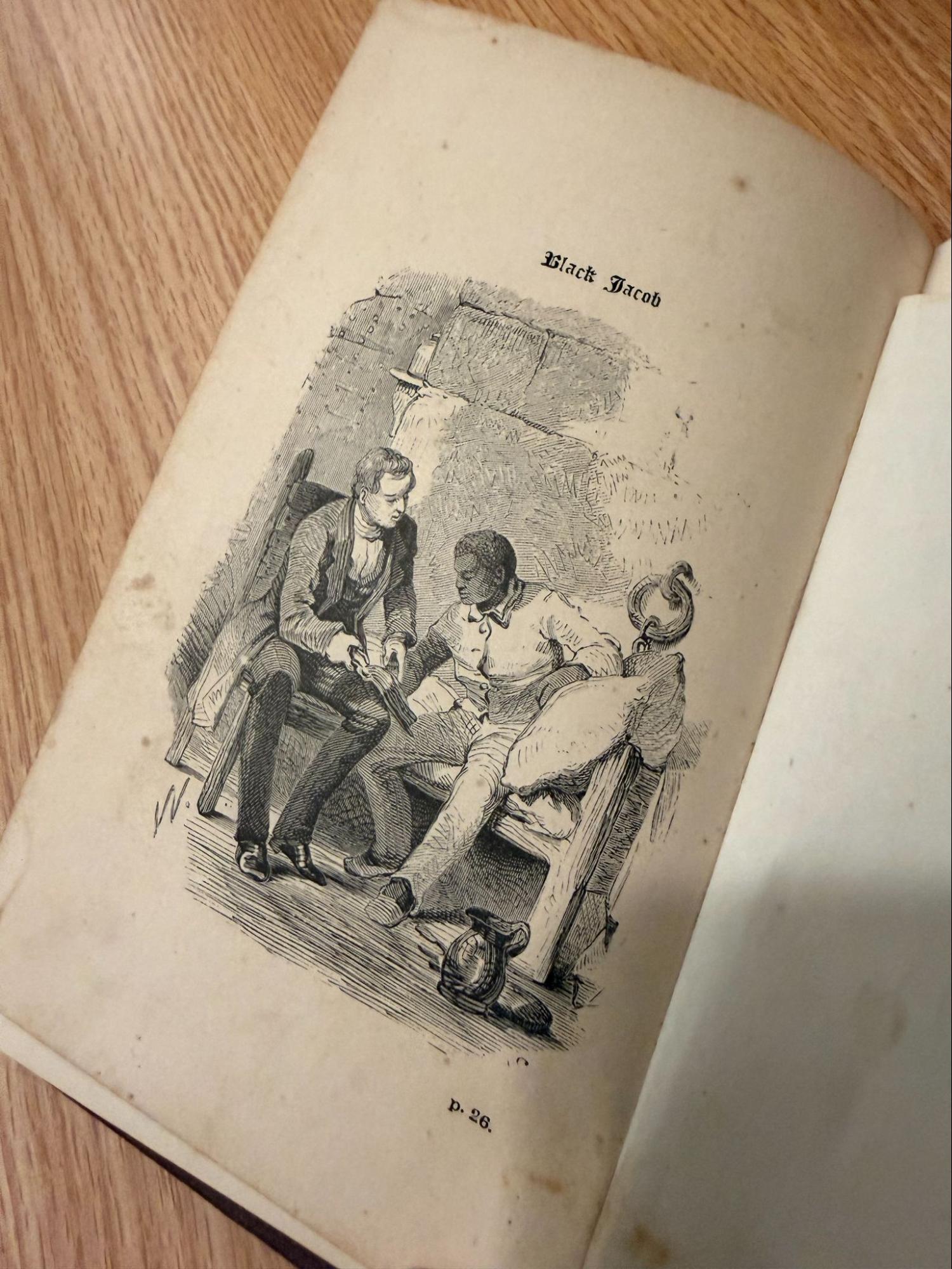
As I continue to explore the collection many books have drawn my attention. One that stood out was a 100 page three by two inch mini book called Black Jacob: A Monument of Grace by A. D. Eddy of Newark, New Jersey. Published in 1842, this quarter sized book is a biography of an African American man born in 1763 near Lancaster, Pennsylvania. Jacob Hodges, was born free, but he was granted no other signal accommodation. The text begins by outlining that, “The family, though extremely depressed, living in ignorance and poverty, were not, as it is known, ever subjects of slavery. Either from the poverty, ignorance, or wickedness of his parents, Jacob was suffered to spend his early years wholly without education or moral restraint.”
Jacob took only what life gave him, as shared by his biographer. He took to trades around the sea and worked jobs on ships which led to drinking in excess and other vices that guided him down the wrong path. Jacob traveled far and wide, seeing many continents and ports in many countries around the world during his time. Eventually, his inability to act or work in a dignified manner, impacted his employment. When his job on the seas came to an end he found himself in rural New York. Eventually, living with his employer he performed common laborer tasks. Jacob’s employer, a woman and two men had their eye on a plot of land in the area owned by a Black man. He had fought hard to own the land and remain independently working it with his family. Jacob’s employers began to scheme on how they could kill the man and take the land. They enlisted Jacob in this plot and by keeping him drunk and sufficiently employed they were able to persuade him to commit the crime of cold blooded murder.
The tale outlines the extensive trial process and litigation that followed. Jacob was not the only person who went to prison for this crime. His time incarcerated was life changing for him and his community. Entirely ignorant, Jacob was able to forge a relationship with a chaplain who visited consistently in prison. This man of a cloth will eventually use the Bible to teach Jacob to read and guide him towards faith to become a dedicated and faithful believer. The book was all about God and obedience. It was evident to the community that Jacob was changed, man. Upon his release from prison, Jacob was not excited and very fearful of what the world had to offer. The chaplain encouraged him to trust in God to continue on his spiritual path. He was gifted the very Bible that taught him to read, and it became his most prize possession.
Jacob himself began to preach the word, became a trusted member of his community, and a testament to faith, perseverance, deliverance. He was haunted by his crime, his entire life, but committed to serving God in every way.
When I first started reading this book, I had no indication of what direction the story would go in. I was actually shocked that it ended up being such a spiritual book when it started as an adventure with a wild young man who had no moral compass drinking at sea. I read the book 50 pages at a time, you cannot check out books from this collection they’re all rare and must be read in the reading room. This book was very delicate and well read from all the spots and marks on some of the pages.
Black Jacob was spoken about affectionately by others according to his biographer. He was proud to carry a key to the home he shared with others, having a key was meaningful to him. He was very proud of this trust that he had built. Trust and faith where the overarching themes of the story. This short book outlined a very meaningful life experience. I can’t wait to see what else collection reveals to me.
