
By Jheri Hardaway
Staff Writer
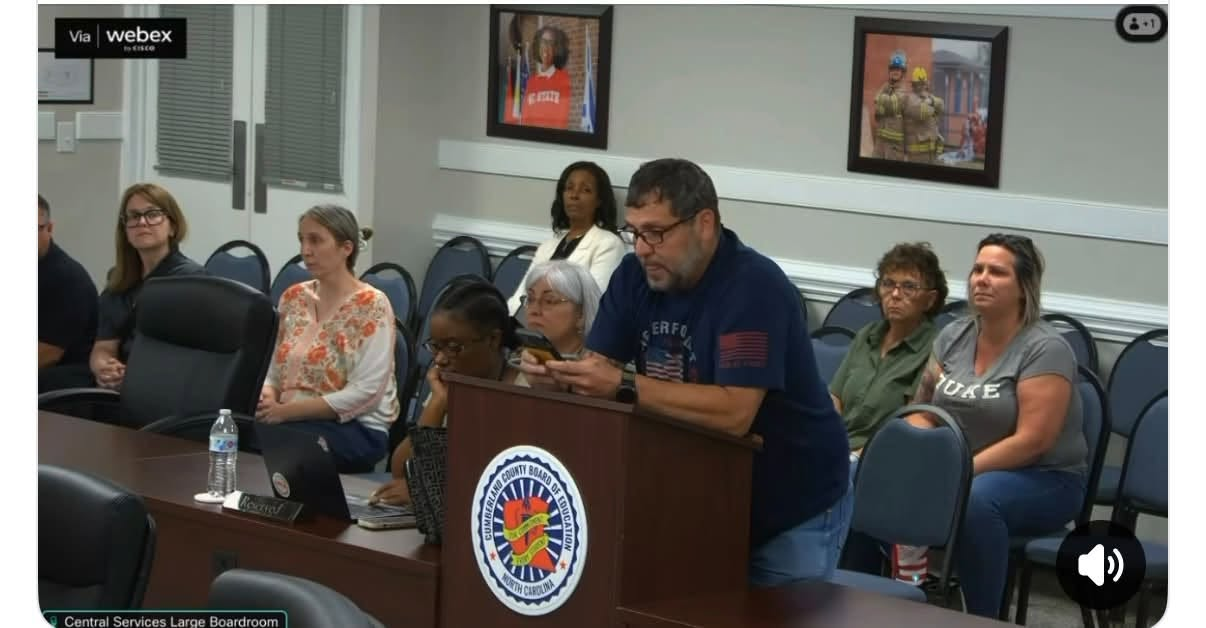
Fayetteville, NC - As an educator, there is nothing more frustrating than hearing an announcement during the school day that a bus isn’t running. Students lose all focus and have to think about how they will get home. Phone calls must be placed; the teaching and learning process is completely disrupted. Recently, in a tense Cumberland County Board of Education meeting, a veteran school bus mechanic, Robert “Tilly” Tillberg, stepped to the podium; not to ask for a raise, but to tender his resignation out of fear for student safety in relation to transportation. His warning, delivered with an emotional voice before district leadership, laid bare severe staffing shortages within the Cumberland County Schools (CCS) Transportation Department. Days later, district officials responded by hiring an outside Raleigh law firm to investigate operating conditions across its fleet.
Tillberg, an employee stretched to his breaking point, is directly responsible for 38 school buses. He told board members that severe understaffing leaves the remaining crew with impossibly small windows to keep vehicles road-ready. According to Tillberg, roughly 15 road mechanics shoulder the burden of servicing approximately 500 buses daily. Between the time morning routes end and afternoon runs begin, mechanics often have only a three- to four-hour turnaround window. Within that short timeframe, technicians must execute mandatory mechanical inspections, perform scheduled maintenance, and diagnose sudden breakdowns.
Under such acute pressure, Tillberg explained, technicians are forced to triage repairs, occasionally leaving minor issues like heating and air unaddressed to get buses back on the road. "I should not have to worry that I cannot do my job to the standards that I know should be done because I am stretched too thin," Tillberg told the board. "This is not because I stopped caring about my job. It’s actually because I care too much." Tillberg warned that at least three other mechanics are actively seeking outside employment due to friction with departmental leadership, cautioning that further departures will compound an already unsustainable workload. His final day with the district is September 18th.
Following the public testimony, Cumberland County Schools announced on September 11th that it has retained the Raleigh-based law firm Tharrington Smith, LLP to conduct an independent investigation into the transportation department’s management, safety practices, and day-to-day operating conditions. Superintendent Dr. Eric C. Bracy sought to reassure parents and staff that vehicle safety remains strictly governed by state guidelines. "We want our families and employees to know that CCS is listening and taking responsible action," Dr. Bracy said in a statement. "Our transportation procedures are guided by state standards, and this external review will provide an additional, objective assessment of our practices."
According to the district, CCS operates 482 yellow buses across the county. The district is allotted 20 bus mechanic positions; 15 are currently filled, leaving five vacancies. Two slots were recently addressed through a new hire and an internal promotion. District policy adheres to North Carolina Department of Public Instruction mandates, requiring 30-day cyclical inspections alongside daily driver pre- and post-trip logs. Buses deemed out-of-service are barred from routes until cleared by maintenance.
Tillberg’s impassioned stand aligns with growing civic frustration among Cumberland County parents and advocates. Toni Stewart, a CCS parent whose child attends Anne Chesnutt Middle School, has been rallying community members to speak directly at school board sessions. Stewart, who previously organized against the proposed closure of Anne Chesnutt Middle and raised alarms when air-conditioning failures forced Westover Middle School into remote instruction, emphasized that community oversight is vital. Stewart’s message to families across the county has remained resolute: show up, speak out, and hold elected leaders accountable to the staff and children inside local facilities.
As Tharrington Smith begins its external assessment, Cumberland County parents and employees will look to the next Board of Education meeting for transparent answers on whether real structural relief is on the way for the workers who keep North Carolina’s schoolchildren safe on the road.
