
By Jheri Hardaway
Staff Writer
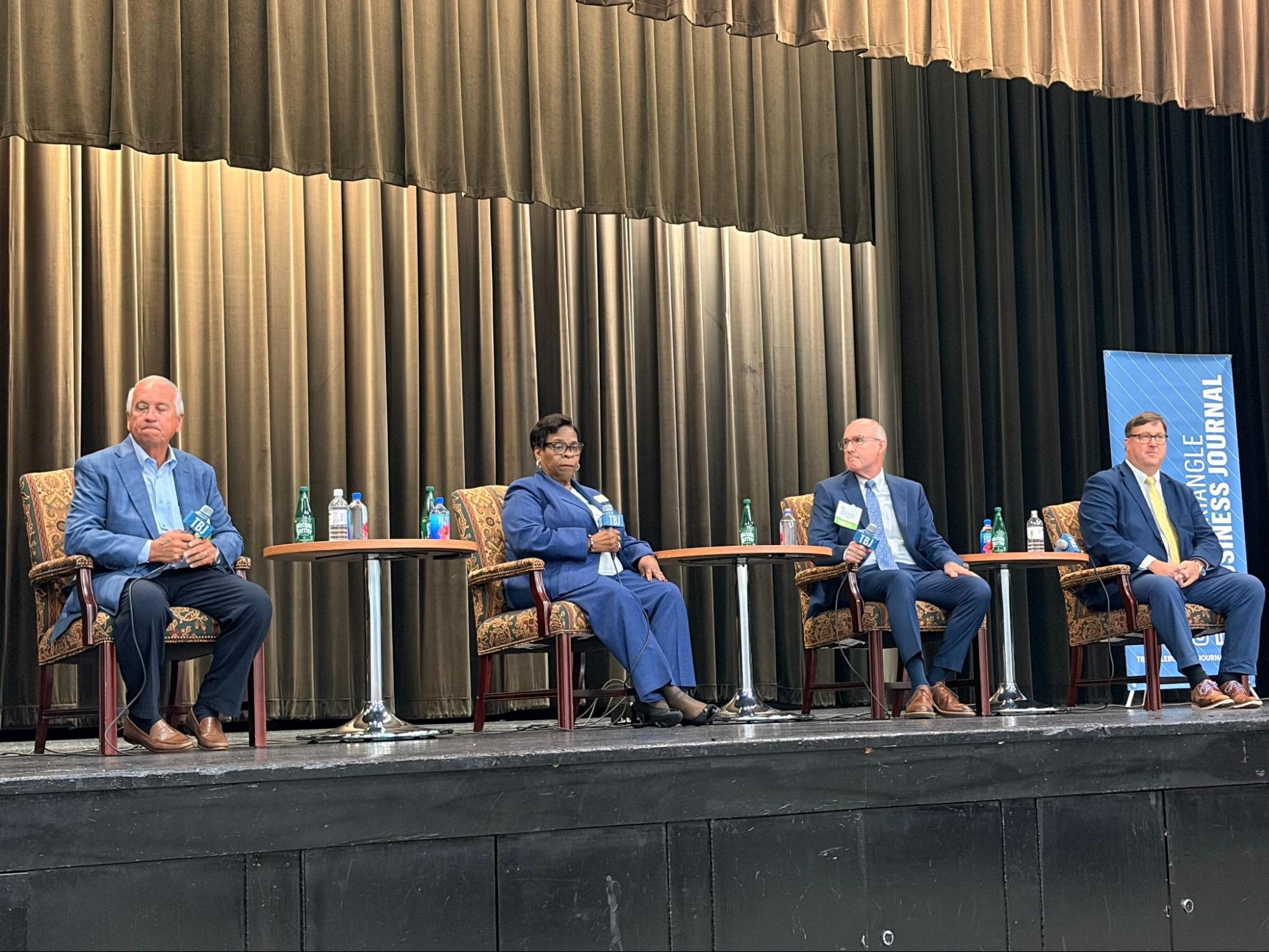
SANFORD, NC - Business leaders, elected officials, and regional developers gathered last Thursday for the Triangle Business Journal’s “Corridors of Opportunity” panel, focusing on the rapid transformation taking place in the Greater Triangle’s southern frontier: Lee and Harnett Counties.
Once defined primarily by manufacturing and agriculture, the region is rapidly transitioning into a high-tech and biomanufacturing hub. However, as escalating land prices and suburban spillover push south from Wake County, local leaders are wrestling with how to balance massive economic recruitment like data centers and life-science facilities with infrastructure capacity, workforce development, and farmland preservation.
Panelists included: Stephen Barrington, Economic Development Director for Harnett County, Harnett County Board of Commissioners Commissioner Barbara McKoy, Donnie Oldham President of Sanford Contractors, Jimmy Randolph CEO of Sanford Growth Alliance, and moderator Ben Tobin the Greater Triangle Reporter for Triangle Business Journal. A starting point of discussion centered on the rise of artificial intelligence and the massive data centers required to power it. Lee and Harnett counties have taken distinctly different policy paths to address data center proposals. While Lee County updated its Unified Development Ordinance (UDO) to establish clear development standards, Harnett County implemented a temporary one-year moratorium to assess long-term impacts on local utilities, noise, and zoning.
Addressing the county’s deliberate pause, Harnett County Commissioner Barbara McKoy emphasized the importance of ensuring that new industrial models align with community planning rather than rushing into quick approvals. "100% percent of the citizen who came before us said no, wait on data centers. We voted on a one-year moratorium; the citizens of Harnett County wanted to see the effects of data centers. That gives us the time to do the research and get the answers that the citizens need. We need jobs, but people need to think about the environment, their health, and all the things the data centers bring before we agree to say yes to a data center,” noted Commissioner McKoy.
Jimmy Randolph, CEO of the Sanford Area Growth Alliance (SAGA), noted that while data centers are not a primary targeted sector for workforce creation due to lower job counts, their massive capital investment significantly broadens the local tax base. Randolph commended Lee County's joint planning commission for establishing proactive standards that protect residents while keeping the door open for critical digital infrastructure.
While Lee County continues to celebrate major biomanufacturing expansions and the pending arrival of large-scale retail assets, Harnett County is making targeted moves to position itself for high-wage industrial projects.
Harnett County Economic Development Director Steve Barrington detailed the county's strategy of developing "market-ready" product along key transit corridors like Interstate 95 and Highway 87 to stay competitive on a national scale. "Building One, which is a 175,000-square-foot building, is being built. Walls are up, about a mile off I-95," said Steve Barrington. "That puts us in a different ballgame in terms of being able to compete with some of the larger projects that come through EDPNC or come directly," Barrington stressed that having shovel-ready land and speculative flex space is essential to sitting at the table for major corporate relocations. "Going after the big fish, if we can compete for the big fish with the product that we're working on... we have about another five projects coming behind in the earlier stages that will yield up to nearly 900 acres of market-ready product," Barrington added. "If we didn't have the product, we're not at the table. You're simply not going to compete for projects."
Barrington also noted that economic success isn't solely defined by thousands of assembly jobs, highlighting that higher-wage positions and a diversified commercial footprint are essential to supporting the tax base. Local business leaders on the panel provided a grounded look at the physical realities of rapid growth. Donnie Oldham, President of Sanford Contractors, spoke to the lingering challenges facing the construction sector, including rising equipment costs, supply chain lead times, and the squeeze on home affordability. Despite cyclical downturns, Oldham highlighted regional wins, including significant retail momentum and strong public-private workforce partnerships like apprenticeship programs with Central Carolina Community College (CCCC) and local high schools.
Commissioner McKoy also spoke to the impact of collaboration with CCCC, including highlighting the new partnership to train the future workforce at the Harnett Advanced Technology Training Center in Dunn. Additionally, she highlighted the new Cape Fear Valley Hospital and the cancer center. As we look forward, we must also look back to understand how major business decisions have impacted the area. Commissioner McKoy provided an eye-opening perspective as she shared what happened with a major Harnett County employer, Erwin Mills: “Erwin was the denim capital of the world and the plant employed 2,000 employees with the highest wages in the area. When the plant closed, it shut down the community. The economy was hit hard when 2,000 people were put out of work, and that is when we saw a drift in our citizens leaving the county for jobs in surrounding counties. The jobs were not there in Harnett County. That’s why I’m supportive of Steven Barrington and the mission he is on to bring jobs to Harnett County.”
The panel concluded with questions from the audience on a plethora of topics, including the protection of agricultural heritage amid rapid development. In response, local leaders affirmed that land-use plans across both counties continue to incorporate rural preservation strategies to protect working farms, ensuring that the region's oldest industry remains viable alongside its newest.
This was an early but powerful morning packed with insight focused on the future of our economy. Great things are happening in rural North Carolina.
