
By Jordan Meadows
Staff Writer
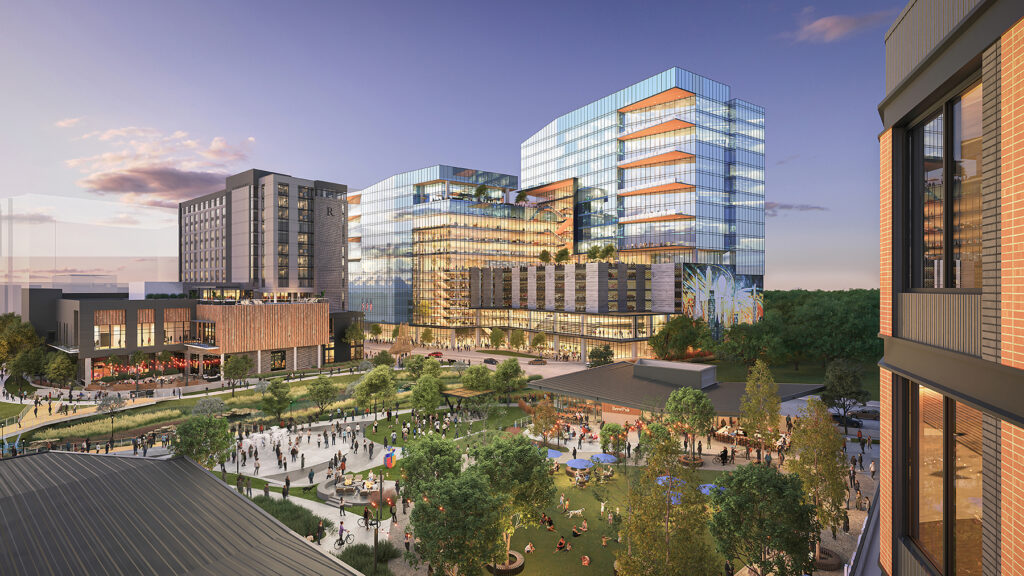
In a unanimous vote at a meeting of the RTP Owners and Tenants Association, companies and landowners across the 7,000-acre research campus approved a sweeping set of new development standards under the RTP 3.0 framework. For the first time in the park's nearly 70-year history, the approval clears the way for mixed-use and residential projects on land that has been governed by a single corporate-campus model since 1959.
The vote capped a five-year planning effort by the Research Triangle Foundation of North Carolina to chart what officials describe as a 50-year vision for the park. The Foundation's board subsequently ratified the measure, and starting Thursday, July 16, 2026, landowners will be able to formally apply to redevelop their properties under one of three new options: an enhanced corporate campus, a residential neighborhood development, or a mixed-use node. Owners can also continue operating under the traditional corporate campus model that has defined RTP for more than six decades.
The scale of the shift is significant. RTP has long limited building coverage to roughly 15 percent of a given site and capped heights at 120 feet, favoring the kind of low-density, tree-shielded office campuses built for commuting employees rather than nearby amenities.
About a fifth of the park's land (roughly 1,400 acres) is devoted to parking. The new standards loosen those constraints, reducing setback requirements and allowing greater density, though the residential option comes with its own limits: detached single-family homes won't be permitted, with townhouses serving as the lowest-density housing type allowed.
Travis Crayton, the Foundation's vice president of planning and public policy, has called RTP 3.0 the most significant modernization of the park's land-use framework since its founding, while also cautioning that the physical character of the park won't change overnight.
The approval follows groundwork laid when Wake County commissioners unanimously amended RTP's zoning rules in June 2025 to accommodate the new framework, and Durham's board followed suit that fall—a necessary step given that the park straddles both counties, though it sits predominantly in Durham. A Durham planning commissioner welcomed the change as a fix for zoning restrictions that had constrained investment and innovation in the park.
RTP 3.0 builds on an earlier phase of change, often referred to as RTP 2.0, which introduced Hub RTP, a walkable district that brought the park's first apartments, along with retail and coworking space through developments like Boxyard RTP and Frontier RTP. Additional Hub RTP projects. Hub RTP is expected to include roughly a million square feet of office and life-science space, tens of thousands of square feet of retail, more than a thousand residential units, hundreds of hotel rooms, and expanded green space.
"For decades, these 7,000 acres… were defined by a single-use corporate campus model. That model served RTP well, but the future demands more," said Scott Levitan, the Foundation's president and CEO, adding that the new standards are meant to "create spaces where people can work, live, collaborate and connect."
A signature piece of the broader RTP 3.0 vision is the proposed RTP Greenway, a 10-mile north-south trail corridor intended to link corporate campuses, mixed-use nodes and natural areas, building on the park's existing 20-mile trail network.
Gina Andersen, RTP's site engagement lead for Cisco and president of the RTP Owners & Tenants Association, pointed to the vote's unanimity as a signal of confidence in the plan.
"This unanimous vote reflects the strong alignment and shared confidence among RTP companies and landowners in the future of the Park," she said. "Every organization in RTP has different needs, and these updated standards provide the flexibility to thoughtfully evolve campuses over time."
Planners have also built the framework around future transit possibilities, including potential bus, bus rapid transit and rail connections, positioning the park for transit-oriented growth down the road.
The Triangle is among the fastest-growing metro areas in the country, with projections pointing to roughly a million new residents by 2050. RTP remains North America's largest research park, spanning an area roughly half the size of Manhattan and home to more than 385 companies and some 55,000 employees, with Fidelity Investments now holding the largest workforce and other major tenants including Cisco, Lenovo, and Eli Lilly.
The park has not been immune to disruption; however, IBM relocated most of its local workforce out of RTP last year.
The Greater Durham Chamber of Commerce and McAdams are hosting a "Reimagine the Park" lunch and learn session on August 13, aimed at RTP companies and members of the local development, design and real estate community.
