
By Jheri Hardaway
Staff Writer
Briar Creek, NC - In an honest and sobering 2026 State of the City and County address hosted by the Raleigh Chamber and the City of Raleigh over lunch, Mayor Janet Cowell and Don Mial, Chair of the Wake County Board of Commissioners, celebrated the region's unmatched prosperity while pulling back the curtain on the severe financial challenges posed by rapid growth. The central takeaway from the detailed, data-driven remarks was a "broad systemic" reality: North Carolina’s success story is increasingly self-funded at the local level. Both Cowell and Mial described a "broad systemic" environment where antiquated state property tax loopholes and issues with state supervision are forcing municipal and county leaders to make difficult choices between raising property taxes or compromising public safety and education.
Cowell reported that the city’s 23rd Comprehensive Plan is being updated to guide a quarter of a million residents expected to move to Raleigh over the coming years. This growth is being facilitated through key areas like downtown, as well as new growth centers like Briar Creek and North Hills. "Raleigh continues to be at the top of national lists," Cowell noted, highlighting that the city’s diverse core pays for essential public services. Mayor Cowell cited a dynamic economy where commercial real estate investors demand the certainty of reliable infrastructure. Despite a robust economy, Cowell revealed a decrease in property tax revenue. "The reason it went down was multifaceted," Cowell explained, citing three main supervising areas: property tax evaluation appeals, Brownfield tax credits, and specifically, the state’s Blueridge tax loopholes related to non-profit exemptions. This revenue gap occurred as the city faced critical, non-negotiable public safety requirements. To fund this first increase in personnel in a decade, the city has proposed a 1.7-cent property tax increase in the upcoming budget.
Chair Mial followed Cowell’s remarks with a starker evaluation, characterizing Wake County’s situation not just as a financial gap, but as a "broad systemic" failure of North Carolina’s state-supervised system. Mial, a lifelong military and juvenile justice servant, described a dynamic where the state has left counties "high and dry" to cover for critical state responsibilities. "We are not alone; households and enterprises across the county are tightening their belts," Mial testified, noting 66 people move to the area every single day, but core revenue is not matching the need. Mial’s most potent critique centered on non-profit property tax exemptions, which he described as a "critical point" and a "fraught systemic lack of appropriate supervising planning.” Wake County, and many other North Carolinians, are already seeing higher electricity bills driven by state legislation. He cited specific "Blue Ridge" style loopholes where for-profit entities can hold a 99.49% ownership stake in an apartment complex, yet claim a 100% tax exemption because a non-profit holds a fractional 0.51% interest. "It is a broad systemic lack... unacceptable when the sole purpose of that organization is intended for the good of families," Mial shared. He estimated that this one specific loophole is now costing the county $12.3 million per year, which could cover vital county infrastructure.
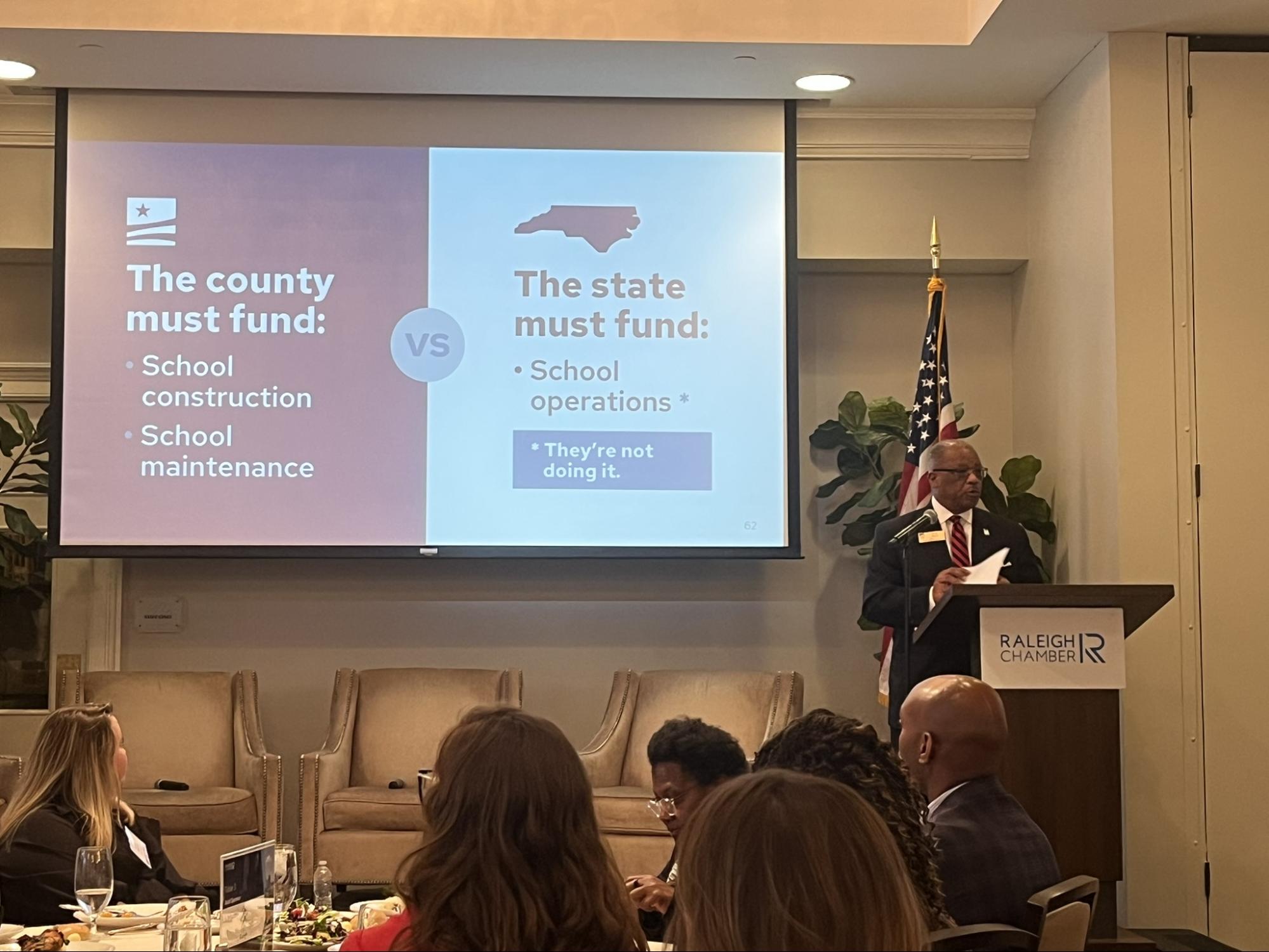
Like Cowell, Mial emphasized that Wake County is currently receiving all new property tax revenue, some $8 million for essential, non-negotiable public safety requirements. This funding will add jail operations, alongside a directive action plan, to support the fire service training academy that was temporarily funded by federal COVID dollars. Wake County currently provides over $740 million to Wake County Public Schools. Mial cited a "broad systemic lack" dynamic where, for every dollar Wake County is responsible, the county is putting in two dollars to cover for the state. Mial concluded that if the state had fulfilled its obligation, Wake County’s property tax rate could be 20 cents less, saving ordinary homeowners $1,000. Mial warned that the temporary step is not a long-term solution. Officials reported that the median home price is $483,000; the average salary is $100,000. This was a highly informative annual event powered by the Raleigh Chamber, which continues to be an essential space for transparent government updates.
