By: Jordan Meadows
Staff Writer
Mary Potter Academy, once a cornerstone of Black education and community life in Granville County, is entering a new chapter more than a century after it was founded.
The academy was established in 1889 by George Clayton Shaw, who served as principal until 1936. Shaw was born enslaved in Louisburg in 1863 and raised by a mother who, despite limited opportunity, received what he later described as a “fairly good education” and passed on a deep belief in the power of learning. All six of her children became educators.
Shaw graduated from Lincoln University in Pennsylvania in 1886 and went on to study at Princeton Theological Seminary before completing his education at Auburn Theological Seminary in New York in 1890. While in New York, Shaw met Mary Potter, secretary to the Presbyterian Freedmen’s Board and a leading supporter of educational opportunities for formerly enslaved people.
 With her backing, Shaw founded the first school for African Americans in Granville County, along with Timothy Darling Presbyterian Church in Oxford in 1888. The school, initially called Timothy Darling in honor of Shaw’s teacher, was funded by the Board of Missions for Freedmen, the New York Synodical Society, and the Albany Presbytery before taking the name Mary Potter Academy in 1892.
For decades, the academy operated as a private boarding school, educating generations of Black students from Oxford and beyond. By the 1950s, it transitioned into a public high school and continued in that role until 1969. Following the desegregation of Oxford schools in 1970, Mary Potter became an integrated middle school.
In a 1932 reflection, Shaw wrote proudly of the thousands of students who passed through the school, describing young people who arrived “crude” and left “refined, cultured, and polished,” prepared to serve their communities as they had been served. Roughly half of the school’s graduates were natives of Granville County, and many went on to become educators, professionals, and civic leaders. In recent years, local residents and alumni have worked to preserve that history by establishing the Mary Potter School Museum in Shaw’s former residence.
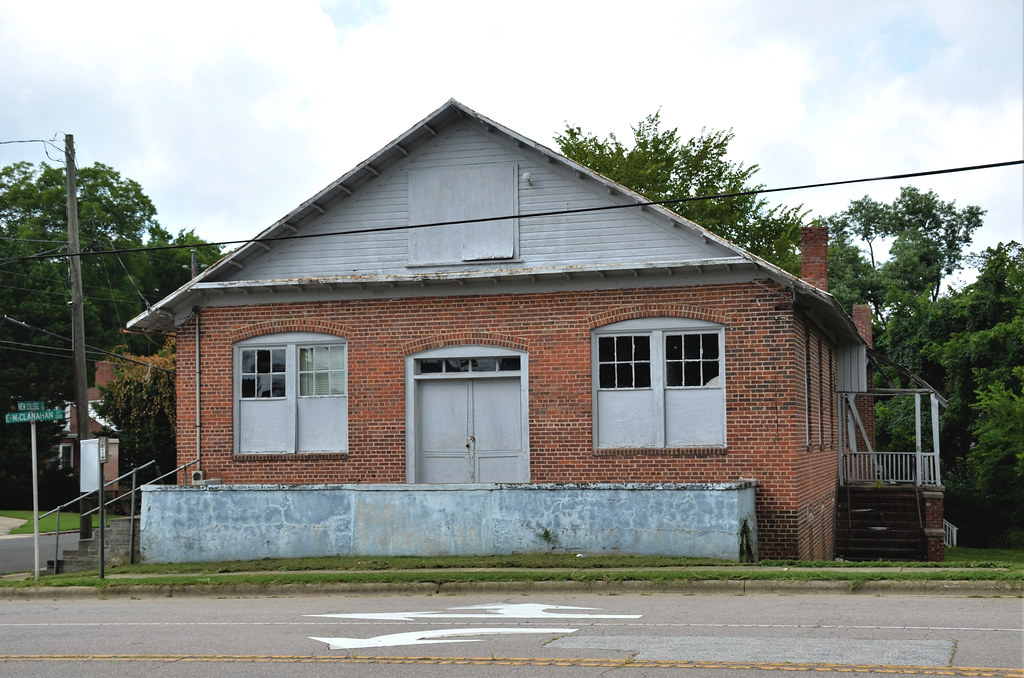
Once one of the largest landowners in downtown Oxford, the academy’s campus has steadily diminished. By the early 21st century, only three buildings remained: Shaw’s residence, restored in 2004; a 9,600-square-foot Industrial Arts Building that has sat vacant since the 1990s; and a similarly scaled gymnasium. Both the industrial arts and gym buildings were originally constructed by students themselves.
Now, Durham-based Evoke Studio Architecture is leading a project to reimagine those structures as the Mary Potter Cultural Complex, a flexible, multi-use campus intended to serve today’s Oxford community while honoring the academy’s mission.
Under the proposal, the former Industrial Arts Building will become a two-story conference center with meeting rooms, gallery space, and offices, including space for start-ups. A new interior stair will connect previously disconnected levels and allow daylight to reach the partially submerged lower floor. The former gymnasium will be transformed into the Mary E. Shaw Cultural Center, capable of hosting large gatherings and events beneath restored wood trusses.
Between the two buildings, an open-air pavilion will replace an aging wood structure that once housed the Oxford Farmers Market. The new steel-and-wood canopy will act as the campus hub, helping tie the site together and reinforcing its role as a gathering place. Across the complex, new canopies and additions will use a restrained palette of dark gray aluminum composite panels, wood insets, and glass, set deliberately against the original brick masonry.
During the Jim Crow and segregation eras, Mary Potter Academy functioned as the epicenter of Oxford’s Black community, bringing a strong Black middle class and serving as an incubator for leadership. Designers say the revitalized campus is intended to welcome multiple generations and races, creating space to gather, collaborate, and celebrate while keeping the academy’s memory alive.
The $3.5 million project is being developed for the National Mary Potter Club, with Evoke Studio Architecture serving as design architect alongside engineers from MMSA and Dewberry.
