By Jheri Hardaway
Staff Writer
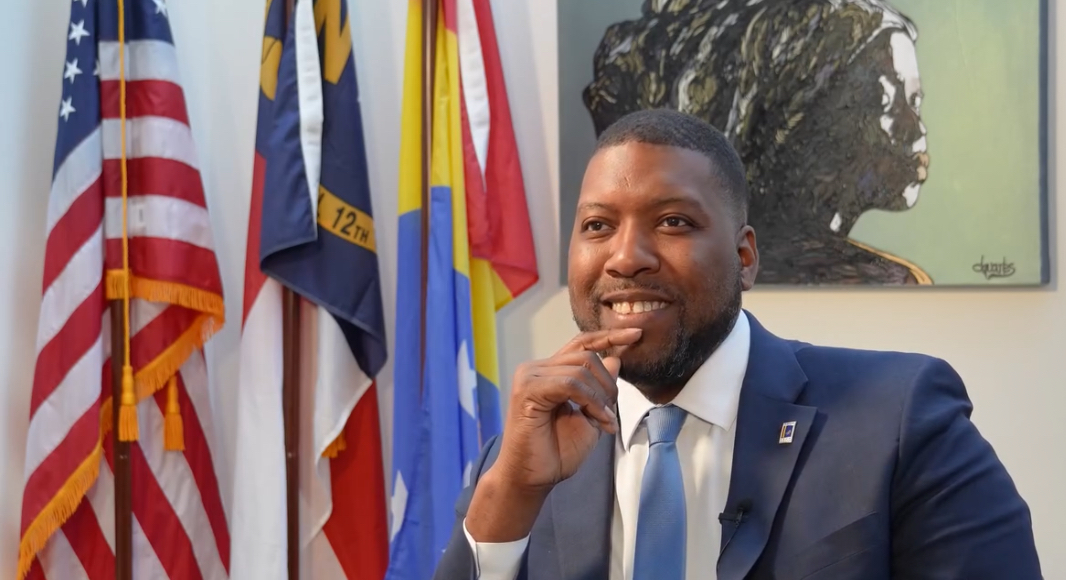
Durham, N.C. - Mayor Leonardo Williams is not interested in code-switching, I’m glad because we are exhausted. Recently the teacher of the year-turned, restaurateur-turned-politician, was asked by a reporter about a comment Williams had made at a town hall meeting. In a moment of candid frustration regarding youth violence, the Mayor had used the acronym "YN." For the uninitiated, it stands for "Young N*****." "She asked, 'Do you want to apologize?'" Williams recalled in a recent sit-down interview. "I said, 'I would not apologize. I’m not apologizing for that.'" For Williams, the controversy that followed—spanning from The Shade Room to local Facebook groups—missed the forest for the trees. While critics fixated on his vocabulary, they ignored the context: a room of 200 Black residents discussing the life-and-death reality of gun violence, broken homes, and children raising children.
"I’m very authentic," Williams said, shrugging off the backlash. "Why do we need to be politically correct? I am a leader who speaks the truth, and this is how I get in trouble a lot. And you know what? I don't give a damn." Williams, a former educator draws a sharp contrast between the survivalist activism of the past, referencing the resilience of his home Hobgood, N.C. after catastrophic flooding, to what he terms the "performative outrage" of today. "We have an ever-growing sense of amnesia," Williams said. He argues that modern local activism often looks backward rather than forward. "We can’t drive the car forward by only looking through the rearview mirror. When you get reckless, looking out the back window and pressing the gas, that is when you can't define what you want." "We know how to fight," Williams noted, "There’s this saying: 'People close to the pain need to be closer to the power.' Well, let them get close to the power and stop speaking for them."
Mayor Williams shared an important data snapshot on the racial wealth gap and housing disparities. To contextualize the Mayor's comments on the necessity of Black wealth generation please note the current Federal Reserve data which highlights the disparity:
* White Families: The median wealth is approximately $285,000.
* Black Families: The median wealth is approximately $44,900.
* Homeownership: In North Carolina, the White homeownership rate sits at roughly 76%, while the Black homeownership rate is approximately 48%. Mayor Williams advocates for wealth generation through entrepreneurship rather than what he views as the "government-incentivized poverty" of traditional public housing systems that lack an "on-ramp" back to economic independence.
One of the most lingering wounds in the greater Research Triangle Park area based politics would be the failure of the Light Rail Transit project. For years, the narrative has blamed Duke University for killing the project at the eleventh hour. Williams asserts that this narrative is false. "Duke was a representative voice," Williams explained. According to the Mayor, the project was effectively dead once the federal government shifted its focus away from light rail to passenger and commuter rail, rendering Durham ineligible for crucial funding. "We paid $154 million to consultants, and a shovel never hit the ground," Williams said.
Looking forward, Williams is concerned about the "sugar rush" of data centers flocking to North Carolina, arguing they drain energy and land while providing few long-term jobs. "They don't produce much in jobs nor sales tax," Williams said. He noted a critical shortage of skilled labor, stating, “The average electrician and plumber in North Carolina is between 65 and 70 years old.” Nationally, nearly 25% of the construction workforce is older than 55. A recent Bureau of Labor Statistics data shared only 6.7% of electricians in the U.S. are Black or African American, compared to 8.5% of the overall workforce, representing a significant opportunity for economic inclusion in these high-paying fields.
Ultimately, Mayor Williams’ vision for Durham is grounded in a specific economic equation: increasing sales tax revenue to relieve the burden on property owners. Currently, for every $5 Durham collects in property tax, it collects only $1 in sales tax. To fund big progressive ideas like fare-free buses and the HEART alternative response team Williams argues Durham needs visitors to foot the bill. "We lost $72 million in denied contracts because our convention center is too small," Williams revealed. "Locals will shop local about once a quarter... The visitors shop every night." For Williams, the path to a better Durham isn't found in performative protests or political correctness, but in hard economic numbers and the "Black excellence" that built the city in the first place invoking the spirit of the original Black Wall Street. "Nobody came to save them 120 years ago... we can’t be blind to our potential."
Editor’s Note (12/22/25): This article was updated on December 22, 2025, to correct factual details and clarify language. Revisions include corrections to place references, descriptive wording, and contextual framing. The substance of the reporting and the views expressed by the interview subject remain unchanged.

Our mayor wants visitors to buy things from Black businesses, and doesn’t want to fund public housing. Certainly sounds as if he’s looking for someone to save us besides him. That isn’t a set of policies that has worked, that’s Reganomics in action.