RALEIGH, N.C. — Try as some might to confine Black history to a month, there’s just too much to limit it to 28 days a year.
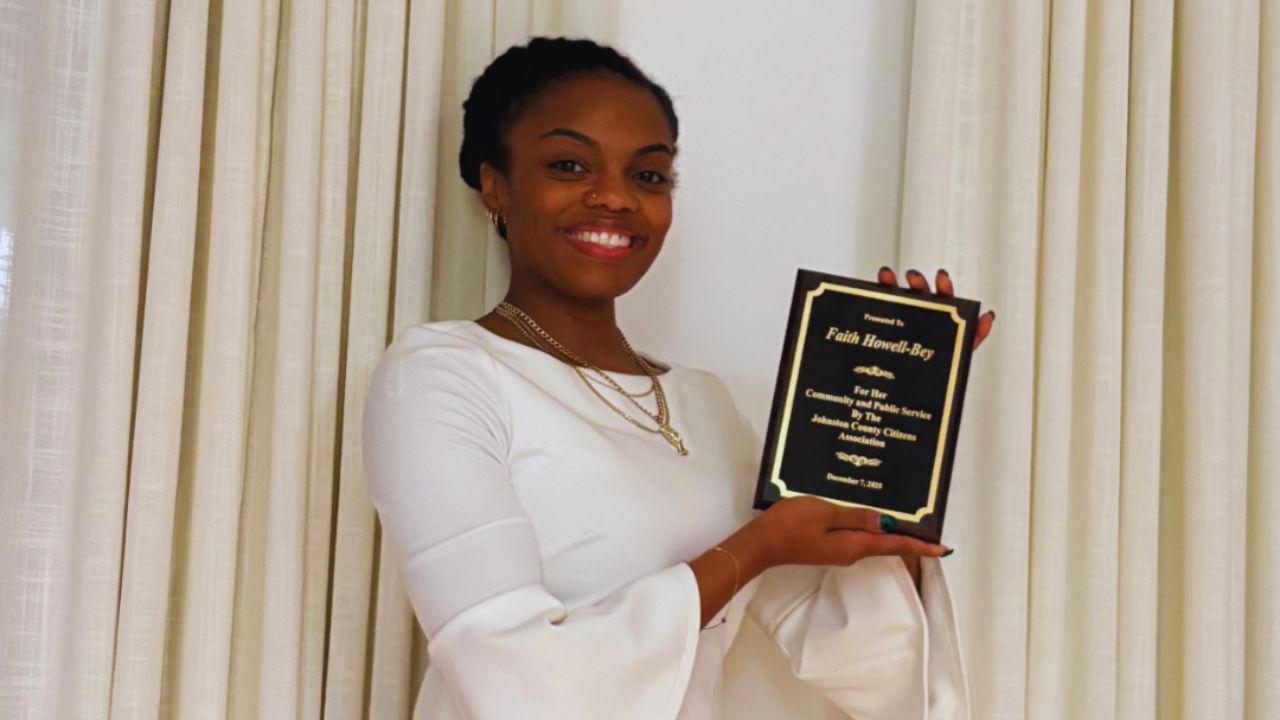
Faith Howell-Bey discovered similarly with Women’s History Month.
“When I first created Queens Table Brunch, it was envisioned as a one-time Women’s History Month event highlighting the work and legacy of Shaundrelle Watson. She’s the founder of The Brown & Black Cultural Exchange, a mentorship program in Selma, North Carolina, serving young Black and Brown girls in Johnston County,” Howell-Bey said.
Queens Table Brunch morphed into its own thing, a series dedicated to curating space where Black women can lean into their crowns. The way the gathering developed provides a patch in the quilt telling the story about why The Johnston County Citizens Association in early December recognized Howell-Bey for her public service.
“There are leaders who work hard, and then there are leaders who shift the very direction of community,” said Lamair Bryan, the Triangle area regional coordinator for Advance Carolina. “Faith is the kind of leader whose impact you don’t just see, you feel.”
Restoring Black women
The Rev. Yolanda Murphy pastors Smithfield’s St. Mark AME Church, which hosted a Queens Table Brunch in May. Her book, “Still Standing: Dealing with Grief, Loss & Sickness,” aligns with the personal restoration Howell-Bey cultivates during the brunches.
“Our culture has a problem with [people] keeping things to themselves,” Murphy said. “It’s those testimonies that help others to deal with certain situations.”
Brunch attendees like newly elected Anchor Lodge town council member Franky Echols said Howell-Bey has created a safe space to give and receive encouragement, and the professional networking is right on time.
Anchor Lodge is in Johnston County. Black people have not had the smoothest of roads in Johnston County, according to the history books. But Howell-Bey’s initiatives there, which include rallying voters to show up and cast ballots, have gotten traction.
“Johnston County is different because she has walked its streets, listened to its people and poured her spirit into their future,” Bryan said. “She sees a barrier and finds a path. She sees a problem and builds a solution. She sees her community struggling, and she shows up again and again, with creativity, resilience and that unmistakable fire that Black women carry when they know their work is transforming lives.”
‘Deep listening’
In other words, Howell-Bey understands her assignment — because she listens to the people.
“Based on the feedback I received from participants, I felt called to transform what began as a one-off gathering into something recurring,” Howell-Bey said. “I asked Black women how they experienced the space and what they needed, and, overwhelmingly, they shared a desire for a space like this to convene regularly.”
Howell-Bey — her background is in African American and diaspora studies, as well as psychology — said her work in Johnston County is rooted in centring the lived realities Black people face and how those experiences show up in their bodies and with each other.
“In my view, there are neighborhoods, there are communities, and then there are villages,” said Howell-Bey, 28. “Neighborhoods are defined by proximity, communities by connection and villages by shared responsibility and collective care. I am truly in the business of developing villages; environments that sustain themselves, empower and uplift one another and are grounded in the principles of Kwanzaa — unity, self-determination, collective work and responsibility, cooperative economics, purpose, creativity and faith. As I move forward with expanding Queens Table Brunch, I am excited to incorporate community days of action with each cohort.”
She understands the assignment.
“What moves me most about Faith is that when challenges show up, she doesn’t back away, she leans in,” Bryan said. “If we want a healthier democracy, if we want real change, we need young leaders like her.”
It’s just listening — seeing a need and meeting it, Howell-Bey explained.
“To see the fruits of my labor so quickly, and to continue building momentum, is a true testament to what happens when you lead with empathy, curiosity, deep listening and a commitment to building alongside the people this work is ultimately for,” she said.
