By: Jordan Meadows
Staff Writer
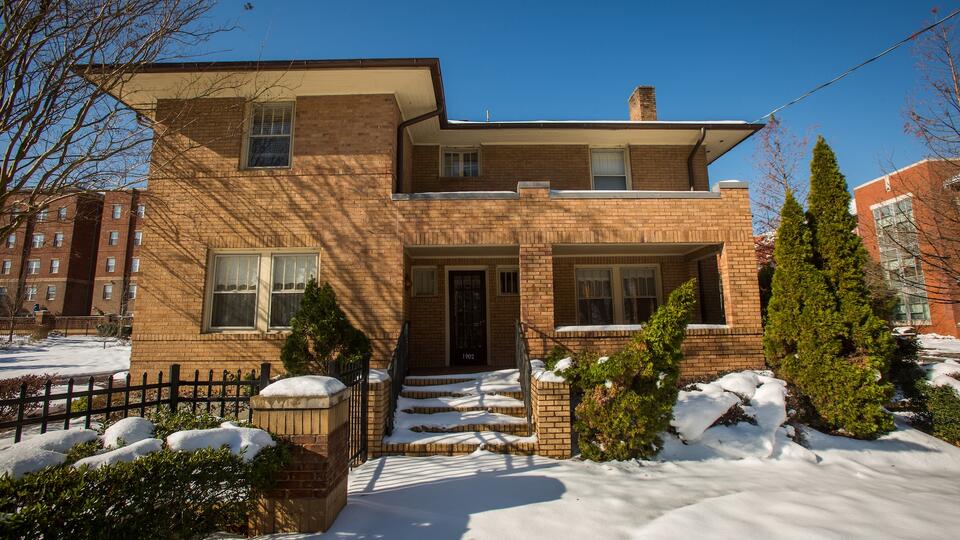
In 1925, a home rose on the corner of Fayetteville and Brant Streets in Durham, built for the founder of what would become one of the nation’s most important historically Black universities. One hundred years later, the Dr. James E. Shepard House at North Carolina Central University still stands.
The home was constructed for university founder and first president James E. Shepard and his family after the original president’s residence burned in 1923.
According to university archivist Andre Vann, the house itself was the result of a broad community effort.
“This home, which celebrates its centennial this year, came as a result of a gift and support from Dr. Shepard’s many friends,” Vann said. “Over the next two years they raised funds in both the Black community and white community to have this wonderful house built that stands today as an anchor of what we call Centennial Square.”
The residence, located at 1902 Fayetteville Street, is now the oldest house in the university’s property inventory and is listed on the National Register of Historic Places. The house contains more than 4,000 square feet and includes a main entryway, parlor, dining room, den, two sun porches, four upstairs bedrooms and a basement. Vann noted that the den was Shepard’s favorite room, while the home’s distinctive architecture includes many horizontal design lines inspired by plans associated with famed designer Frank Lloyd Wright.
Beyond its architectural features, the Shepard House played a central role in campus life during the early decades of the university.
“The James Shepard House was a very important and focal point for life here on this campus,” Vann said. “Not only as the home for Dr. Shepard but also for many guests who would come to speak in the B.N. Duke Auditorium.” Among the prominent figures hosted at the home were renowned intellectuals such as W. E. B. Du Bois and Benjamin E. Mays.
The home also served as a gathering place during an era defined by segregation in the South. Vann recalled a historic moment when Eleanor Roosevelt visited the campus and was entertained at the house by university leadership.
“While Jim Crow law was on the books, the university was able to offer opportunities for whites and Blacks to sit together and talk and communicate over food,” Vann said.
Shepard himself, in 1910, founded the National Religious Training School and Chautauqua for the Colored Race, the institution that eventually became North Carolina Central University—the first state-supported liberal arts college for Black students in the nation. An educator, pharmacist, businessman and civil servant, Shepard was also one of the first investors in North Carolina Mutual Life Insurance Company and helped incorporate Mechanics and Farmers Bank, both key institutions of Durham’s historic Black Wall Street.
The Shepard House remained a presidential residence for decades. After Shepard’s death in 1947, the State of North Carolina purchased the home in 1949, and it continued to house university presidents and chancellors until 1974. Leaders including presidents Alfonso Elder and Albert N. Whiting lived there during their tenures. In later years, the building nearly disappeared.
“This house had almost faced demolition on three different occasions,” Vann said. “Each and every time it was alums working with the leaders of the institution who talked about the importance and the need of preserving such a structure.”
Preservation eventually gained momentum under Chancellor Julius L. Chambers and later Chancellor James Ammons. The restoration effort culminated in a major renovation completed in 2004, funded in part by more than $340,000 from the National Park Service along with private donations and alumni support. The project also benefited from the work of renowned Durham architect Phil Freelon, who helped stabilize and preserve portions of the house, including a breakfast nook that had nearly collapsed.
Today, the Shepard House serves as a museum and cultural site featuring exhibits on Shepard’s life and the early history of the university. The interior has been recreated in a 1940s style based on photographs and interviews with Shepard’s descendants and community members. Furnishings include Tiffany-style lamps, period furniture and a player baby grand piano, giving visitors a glimpse of the home as it would have appeared during the height of Shepard’s leadership before his death in 1947.
The home now anchors the university’s Centennial Square, alongside Centennial Gardens and Centennial Chapel, which was dedicated during the school’s 2010 centennial celebration.
“This house serves as a very important anchor for the university, a look at our historical past but also a great opportunity to prospect going forward,” Vann said. “It allows people to feel the spirit of Dr. Shepard and understand the important function of a house like this to the history of North Carolina Central University.”
