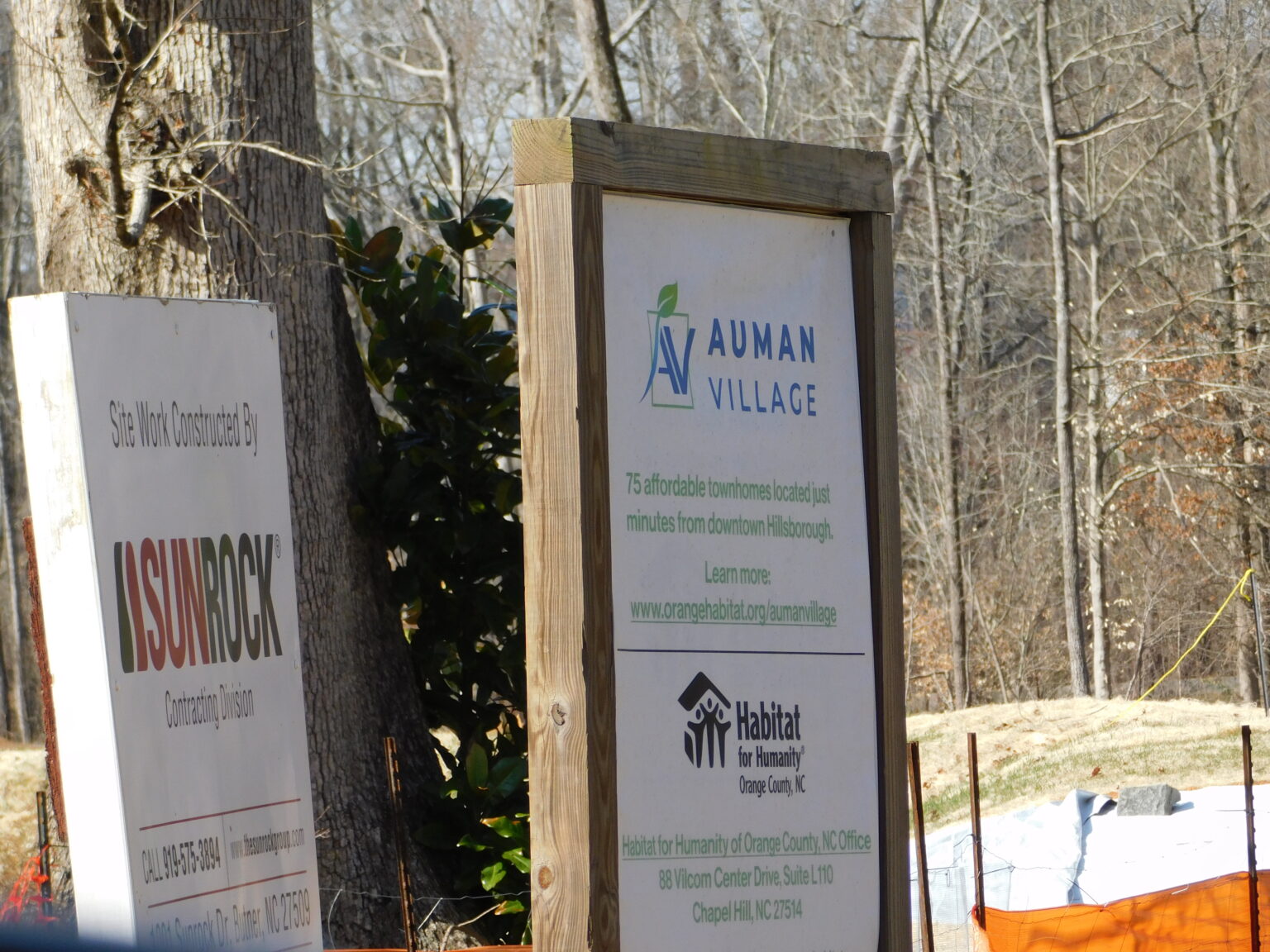
NC Newsline – Longtime affordable housing allies in Orange County are at odds over a 75-unit townhouse development in Hillsborough that one side contends prices out low- and modest-income African American families.
The disagreement pits Habitat For Humanity of Orange County against four pastors — including two from influential, predominately white churches in Chapel Hill — who are concerned about Habitat’s decision to require a $61,100 minimum income to be eligible to purchase one of 75 townhomes planned for Auman Village.
The pastors said Habitat’s decision has put them in an “awkward position.”
“For many years our churches have been enthusiastic supporters of Habitat for Humanity, but as faith leaders we cannot support Habitat’s current plans for a new housing development in Hillsborough,” they wrote in an op-ed published by Chapelboro.com.
The area median income for Black households in Orange County is $52,121, according to the U.S. Census Bureau’s American Community Survey. That’s dramatically lower — $46,847 — than the $98,968 area median income for white households.
The census data is a five-year look at median income for Black and white households in Orange County. The five-year surveys are considered more reliable for small geographic areas and small population subgroups.
The pastors said a $61,100 minimum income requirement would price many Black households out of an opportunity to own one of the townhomes. The overall median household income in Orange County is $90,089, according to the U.S. Census.
“This won’t be a problem for most white families in Orange County,” the pastors wrote. “But there is a large income gap between white and Black families in our area.”
Jennifer Player, president and CEO of Habitat Orange, told NC Newsline the $61,100 is a placeholder and could change by the time Auman Village is completed.
The final number will depend on how much additional funding the nonprofit can raise via local government, grants and private philanthropy before the townhomes are completed, she said.
“We start out with kind of the worst case scenario,” Player said. “This [$61,100] is what we’re really looking at if we don’t bring in additional sources of revenue into the project.”
Player said that Habitat organizations across the state and nation are facing financial pressures in the wake of higher land costs and construction costs, which have made it more difficult to serve people earning 30% of area median income. She said the cost to build a home in Orange County has risen 40% to 50% since the pandemic.
“The problem is that our sources of funding have not increased,” Player said.
Habitat also wants to set homebuyers up for long-term financial success, Player said.
“The last thing that we want to do is sell a home to someone who maybe is not ready for that responsibility, ready for HOA dues or property taxes, and saving for long-term maintenance needs on the home,” Player said.
Fifteen of the townhomes are designated as “workforce housing” for households with incomes higher than a traditional Habitat homeowner. Those homes will be sold to families earning 80-120% of the area median income or an income of roughly $85,000 to $125,000 per year for a family of four.
Rev. Tony Boss, pastor of Piney Grove Missionary Baptist Church and one of the pastors who wrote the op-ed, asked Habitat to set aside at least six townhomes for low-wage earners making 30% of area median income, or roughly $33,000 a year.
Boss’ church is about a mile from the Auman Village site, which is currently being cleared for construction. He initially asked for homes to be set aside for members of his congregation, but now says all African Americans with modest incomes should have a chance to buy homes in Auman Village.
“I should have been looking out for all African Americans that live in Orange County,” Boss said.
In addition to Boss, Rev. Cameron Barr of the United Church of Chapel Hill, Rev. Dr. George Crews III of Lattisville Grove Baptist Church in Hurdle Mills, and Rev. Jarrett McLaughlin United Presbyterian Church in Chapel Hill, signed the op-ed. Barr, Boss and Crews are members of the Orange County Justice United strategy team. The coalition of 23 congregations and community groups across Orange County work on affordable housing issues, among others.
McLaughlin told NC Newsline that he’s worried that affordable housing is now out of reach for residents earning 30% of area median household income. High rents and high property taxes are making it increasingly difficult for residents of modest means, he said.
“I think Orange County likes being a diverse county, but sometimes you have to actually be intentional to keep it that way,” McLaughlin said.
“I want Rev. Boss’s church to be part of Orange County and I want the congregation [at Piney Grove Missionary Baptist Church] to be part of Orange County,” McLaughlin said. “I feel like that’s slipping away, if even affordable housing is out of their reach.”
The pastors have offered to raise money to offset construction costs to make it feasible for families earning 30% of area median income to buy at least some homes in Auman Village, McLaughlin said.
Player, the Habitat president and CEO, said the nonprofit would welcome such assistance on the Auman Village project.
“If they have additional sources of funding that they can bring in to help subsidize those costs, that would be incredible,” Player said. “We’re happy and would love to partner with them on that.”
Meanwhile, the pastors hope for more clarity Saturday after Habitat’s Board of Directors meets.
Player said she expects that to happen.
“By the end of the day [Saturday], our goal is that we’ll be able to come out with a really strong counterproposal to go back to the clergy,” Player said.
