By Jordan Meadows
Staff Writer
Frank S. Greene Jr. stands as one of Silicon Valley’s quiet architects, an engineer whose work on early semiconductor memory chips helped accelerate modern computing.
Born in Washington, D.C., and raised in St. Louis during an era of racial segregation, Greene showed an early talent for math and science. Encouraged by his parents to pursue education despite systemic barriers, he became one of the first black students to attend Washington University in St. Louis, earning a bachelor’s degree in electrical engineering in 1961. He continued to Purdue University, completing a master’s degree in 1962, and later earned a Ph.D. in electrical engineering from Santa Clara University in 1970.
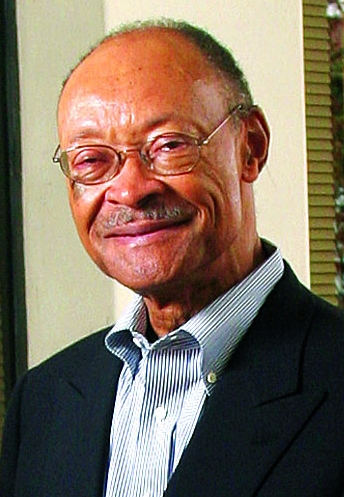 Greene’s early career placed him at the intersection of national security and cutting-edge technology. As an electronics officer in the United States Air Force, he became the first African-American cadet to graduate from the Air Force ROTC program and rose to the rank of captain. During his service, he worked on high-performance computers for the National Security Agency; systems that demanded speed, reliability, and innovation at a time when computing power was scarce and expensive.
Greene’s most influential technical contribution came during his time at Fairchild Semiconductor in the mid-1960s. Fairchild was a birthplace of Silicon Valley innovation, and Greene was part of a team developing high-speed semiconductor memory systems. Their work led to a patented memory chip design that achieved the fastest speeds of its time.
This breakthrough mattered because memory speed is foundational to computing performance. Faster memory allows processors to access data more quickly, enabling complex calculations, real-time decision-making, and scalable systems. While today’s AI accelerators and GPUs are vastly more powerful, they still rely on the same core principle Greene helped advance: reducing the distance between data and computation. In many ways, Greene’s work anticipated modern challenges in AI hardware. Today’s chip designers focus on memory bandwidth, latency, and energy efficiency to support machine learning models with billions of parameters.
In 1971, Greene became the founding CEO of Technology Development Corporation (TDC), a research and development firm that provided engineering services to the U.S. government. TDC grew from four employees to more than 300, contributing to major projects such as avionics for the F-16 Fighting Falcon, systems for the space shuttle program, and even underwater communication systems for scuba divers.
In 1985, Greene founded ZeroOne Systems, a supercomputing systems company that reached $15 million in annual revenue within two years. In 1993, he founded New Vista Capital, one of the first venture capital firms dedicated to supporting startups led by women and people from marginalized communities.
Greene taught electrical engineering and computer science at institutions including Stanford University, Santa Clara University, Howard University, and Washington University in St. Louis. He also became the first African-American trustee at Santa Clara University, helping influence institutional leadership from within.
His commitment to the next generation is embodied in the Dr. Frank S. Greene Jr. Scholars Program, a K–12 STEM initiative supporting African-American students. With hands-on science fairs, engineering competitions, mentoring, and parent engagement, the program has achieved remarkable success. Greene also supported scholarships honoring his wife, Phyllis Greene, and founded initiatives aimed at building vision, relationships, and execution in young leaders.
