By Jordan Meadows
Staff Writer
Last Wednesday, North Carolina House lawmakers opened the new legislative year with a contentious first meeting of the House Select Committee on Government Efficiency, focusing heavily on DEI policies in Asheville, Buncombe County and the City of Raleigh.
Much of the scrutiny centered on allegations that local governments and publicly funded programs have unlawfully prioritized race and gender in violation of federal and state civil rights laws.
Asheville attorney Ruth Smith delivered an extended presentation to the committee, arguing that several policies and programs in Buncombe County and Asheville violate the 14th Amendment, Article I, Section 19 of the North Carolina Constitution, and Title VI of the 1964 Civil Rights Act.
Smith cited decades of Supreme Court precedent, noting that nearly every affirmative action case outside of higher education has failed strict scrutiny under equal protection laws, culminating in the U.S. Supreme Court’s 2023 ruling striking down race-based college admissions policies. She also referenced Ames v. Ohio, a unanimous decision affirming an individual’s right not to be discriminated against on the basis of race.
A major focus of Smith’s testimony involved disaster relief funding following Hurricane Helene. She alleged that Buncombe County repurposed federal relief funds and prioritized recipients based on race and gender.
Asheville initially proposed prioritizing minority- and women-owned businesses in its plan to distribute $225 million in Community Development Block Grant–Disaster Recovery funds. The U.S. Department of Housing and Urban Development rejected that plan, citing violations of a presidential executive order banning DEI criteria. After removing the prioritization language, the revised plan was approved by Asheville City Council in April 2025 and by HUD in May 2025.
Smith also highlighted education and internship programs she said improperly exclude certain racial groups. One example was the Medical Mentorship Program run by the Mountain Area Health Education Center (MAHEC), which offers a semester-long shadowing experience for high school seniors interested in medicine. Eligibility criteria limit applicants to Black, Indigenous, People of Color, and underrepresented Asian communities, excluding white students and prevalent Asian ethnicities such as Chinese, Indian and Korean students. A watchdog group, WNC Citizens for Equality, filed two federal civil rights complaints this week alleging the program continues to use discriminatory criteria despite recent changes.
Additional examples included the City of Asheville’s 2021 creation of race-specific scholarships using proceeds from a water fee class-action settlement. Funds were directed to scholarships for Black students and BIPOC educators through the Asheville City Schools Foundation, prompting a legal challenge from Judicial Watch.
Smith also referenced litigation involving Asheville’s Human Relations Commission, where white applicants were allegedly required to demonstrate additional “plus factors”—such as sexual orientation, disability or housing status—to qualify, while non-white applicants were not.
The Asheville City Council voted in August 2025 to eliminate all race-based preferences for commission appointments, and a federal judge later ordered the city to pay more than $81,000 in legal fees to the plaintiffs.
Lawmakers also raised concerns about the Asheville-Buncombe Community Reparations Commission, which received $7.7 million in funding and spent nearly $5 million on consultants, outreach and media efforts.
No representatives from Asheville or Buncombe County testified at Wednesday’s meeting, though lawmakers said they were open to hearing from local officials in the future.
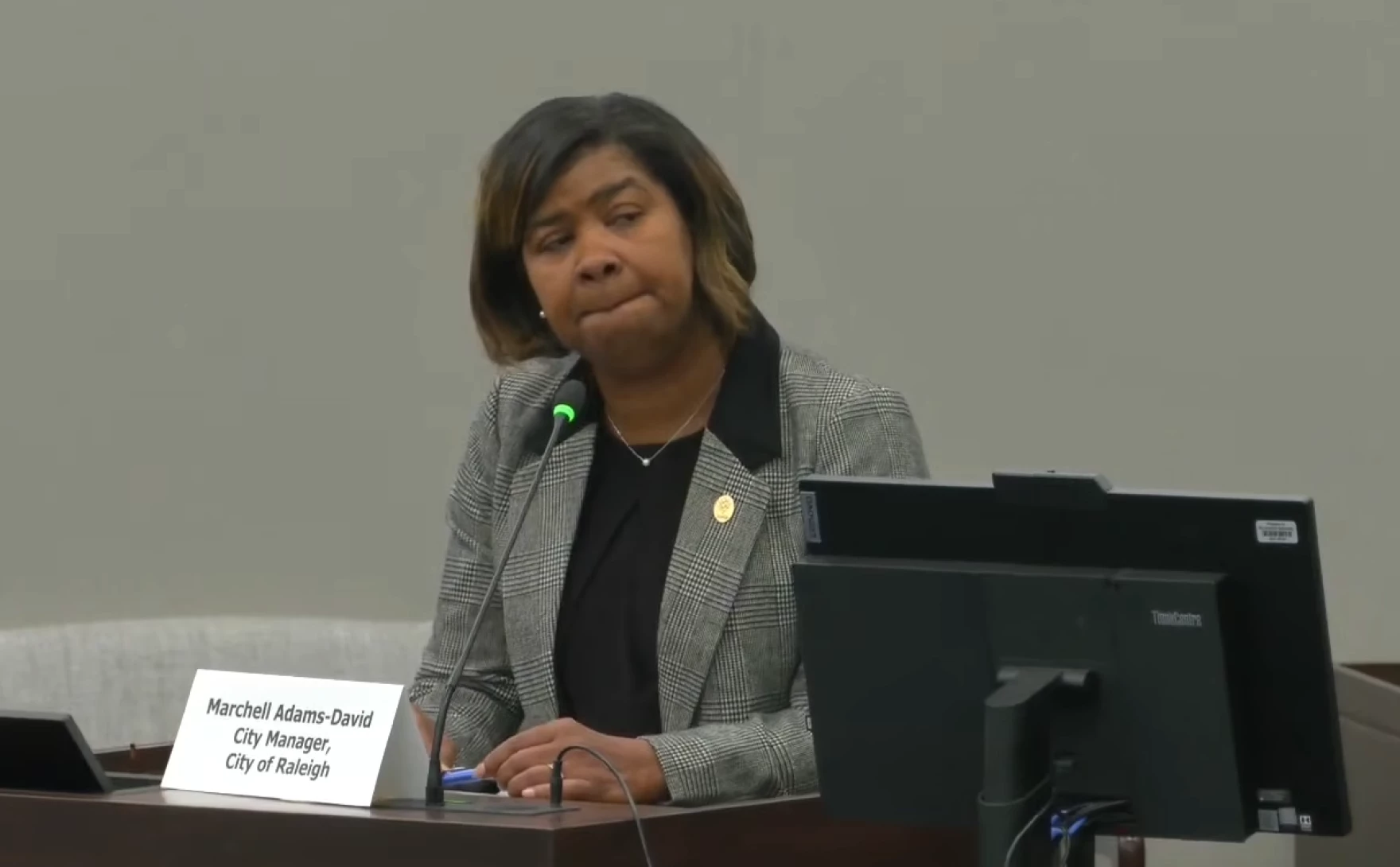
The committee also heard testimony from Raleigh Mayor Janet Cowell and City Manager Marchell Adams-David following an undercover video released by the conservative group Accuracy in Media. The video, recorded in February and released in October, appeared to show a city employee referring to a department as a “champion for DEI,” prompting allegations that Raleigh violated a federal ban on DEI programs.
Adams-David told lawmakers the video was misleading and edited out of context, noting the city was still reviewing President Donald Trump’s January 2025 executive order banning DEI in federally funded programs at the time of filming. She said Raleigh has since suspended equity training initiatives, restructured departments, and renamed its Department of Equity and Inclusion as the Department of Economic and Social Advancement to comply with federal law.
Legislators asked few follow-up questions, and no immediate action was announced. The Republican-controlled General Assembly has passed multiple measures in recent years restricting DEI initiatives in schools, universities and state governments, arguing such programs constitute unlawful racial preferences.
The committee is expected to continue reviewing DEI-related practices across state and local governments, including within the UNC System and municipalities like Asheville and Raleigh, in future meetings.
