By Jordan Meadows
Staff Writer
When the United States entered the First World War in April 1917, it proclaimed itself a defender of democracy abroad. At home, however, the pressures of war exposed and intensified long-standing racial and economic injustices. Nowhere was this contradiction more violently revealed than in the racial riots and massacres that erupted during the summer of 1917—most notably in East St. Louis, Illinois, and later in Houston, Texas.
World War I reshaped the American labor market almost overnight. As millions of men were drafted or enlisted into military service, industrial employers in northern cities faced severe labor shortages. At the same time, European immigration slowed dramatically due to the war. To fill the gap, industries increasingly turned to Black American labor.
This demand coincided with the Great Migration, during which Black Americans fled the rural South in search of industrial jobs, education, and freedom from lynching and Jim Crow laws. Cities such as the industrial hub of East St. Louis, Illinois, became major destinations. By the spring of 1917, as many as 2,000 Black migrants were arriving in St. Louis each week.
White workers—many of them European immigrants themselves—often viewed these newcomers with hostility. Competition for jobs and housing, combined with racist fears that Black workers would accept lower wages, fueled resentment. Employers frequently worsened tensions by hiring Black workers as strikebreakers, while white unions attempted to exclude Black labor altogether. Economic competition thus became racialized, with Black workers blamed for conditions they did not create.
Beginning in late May 1917 and culminating in early July, white mobs launched a campaign of terror against the city’s Black residents. On May 28, after a meeting fueled by labor grievances and racist rhetoric, between 1,000 and 3,000 white men marched through downtown East St. Louis, attacking Black Americans in the streets and on streetcars and burning buildings. A state labor investigation later blamed Black migrants themselves, claiming they had been “misled” into coming to the city by unscrupulous labor agents.
The deadliest violence occurred on July 1–2, 1917. On July 1, a Black Ford Model T occupied by white men drove through a Black neighborhood, firing shots into a crowd. When another car passed through the area an hour later—carrying two white police detectives and a journalist—Black residents, believing they were under attack again, opened fire. One officer was killed instantly, another mortally wounded.
The following day, thousands of white spectators gathered to view the bloodstained police car. The crowd soon turned into a mob, which surged into Black neighborhoods south and west of downtown. What followed was a massacre. White rioters beat, shot, lynched, and burned Black residents, including women and children. Fire hoses were deliberately cut so entire neighborhoods could be destroyed, and people fleeing the flames were shot as they ran. Some whites openly called for lynchings, claiming Black people “deserved” such punishment.
A reporter for the St. Louis Post-Dispatch wrote that “black skin was a death warrant.” Impartial witnesses overwhelmingly agreed that police and National Guard units were indifferent or inactive, if not openly encouraging the violence. The failure of authorities to intervene allowed the killings to continue unchecked. Estimates of the death toll varied widely. Police officials suggested about 100 Black Americans were killed, while journalist Ida B. Wells reported between 40 and 150 deaths. The NAACP estimated as many as 200.
Approximately 6,000 Black residents were left homeless, and property damage reached $400,000—nearly $10 million in today’s dollars. When schools reopened that fall, Black enrollment had dropped by 35 percent.
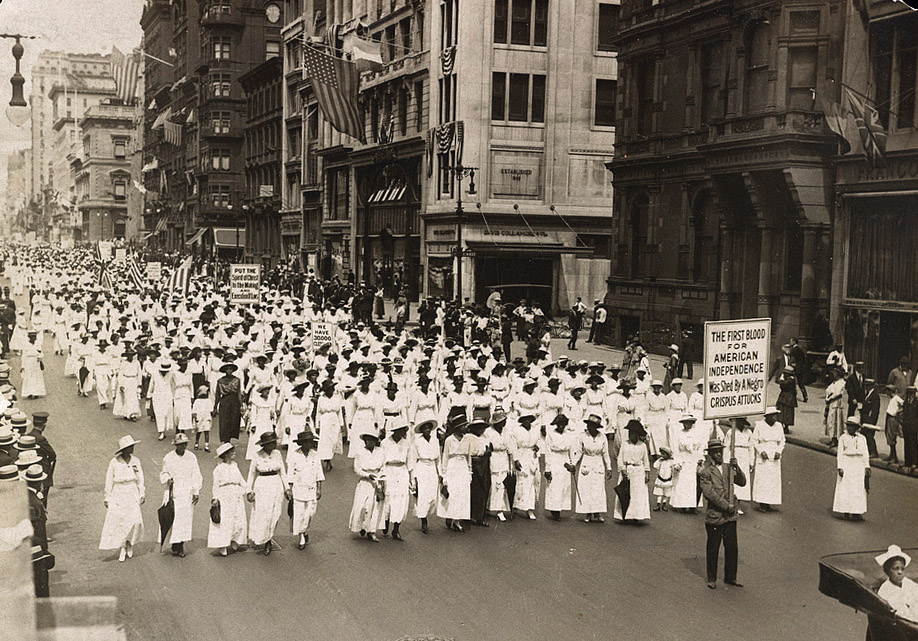
The massacre drew national attention. At the end of July 1917, 10,000 Black Americans marched silently down Fifth Avenue in New York City to protest lynching and racial violence. Former President Theodore Roosevelt denounced the massacre as “an appalling outbreak of savagery,” rejecting attempts to excuse the violence as an inevitable result of labor competition. W. E. B. Du Bois praised Roosevelt’s stance, particularly as President Woodrow Wilson remained silent for a full year.
Black nationalist leader Marcus Garvey went further, calling the massacre proof of America’s hypocrisy. While condemning German abuses abroad, the United States, he argued, permitted “one of the bloodiest outrages against mankind” at home. For many Black Americans, East St. Louis shattered any illusion that wartime rhetoric about democracy applied equally to them.
Just weeks later, another eruption of racial violence involving Black soldiers in uniform occurred. In August 1917, members of the all-Black 24th Infantry Regiment were stationed at Camp Logan near Houston, Texas, to guard wartime construction. Their presence in a rigidly segregated city governed by Jim Crow laws immediately heightened tensions.
Black soldiers endured racist taunts, segregated facilities, and repeated assaults by the all-white Houston Police Department. The breaking point came on August 23, when police arrested and assaulted a Black woman and then brutally beat and arrested a Black soldier who questioned the arrest. When Corporal Charles Baltimore, a military police officer, attempted to investigate, he too was beaten and shot.
Rumors spread through the camp that Baltimore had been killed and that a white mob was approaching. Fearing for their lives, 156 soldiers armed themselves and marched toward Houston. In the chaos that followed, they killed eleven civilians and five policemen.
In the largest murder trial in U.S. history, 118 soldiers were tried in three courts-martial. A total of 110 were convicted; 19 were executed and 63 were sentenced to life in prison. No white civilians were prosecuted, and two white officers charged were released. Decades later, in November 2023, the U.S. Army formally set aside all convictions, acknowledging that the soldiers had not received fair trials due to racism.
President Wilson portrayed Germany as the foremost violator of human rights and cast American intervention as a noble crusade against tyranny. Yet the unchecked racial terror of 1917 exposed the illusory nature of this moral argument. The war magnified racial divisions and radicalized Black political thought, forcing many Black Americans to confront the reality that their greatest oppressor was not overseas.
