
By Jordan Meadows
Staff Writer
Opened in 2001, the Oliver Nestus Freeman Round House Museum stands as one of eastern North Carolina’s most distinctive historic landmarks, and as a tribute to the life and craftsmanship of Oliver Nestus Freeman.
Born in 1882 as the son of a former slave, Oliver Nestus Freeman like many other African-Americans in Wilson, NC found few opportunities. Educated at the Tuskegee Normal School in Alabama, Freeman returned to Wilson and helped construct a number of houses to help alleviate the shortage of housing for soldiers returning from World War II.
Freeman's contributions to Wilson's architecture and affordable housing efforts were recognized by the naming of Wilson's first housing redevelopment project—Freeman Place.
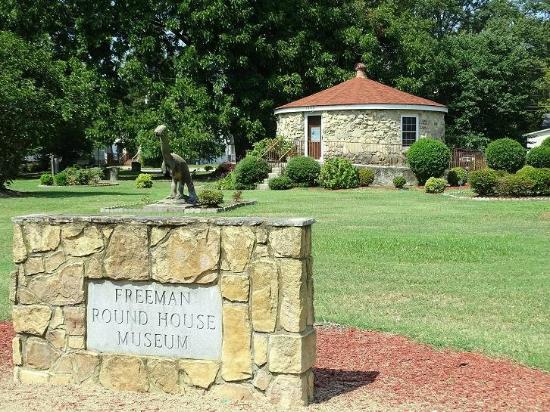
The museum’s mission is to “preserve, promote and present African-American history, art and culture to all citizens of Wilson and the region in order to increase the awareness, understanding and appreciation of cultural traditions and African-American contributions to society.” Fittingly, it operates inside Freeman’s most unusual creation: a circular stone dwelling known locally as the Freeman Round House.
 Freeman formed friendships with prominent leaders including Booker T. Washington and George Washington Carver. Around 1910, he settled in Wilson, where Freeman built a modest brick house at 1300 East Nash Street, a home that remained in the family for generations and served as the starting point for a lifetime of craftsmanship.
Freeman identified himself in the 1910 and 1920 censuses as a brickmason, but his skills extended well beyond brickwork. Over the next four decades, he became Wilson’s preeminent brick and stonemason, working in brick, stone and tile. His bold, rough stone foundations, chimneys and columns became a defining feature of many of the city’s early 20th-century bungalows. He also created imaginative masonry garden sculptures that still dot local landscapes.
His most famous works, however, were those he built for himself. In the 1920s, he transformed his original brick cottage into a striking stone bungalow, adding textured masonry details and handcrafted elements that showcased his creativity. On the same property, he constructed a nearby rental dwelling to help address housing shortages.
In the 1940s, Freeman completed what would become his signature project: the Freeman Round House. Built of rough stone and featuring a circular plan divided into wedge-shaped rooms, the house is locally unique. Over time, he added concrete and stone garden sculptures to the grounds, including a whimsical 7-foot dinosaur that remains one of the property’s most memorable features.
Freeman’s work also extended beyond private homes. After World War II, he helped construct houses to alleviate shortages for returning soldiers. His contributions to affordable housing and to Wilson’s architectural landscape were later recognized when the city named its first housing redevelopment project Freeman Place in his honor.
Oliver Nestus Freeman died Sept. 28, 1955, leaving behind a built legacy that blended skill, artistry and service. Decades later, community leaders preserved the Round House as a museum so that his work would not be forgotten.
