
WUNC - The Eastern Band of Cherokee Indians is scheduled to formally break ground next week on North Carolina's first tribal national veterans cemetery.
The Department of Veterans Affairs awarded a $3.7 million grant to the project this year and officially recognized it as a national cemetery. But even before that, the tribe had bought the site in the Wolftown community and began burying its veterans there — 13 so far.
"What this grant allows us to do is we become the 15th National Tribal Veterans Cemetery in the United States, which is a great honor,” said Gerard Ball, program director for the tribe’s Department of Military and Veterans Affairs.
The Eastern Band of the Cherokee Indians Burgess-Oocumma National Tribal Veterans Cemetery is named after two members of the tribe who were killed while fighting in the Vietnam War.
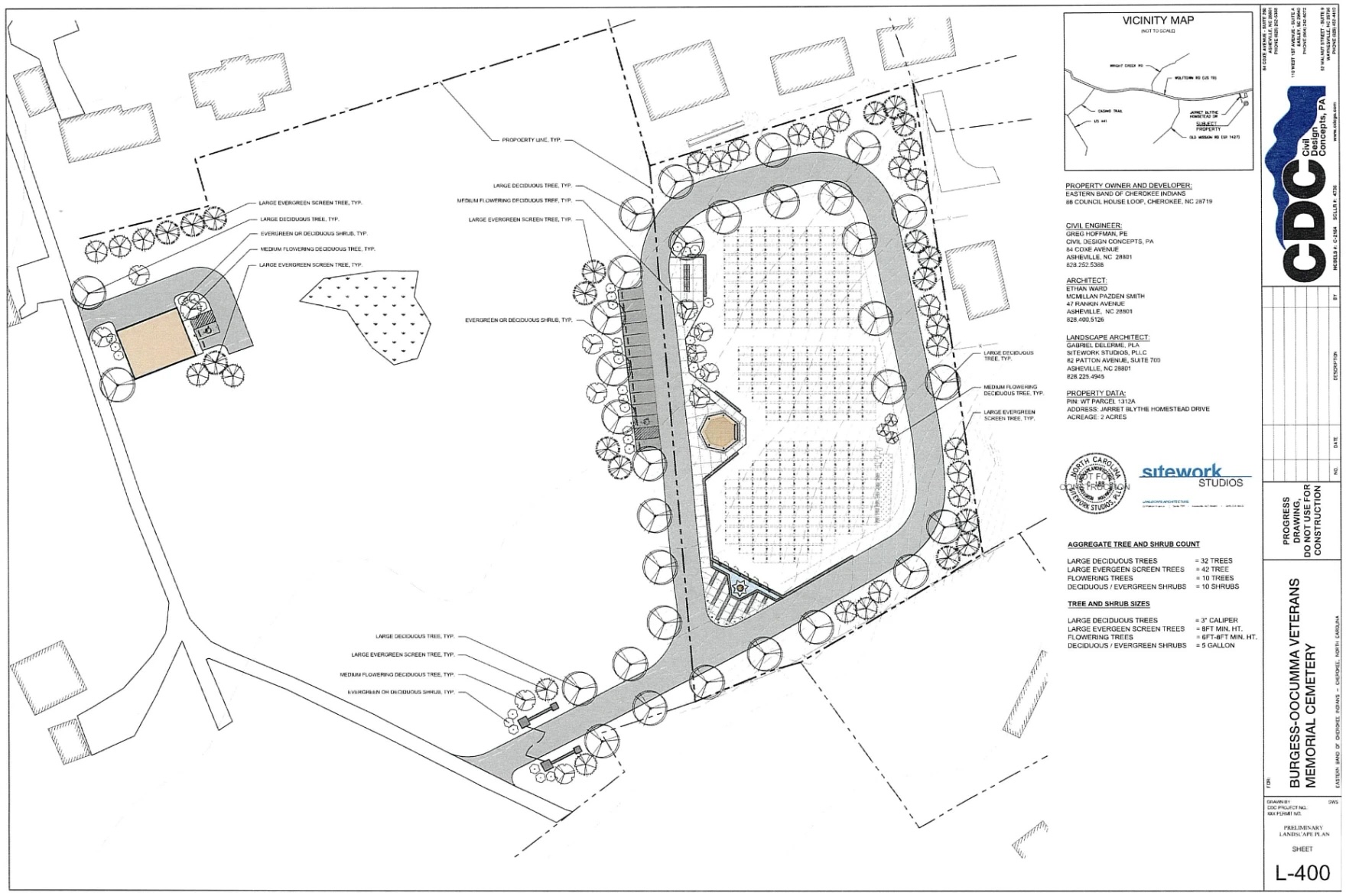
It's designed to have 250 in-ground burial sites and 190 columbarium spaces for members of federally recognized tribes and eligible family members.
To qualify as a national cemetery, it had to meet various government standards, but Ball said key parts of the design were developed with the tribe’s culture and heritage front of mind. It will have water and fire features, which are a tie to the Cherokee use of water and fire in sacred ceremonies. The building that will house ceremonies will have seven sides because that number is sacred to the tribe.
The site is now just a field, but it will be landscaped with trees and shrubs native to the lands the Cherokee roamed across the Southeast.
"So everything in it is done in the Cherokee way, the graves face to the east, so the sun rises on our veterans and sunsets to their backs," Ball said.
Signage will be in both English and Cherokee, he said.
Even tribal members who died in wars and were buried elsewhere will be present, in a sense, thanks to a memorial wall that will be a major feature.
"Whether they’re interred in a mass grave or buried in a national cemetery somewhere else, like in Belgium or France, Normandy, we can put their names on the wall, which in a sense, gives the family some closure, brings them home.
"We want this facility to be just a true site for Cherokee and to represent us, so when folks come in and they go to visit a veteran or they go to the memorials inside the cemetery, they can understand, hey, this just means more," Ball said.
The cemetery also may bring another kind of closure to some members of the tribe. Ball said they're working with the government to allow the burial of Cherokee who died at the notorious church and government-run boarding schools from the mid-19th century into the 20th century.
Many Native American children were sent to the schools to assimilate by force into Anglo-American culture. Many were abused and traumatized, and significant numbers died at the schools from diseases or other causes.
Ball said if family members request it, those buried at the school sites can be disinterred and moved to the new cemetery.
