
RALEIGH, N.C. — What began as a challenging midterm election for Democrats turned into a political tsunami Tuesday, Nov. 3, as voters delivered a stunning rebuke to Republicans and President Donald Trump, shifting the balance of power in Washington and reshaping North Carolina’s political landscape.
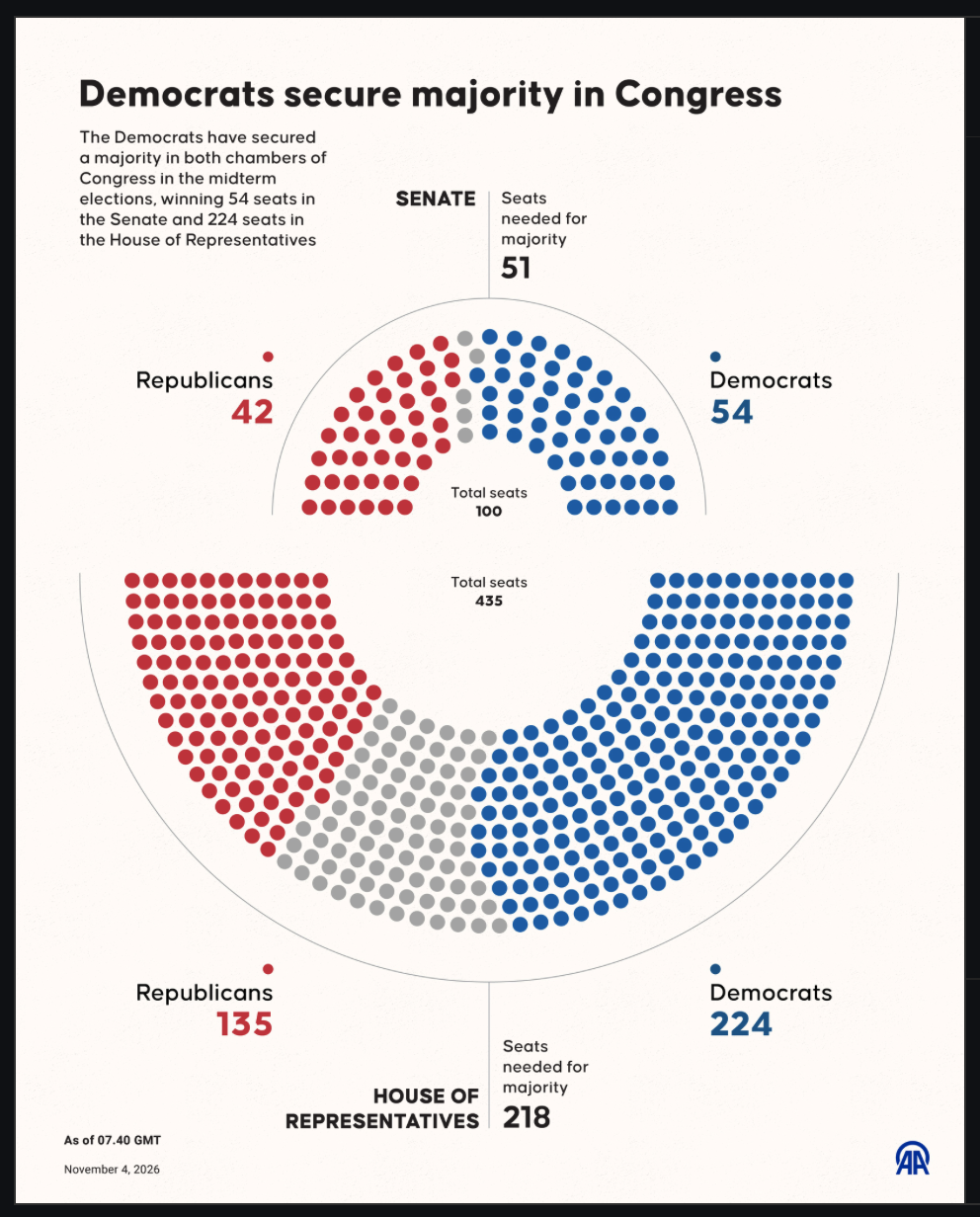
Democrats captured control of both the U.S. House of Representatives and the U.S. Senate, according to election-night projections and results reported early Wednesday. The victories represent a dramatic reversal for a party that suffered major losses in 2024, when Republicans secured control of the White House and both chambers of Congress.
The outcome threatens to derail much of Trump’s remaining legislative agenda during the final two years of his second term. It also raises new questions about the direction of the Democratic Party, the priorities of its incoming congressional leadership and whether the party can translate electoral victories into tangible improvements in the lives of ordinary Americans.
For North Carolina, the results were particularly significant. Former Gov. Roy Cooper defeated Republican Michael Whatley in the U.S. Senate race, Democrats made substantial gains in congressional contests and the party appeared poised to take control of the state House of Representatives for the first time in more than a decade.
The results underscore a political reality that neither party can afford to ignore: Voters may reward or punish those in power based on their experiences with the economy, the cost of living, public policy and the direction of the country.
Roy Cooper, who served two terms as governor, campaigned heavily on affordability, health care and the need for a more independent voice in Washington. His victory is especially notable in a state that has frequently supported Republican candidates in presidential elections and has generally proved difficult for Democrats to win in statewide federal contests.
According to The Associated Press, Cooper defeated Whatley by nearly 20 percentage points, delivering Democrats a critical Senate pickup and helping the party secure control of the chamber.
Whatley, the former chairman of the Republican National Committee, entered the race with strong ties to Trump and the national Republican establishment. But that association became a political liability among voters dissatisfied with the administration’s direction.
The contest also highlighted the importance of North Carolina’s Black voters, younger voters, independents and other constituencies that helped form the coalition behind Cooper’s campaign.
For Democrats, the win represents more than a single Senate seat. It offers an opportunity to influence national legislation, scrutinize the administration and exercise greater oversight over federal spending and executive branch decisions.
For Republicans, the defeat raises difficult questions about candidate recruitment, campaign strategy and the political consequences of closely aligning local and statewide candidates with an unpopular national administration.
In western North Carolina, Democrat Jamie Ager defeated Republican Jennifer Balkcom in the 11th Congressional District, flipping a seat that Republicans had expected to retain. The race became especially competitive after Republican incumbent Chuck Edwards withdrew from his reelection bid.
The defeat of Republican Rep. Tim Moore, a prominent figure in North Carolina politics and a former state House speaker, added to the Democrats’ gains. His loss illustrated the depth of the shift, as Democratic candidates found success in contests that had appeared more favorable to Republicans.
Meanwhile, the 1st Congressional District, represented by Democrat Don Davis, remained an important race to watch because of Republican efforts to redraw district boundaries in the party’s favor. The contest demonstrated how redistricting, candidate appeal and voter sentiment could combine to produce unexpected outcomes.
Democratic gains in North Carolina also reflected a broader national pattern. Republicans had pursued mid-decade redistricting in several states in hopes of strengthening their congressional majority. But the strategy did not prevent Democrats from making gains in multiple competitive districts. The results suggest that favorable district boundaries and campaign spending cannot always overcome voter dissatisfaction.
The national consequences of the election are substantial.
Democrats crossed the threshold needed to regain control of the House, with election results reported by Roll Call showing the party securing the majority. The victory positions House Democratic Leader Hakeem Jeffries to become speaker when the new Congress convenes in January.
Control of the House gives Democrats considerable power over legislative priorities, committee leadership, federal spending legislation and congressional investigations.
The party is expected to pursue policies aimed at reducing the cost of living, protecting access to health care and challenging portions of the Trump administration’s agenda. Democratic leaders have also signaled that oversight of the administration will be a major priority.
The Senate results were equally consequential. Democratic victories in North Carolina and several other Republican-held states helped the party reclaim the upper chamber.
A Democratic Senate majority would give the party greater influence over judicial and executive nominations, committee investigations and the legislative process. It would also make it substantially more difficult for the White House to advance nominations or legislation without negotiating with Democratic lawmakers.
Although Republicans will lose their unified control of Washington, the president will retain executive authority, including the power to veto legislation. The result is likely to produce a more confrontational relationship between Congress and the White House.
The change in congressional leadership does not guarantee that Democrats will be able to enact every element of their agenda. Internal divisions within the party, Senate procedural requirements, presidential vetoes and disagreements over spending could complicate their efforts. Nevertheless, the election represents a major change in the political balance of power.
The Democratic wave extended into state government, where the party appeared poised to capture the North Carolina House of Representatives.
Democrats made significant gains in districts previously held by Republicans, defeating several veteran lawmakers and disrupting a Republican legislative majority that had been in place since 2011.
The victories included races involving influential Republican legislators and budget writers. Democratic gains also came in districts that had not initially been considered among the most competitive contests.
The shift could have major implications for Gov. Josh Stein, a Democrat who has faced a Republican-controlled legislature during his first years in office.
A Democratic-controlled state House would give Stein a stronger negotiating position on education, housing, health care and state spending. It could also make it more difficult for Republicans to override gubernatorial vetoes.
However, Democrats did not appear to win control of the state Senate. Republicans maintained their majority there, leaving North Carolina with a divided legislature.
That division could produce negotiations, policy compromises and political gridlock. It also means Democrats will have to work with Republican senators to advance much of their legislative agenda.
The election therefore changes the balance of power without guaranteeing a sweeping Democratic transformation of state policy.
For communities across eastern North Carolina, including Rocky Mount and surrounding rural areas, the legislative shift could influence debates over public education, economic development, infrastructure, affordable housing and the distribution of state resources.
The extent of any changes will depend on which proposals lawmakers prioritize and whether members of both parties can agree on practical solutions.
While Democrats celebrated their victories, the results did not eliminate concerns among voters who are uncertain about the prospect of Democratic control in Washington.
For some Americans, the election represents a necessary correction to Republican policies. For others, it raises fears that a Democratic majority could bring its own set of economic, social and political problems.
One major concern is the economy.
Voters struggling with high grocery bills, housing costs, insurance premiums and other household expenses may be skeptical of either party’s promises. They want to know whether a change in congressional leadership will produce measurable improvements in their financial circumstances.
Democrats have promised to focus on affordability and access to health care. But voters will ultimately judge the party on its ability to deliver results, not simply on its campaign commitments.
Another concern involves government spending and the national debt. Fiscal conservatives and some independent voters worry that Democratic proposals could increase federal spending, expand government programs or raise taxes. Democrats, meanwhile, argue that investments in working families, health care and economic opportunity can improve financial security and strengthen the economy.
Immigration and border security also remain contentious issues. Some voters who supported Trump want to see continued enforcement of immigration laws and may oppose efforts by Democrats to reverse or substantially modify administration policies.
Other voters are concerned about civil liberties, the treatment of immigrants and the economic and humanitarian consequences of aggressive enforcement. These disagreements will likely remain central to the national debate.
There are also concerns that a Democratic-controlled Congress could devote too much attention to investigations and political retaliation rather than legislation addressing everyday problems. Democratic leaders have indicated that oversight of the Trump administration will be a priority. Supporters view that responsibility as an essential constitutional check on executive power. Critics worry that prolonged investigations could deepen partisan divisions and leave important policy questions unresolved.
Both concerns reflect a broader challenge facing Congress: conducting legitimate oversight while continuing to address the needs of the public.
Finally, some voters remain uneasy about the Democratic Party’s ideological divisions. Progressive Democrats are likely to press for more aggressive action on health care, taxes, climate policy and social programs, while moderates may favor narrower proposals and bipartisan negotiations.
How party leaders manage those competing priorities will help determine whether the new majority can govern effectively.
The election offers lessons that extend beyond a single party’s victory.
For Republicans, the results are a warning that holding the presidency does not guarantee continued support from voters. Midterm elections often serve as a referendum on the party in power, and economic anxiety or dissatisfaction with national leadership can reshape the political landscape. Republicans will have to decide whether to maintain their current approach, reconsider their policy priorities or distance themselves from unpopular elements of the administration’s agenda.
For Democrats, the challenge is different but equally significant. Winning elections is not the same as earning lasting public confidence. The party must demonstrate that it can govern responsibly, address economic pressures and respond to concerns from voters who may have supported Democratic candidates without embracing every aspect of the party’s platform.
North Carolina offers a particularly important example. Cooper’s victory and the Democrats’ gains in legislative and congressional contests demonstrate that the state’s political landscape remains competitive and that voters are willing to reconsider their choices.
But the results do not mean every North Carolinian supports the same policies or shares the same vision for the state and the nation.
The state’s divided legislature is a reminder that political power remains contested and that compromise may be necessary to move policy forward.
