By Jheri Hardaway
Staff Writer
Raleigh, NC — In a soul-stirring atmosphere saturated with jazz, deep ancestral memory, and holy celebration, St. Ambrose Episcopal Church celebrated a year-long jubilee on Sunday, October 18th, marking sixty years on Darby Street in Southeast Raleigh’s historic Rochester Heights community. The landmark milestone brought together a rich, multigenerational congregation alongside the Right Reverend Michael B. Curry, the XXVII Presiding Bishop of the Episcopal Church, who served as celebrant and preacher.
Founded in the wake of the Civil War on February 11, 1868, as a ministry to newly emancipated African Americans connected to Saint Augustine’s Normal School, St. Ambrose has persevered through more than 158 years of institutional life. The parish’s sacred journey took it from a Carpenter Gothic chapel rolled literally down the street on logs at the turn of the 20th century to its consecration on Darby Street in October 1965.
Sunday’s service was defined by powerful liturgical and cultural expression, anchored by the North Carolina Central University Jazz Ensemble. The service music paid tribute to legendary composer, pianist, and sacred jazz trailblazer Mary Lou Williams, incorporating movements from her groundbreaking 1970 Mary Lou’s Mass alongside her 1964 Pittsburgh Mass.
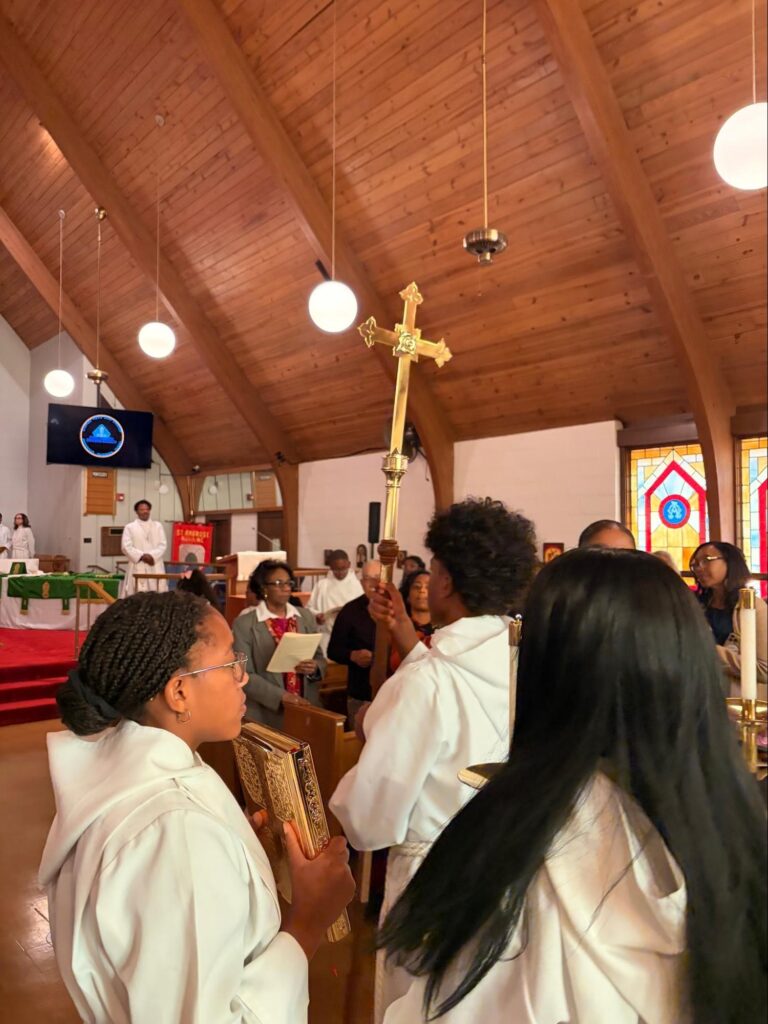
The celebration carried a long tradition of musical and liturgical pioneering at St. Ambrose: from the 1920s compositions of the Rev. Arthur Myron Cochran, who set the historic Cochran Mass to Negro Spirituals, to the parish's late-1990s introduction of the Jazz Mass under former rector the Rev. Dr. Michael J. Battle. Clergy and church leaders marched in vibrant vestments and under Ethiopian ceremonial umbrellas, lifting up ancient African Christian heritage in harmony with contemporary rhythm.
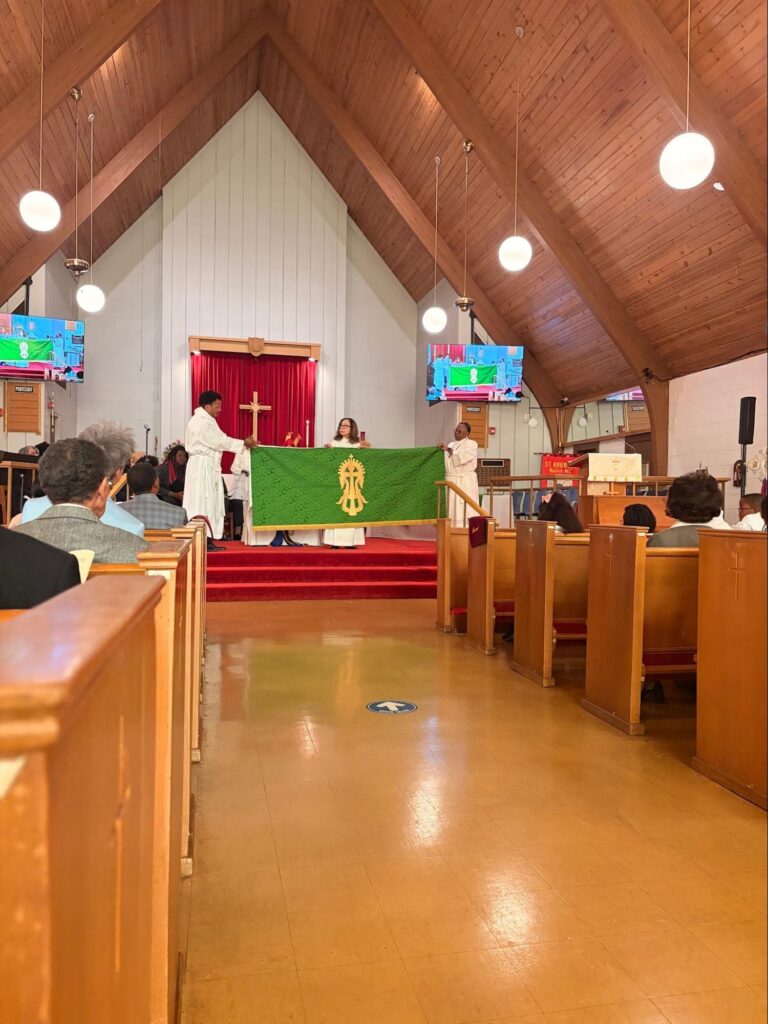
There was a dedication of new altar hangings; the green altar vestments have the Ethiopian Lalibela cross design. Queen Masqal Kiora, the 12th-century Ethiopian queen, designed the cross and used it to bless people. Queen Masgal functioned as a priest. The design shows a central cross encircled by a band, symbolizing the interconnection of heaven and earth. The twelve images around the cross are the Twelve Apostles, with Jesus centered in the middle. The birds and wings symbolize the Lord's Estate, Garden of Eden, and the Paradise to come. We were reminded that ancient African history suggests the earliest practices of Christianity come out of Ethiopia, and these vestments pay tribute to that enduring legacy.
Preaching with his signature warmth, humor, and prophetic urgency, Presiding Bishop Curry grounded his sermon in the 17th chapter of Jeremiah: “They shall be like a tree planted by water, sending out its roots by the stream. It shall not fear when heat comes, and its leaves shall be green; in the year of drought it shall not be overcome by anxiety, and it does not cease to bear fruit.”
Singing the timeless Negro spiritual born of that passage, Curry proclaimed, “Our enslaved African ancestors used to say, ‘I shall not be moved. Like a tree planted by the water, I shall not be moved.’ An anniversary is a time to reclaim origin, to go deep into the very roots of who we are. Sandy soil only goes so deep. But if you sink your roots deep enough into God, you find rich, life-giving soil.”
Curry drew a vivid parallel from his own pilgrimage to Ghana with fellow descendants of the enslaved and enslavers, recalling a massive centuries-old tree that stood near the slave routes where ancestors were granted a single day of respite before being forced toward Cape Coast Castle, “That tree stood through the rise and fall of empires, through the transatlantic slave trade, through Danish and British conquerors, surviving in a landscape where the Sahara’s sand constantly encroaches on good earth. Life itself is lived in an admixture of sand and rich soil. St. Ambrose has stood like that tree for 60 years on Darby Street and 158 years in Raleigh—bearing fruit, offering shade, and refusing to be moved.”
Turning toward national conscience and civic life, Curry challenged the congregation not to separate their spiritual roots from their moral responsibility, calling on the faithful to practice active citizenship by voting: “I love my country. But I love it enough that I refuse not to criticize it when it’s wrong. When this country mistreats immigrant families or separates children from their mothers, we must stand up and correct it. We must go out and vote. Real love is not an emotional feeling; it is a moral decision to seek the good and the welfare of your neighbor, even when they don’t look like you, think like you, or even love you back.”
During the liturgy, the congregation offered a Progressive Eucharist, reading prayers honoring each era of the church's relocations and quoting Father Absalom Jones's historic 1808 Thanksgiving sermon celebrating the abolition of the transatlantic slave trade. Special prayers of thanksgiving were lifted up for the leaders who shaped the parish's legacy:
The Founders and Builders: The Rev. Jacob Brinton Smith, the Rev. James E. King, and the faithful members who physically relocated the church from Dawson Street to Cabarrus and South Wilmington Street in 1900.
Educational and Social Reformers: Mary E. Phillips, who founded the Saint Ambrose School in 1896 during an era when African American public education was deliberately starved. The school enrolled 170 students and had one of only four kindergartens in North Carolina.
Civil and Environmental Pioneers: The Rev. Arthur J. Calloway, who led the congregation onto Darby Street and served three terms on the Raleigh City Council, and the community warriors who organized against environmental racism along the Walnut Creek wetland.
Historic Firsts: The Rt. Rev. Kimberly D. Lucas, who made history at St. Ambrose as the first African American woman ordained priest in the Diocese of North Carolina before becoming its tenth rector.
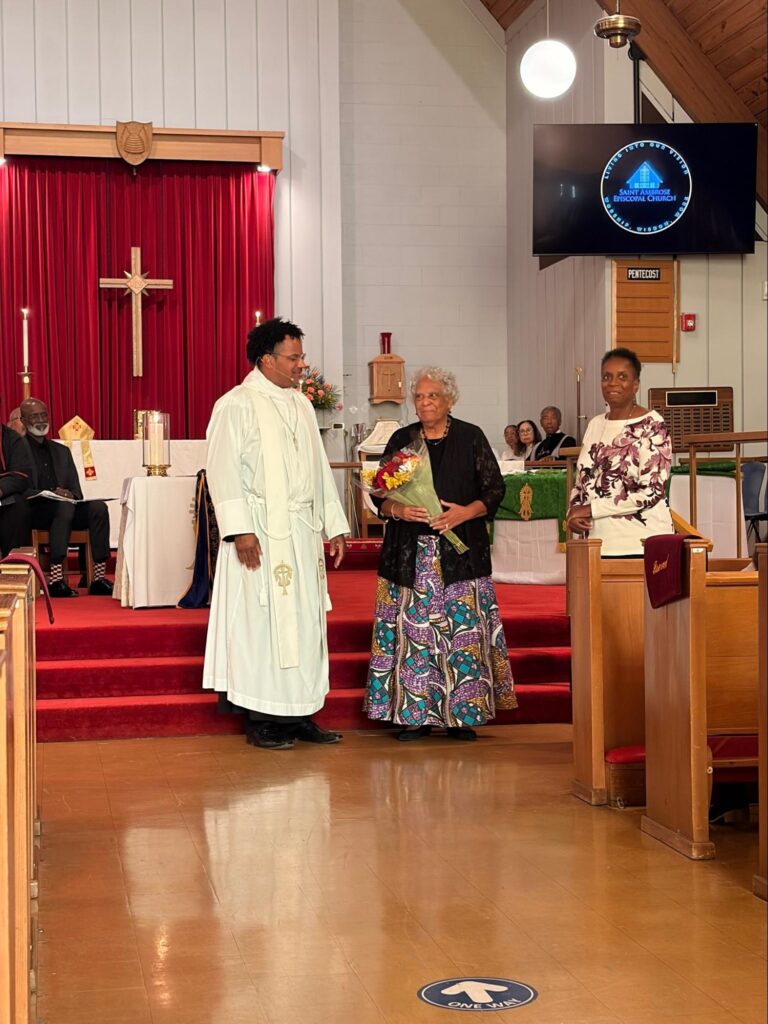
The parish also recognized its current shepherd, the Rev. Robert Jemonde Taylor, celebrating his visionary leadership, scholarship, and community engagement across Raleigh and beyond. Additionally, Edna Rich-Ballentine, Emily Cadogan, Douglas Fulford Jr., and the late Gwendolyn Chunn were honored as members of the 60th Anniversary Steering Committee. Connecting faith to direct community engagement, representatives from the Young Black Lawyers’ Organizing Coalition addressed the congregation during the announcements, reminding worshippers that North Carolina’s early voting window was officially open through October 31. Calling out the refrain “Black Ballots, Black Futures,” the coalition provided nonpartisan voting guides and shared the Election Protection Hotline (866-OUR-VOTE) to ensure every parishioner’s voice is heard.
For sixty years in Rochester Heights, St. Ambrose has served as a sanctuary of resilience, spiritual nourishment, and prophetic justice. As the final notes of the brass band rang across Darby Street, the message of the day was clear: anchored in rich soil and watered by grace, St. Ambrose remains unshakeable.