
By Jheri Hardaway
Staff Writer
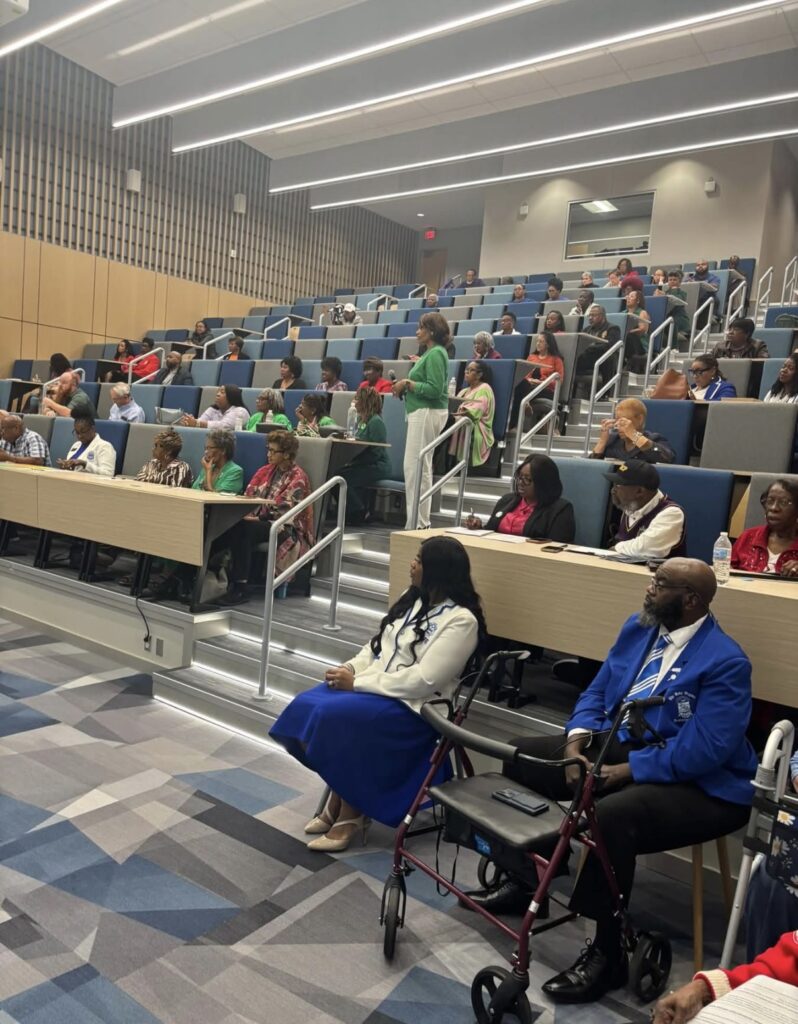
Smithfield, NC — As the countdown to the general election narrows to days, community members packed the Wood Building at Johnston Community College on Friday evening for a nonpartisan candidate forum organized by the Johnston County Branch of the NAACP. Convening under the banner of “Educate, Engage, Empower,” the October 9th gathering brought together candidates across federal, state, and county races from the U.S. Senate and Congress to the General Assembly, County Commission, Register of Deeds, Soil & Water Conservation, and the Clerk of Superior Court.
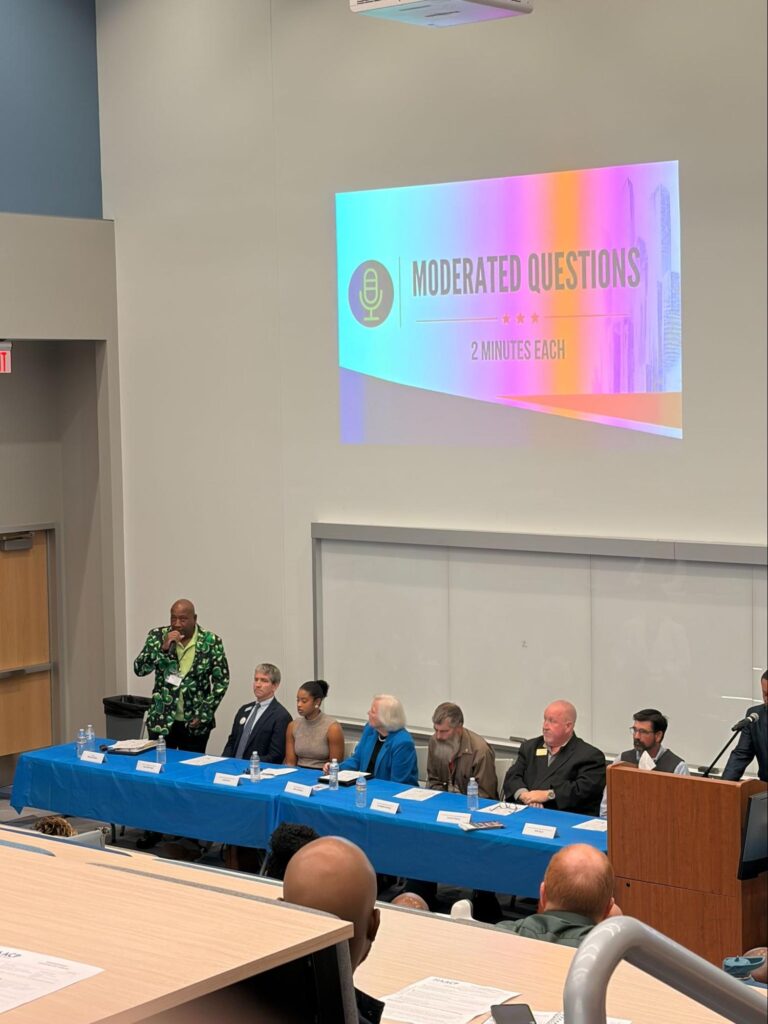
Moderated by Rev. Dr. Christopher Kornegay, President of the Johnston County NAACP, the evening offered voters a direct look at the contenders seeking to represent one of North Carolina’s fastest-growing counties. Dr. Kornegay opened the forum by outlining forum guidelines and by emphasizing that democracy functions best when elected officials are held accountable directly by the electorate. Throughout the evening, candidates fielded questions on equal service, government accessibility, environmental health, civil rights, and much more.
Dr. L’Bertrice Solomon, candidate for N.C. House of Representatives District 26, made an impassioned case for collaborative leadership that places listening ahead of top-down political agendas, “One does this, another does that. But if it does not touch the humanity of each and every one of us linked together, then it means absolutely nothing,” Dr. Solomon told the gathering. “I call myself a concerned person—I am on point, and I will never give up. Your conversations have helped shape my priorities by listening. I will ensure that I don’t take an agenda from Raleigh to you, but take your priorities to them.”
In post-event remarks, Dr. Solomon reflected on the necessity of the NAACP-sponsored forum: “Oftentimes this particular community is overlooked, and it’s time to engender the help. You do that by inviting them out, letting them see who you are, and hearing their needs. It allows us to see that leadership is a partnership—accountability, responsibility, and the reciprocity of leading.”
U.S. Senate candidate Michael Dublin, who stood out in the hall wearing a signature green shamrock blazer designed to fix his name in voters' memories, echoed the urgency of community mobilization as early voting approaches: “This event was well run, and it was excellent to engage with the people of Johnston County,” Dublin remarked following the discussion. “It was heartfelt and really powerful. With elections starting next week, we need this. I was impressed to see people that look like us getting involved and stressing how important it is to take part in this process. Malcolm X said in 1964, ‘the ballot or the bullet.’ I believe it’s the ballot and the bullet—and when I say the bullet, I’m talking about our collective organizing, our work, and our power.”
The forum spanned every tier of governance, giving voters a rare opportunity to hear localized debate on everyday community services:
First, Legislative Priorities. In the state legislative races, N.C. House candidate Kevin Thurman underscored grassroots transparency, proposing bi-annual town halls rotating through all 10 precincts of his district so transportation-insecure residents are not left out of the legislative process. 13th Congressional District Democratic nominee Paul Berringer highlighted cost-of-living relief, healthcare access, and anti-corruption measures, pledging consistent town halls across partisan lines.
The next focus was Courts and Constitutional Protections. Representatives for incumbent N.C. Supreme Court Justice Anita Earls urged voters to pay close attention to judicial races up and down the ballot, highlighting Earls' decades of civil rights advocacy and her perspective as the sole African American justice on the state's highest court. Johnston County Clerk of Superior Court Michelle Preach Ball addressed courtroom accessibility, highlighting electronic records improvements, translation and disability coordination, and her philosophy of servant leadership grounded in the biblical call to “do justice, love mercy, and walk humbly.”
Next, County Governance and Growth. Longtime Johnston County Register of Deeds Craig Olive pointed to his 24-year tenure serving all residents regardless of race, political affiliation, or background, pointing to initiatives such as the “Thank A Vet” discount program and returning $4.7 million in unexpended funds to the county. Johnston County Board of Commissioners candidates, including incumbent Patrick Harris and challenger Will Beard, wrestled with rapid suburban growth, rural water infrastructure, expanded Department of Social Services facilities, and healthcare expansion.
The final issues discussed were Conservation and Environmental Health. Local concerns over safe drinking water, soil protection, and agricultural preservation surfaced prominently during remarks from Soil & Water Conservation candidates and surrogates, including Joe Austin and a representative for candidate Gracie Chambers, who connected water contamination along the Neuse basin directly to cancer risks, developmental health, and rural equity.
Following the moderated questions, attendees had the opportunity to challenge candidates on specific issues including services for Vietnam-era military veterans and courthouse accommodations for persons with disabilities before breaking into an informal hour-long meet-and-greet reception.
With voter registration resources, election guides, and early voting information, and even copies of The Carolinian newspaper distributed throughout the evening, the NAACP branch drove home the broader civic stakes. As attendees departed the auditorium, the sentiment shared by organizers and candidates alike was clear: civic progress across Johnston County will not be determined in distant backrooms, but at the ballot box by informed voters demanding transparency, equity, and public service that works for everyone.
