
By: Jordan Meadows
Staff Writer
Raleigh voters will decide this November whether the city can borrow up to $203 million in general obligation bonds for housing, education, and transportation, a package city officials say can be repaid without raising property taxes.
The city says it can borrow that much without a tax increase because of what it calls a "Steady State" financing model. Beginning with the fiscal year 2026 budget, Raleigh started setting aside money from property and sales taxes in a dedicated Debt Fund to pay for large capital projects. City finance staff estimate that fund can support $203 million in borrowing every four years without a tax hike, and officials expect to bring bond packages to voters at that interval if this one passes.
The city acknowledges a risk: property and sales tax collections generally rise but could fall, which would shrink the amount of debt the fund can support. If voters reject the bonds, City Council could fund the projects from other sources, but if no money is available, the projects would not move forward.
The housing bond would split its $101.5 million four ways. The largest share, $57.6 million, would go toward building new affordable housing and preserving existing affordable units. Another $21.5 million would be held in reserve for major redevelopments of city-owned sites, intended to create communities serving a range of income levels.
The bond would put $12 million toward homelessness response, funding Wake at Home, a public-private partnership coordinated by the Wake County Continuum of Care that supports decommissioning homeless encampments and connecting people to housing and services. The remaining $10.4 million would go to homebuyer assistance for buyers earning at or below 80% of the area median income, along with programs that help seniors stay in their homes as they age.
Past bond money has financed projects including the Milner Commons housing development in 2020 and the Atlantic Avenue roadway in 2017. The 2020 housing bond, an $80 million package, was approved by voters and, by the end of fiscal year 2024-25, about 79% of it had been committed to create or preserve roughly 1,800 affordable units.
The transportation bond would put $51.5 million toward three road projects: Marsh Creek Road and Trawick Road-West, Ebenezer Church Road, and general-purpose lanes along the Southern Bus Rapid Transit corridor that are not eligible for federal funding. Another $40 million would go to transportation plans the council has already adopted, including an expansion of walking and biking networks that calls for more than 5 miles of sidewalks and 50 miles of bikeways within five years under the city's Active Mobility Plan.
The money would also support the Comprehensive Safety Action Plan, which uses data to recommend changes to traffic flow and infrastructure at busy intersections and near schools to reduce traffic deaths and serious injuries.
Raleigh's bonds are among several local questions on the back of the ballot in Wake County.
Countywide, voters will weigh bonds for the Wake County Public School System and Wake Technical Community College, and Knightdale voters will consider a $55 million parks bond for a new public park and community center, with an estimated cost of $35 per $100,000 of assessed property value per year.
The school system, which serves about 161,000 students across 204 schools, plans to use its bond, plus an additional $152.3 million cash commitment from Wake County, to build two new elementary schools in Wendell and Knightdale and design another in Zebulon. Nine existing elementary, middle and high schools in Raleigh, Cary, Garner and Wendell are slated for renovation or replacement, with construction funded for six and design for three.
Wake Tech's bond would cost an estimated 90 cents per $100,000 of assessed property value per year. It would put $41 million toward expanding programs in public safety, skilled trades, automotive and dental hygiene, $65 million toward renovating the Southern Wake campus, $20.4 million toward facilities updates across all seven campuses, and $22.7 million toward technology, vehicles and equipment.
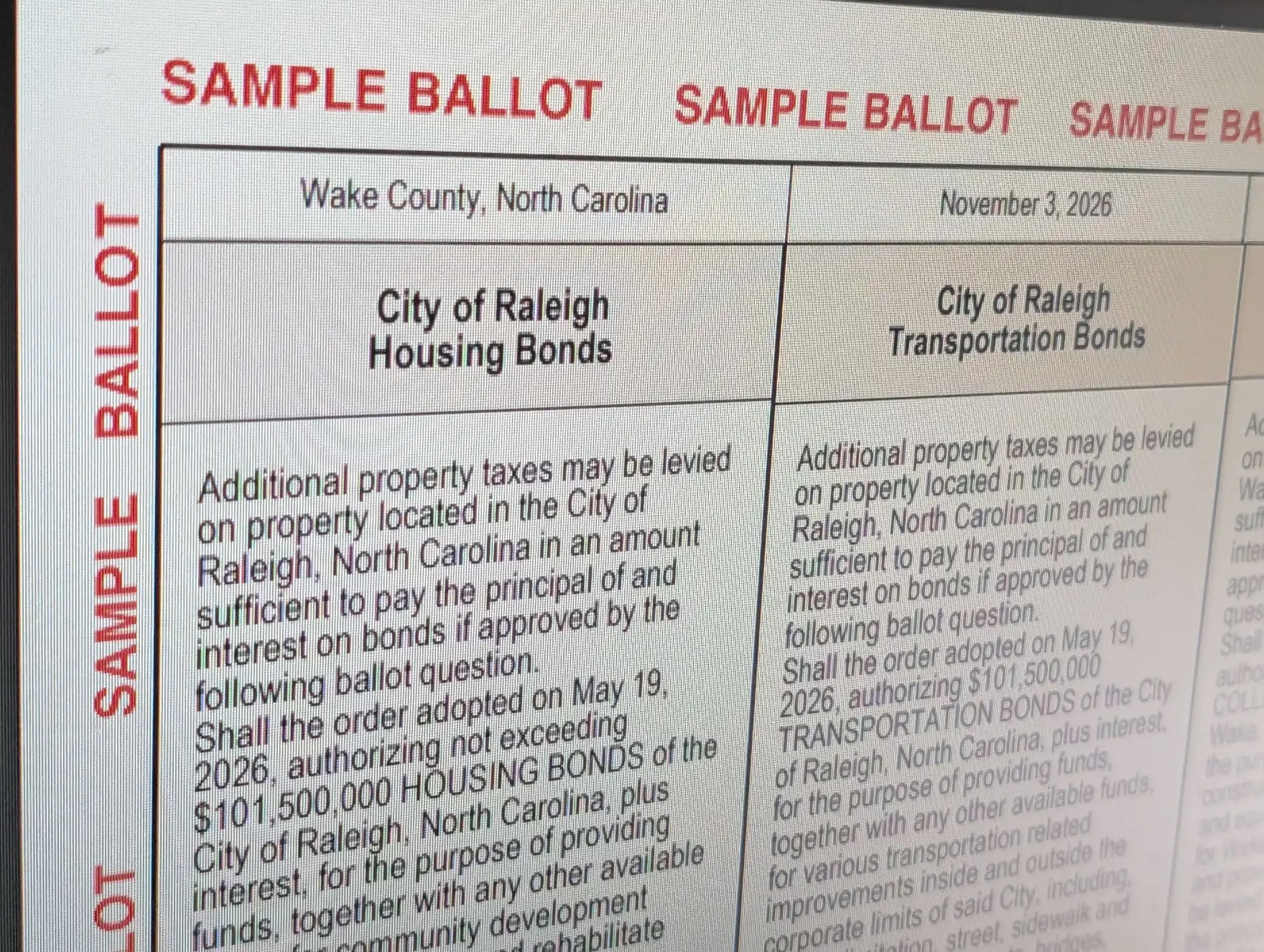
The ballot language is set by the state legislature, and it carries wording that may surprise some voters. Each question says "additional taxes may be levied in an amount sufficient to pay the principal of and interest on the bonds."
Under the state's Bond Transparency Act, however, ballots must also disclose the total estimated cost over the life of the bond and the estimated property tax impact, and the city has filled in that figure as "$0 (zero dollars)."
Wake County voters have historically backed bonds by wide margins, with the 2024 library bond, the 2022 school and community college bonds and Raleigh's 2020 housing bond all passing easily. A notable exception came in 2024, when Cary voters rejected parks and housing bonds with a combined price tag of $560 million, after residents were already facing higher-than-expected tax bills following that year's property revaluation.
Bond referenda need a simple majority to pass.
