
By Jordan Meadows
Staff Writer
The City of Raleigh has launched an online Housing Production Dashboard that maps and tracks the affordable housing it has helped build.
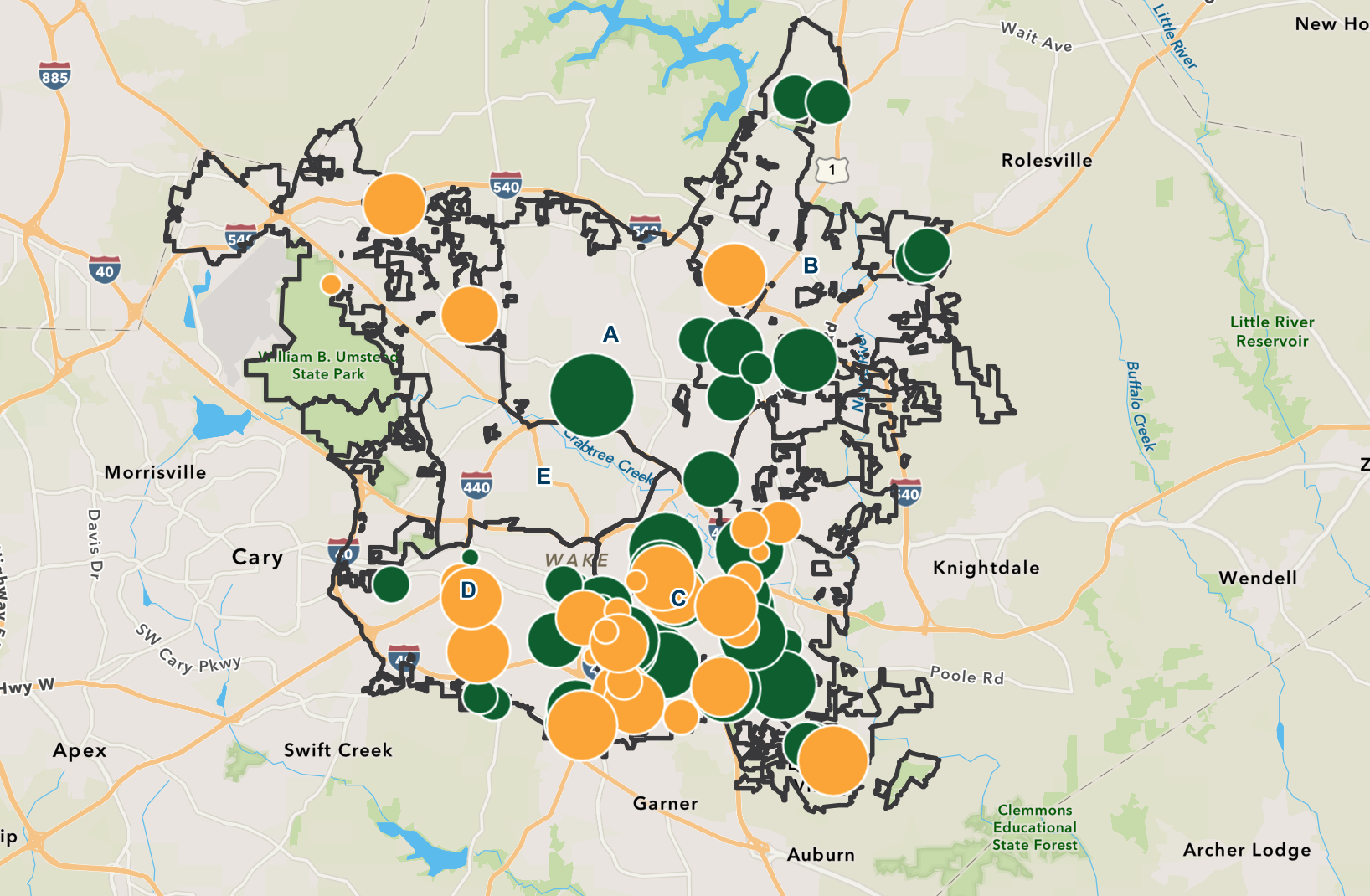
The interactive dashboard pulls years of housing data into one place. Users can see how many affordable homes have been created or preserved, sort projects by program and year, and track spending from the 2020 Affordable Housing Bond. City staff said it highlights more than 5,900 affordable units the city has helped develop, along with housing built by private organizations.
A map shows affordable developments completed or started over the past decade, layered with transit routes and Bus Rapid Transit corridors, City Council districts, Neighborhood Conservation Overlay Districts, median rent and home values, other market indicators, and other subsidized housing such as Low-Income Housing Tax Credit developments and Housing Authority properties.
A charts section breaks down work completed each year, development types, cumulative totals and the city's work helping first-time homebuyers and funding homeowner repairs. It also shows what percentage of bond money has been committed and what it has been spent on.
Housing & Community Development Director Emila Sutton said, "We are excited to launch our new Housing Production Dashboard to offer community members a clear window into where affordable housing is being built and preserved and how these efforts are shaping Raleigh's housing future."
Erika Brandt, the department's assistant director, said the tool serves two purposes.
"One piece of it is really just showing that production, showing the work that's being done. Another piece of it is showing what are the options that are out there," Brandt said. "If you're improving affordable housing and housing affordability across the market, you are going to see lower rates of homelessness.”
The dashboard supports the city's 2026-2030 Affordable Housing Plan, "A Home for Every Neighbor," which describes Raleigh as facing an urgent affordability and homelessness crisis. The plan says population growth is outpacing housing development while rising construction costs push up rents and home prices. Between 2017 and 2022, the most recent period with available data, median gross rent in Raleigh rose about 37%. The city has grown by more than 70,000 people since 2010, making it one of the fastest-growing cities in the country, second only to Austin, Texas, over the past decade, and the metro area, which includes Wake, Johnston, and Franklin counties, has added more than 350,000 residents.
The plan notes that many newcomers are relocating from more expensive parts of the country for higher-paying jobs. Raleigh has almost twice the national average of jobs paying over $100,000 a year, which lets new arrivals outcompete longtime residents for housing. Demand for urban living has also driven up land values near downtown and put pressure on historically affordable neighborhoods such as South Park, Hungry Neck, Battery Heights, and Roberts Park.
Supply has been another problem: Before 2021, 55% of the city, and more than 70% of its residentially zoned land, was limited to single-family housing, and homebuilding of all types stalled after the 2008 recession. City Council passed zoning reforms in 2021 and 2022 allowing "missing middle" housing such as duplexes, triplexes, courtyard apartments, townhomes and live/work units. The market responded, and over 2,000 units, almost a third of all approved units, have been in those types. Median household income rose 28% from 2017 to 2022, but the plan says that reflects an influx of higher-paying jobs rather than gains for low-income residents.
Inflation-adjusted incomes have fallen for low-income households and stagnated for the middle class. A household must earn almost $66,000 a year to afford a two-bedroom apartment at Raleigh's Fair Market Rent, and the market is short about 38,000 units for households earning between $15,000 and $35,000.
"At its root, homelessness is a housing affordability problem," the dashboard states.
It cites a national report finding that every $100 increase in a community's average monthly rent is associated with a 9% increase in homelessness. It offers a musical chairs analogy: if there are nine chairs and ten players, the player with a broken leg will likely be left standing, but the broken leg is not the cause.
"The issue is structural," the plan says.
National research from 2017 put the public cost of one person experiencing chronic homelessness at about $36,000 a year, and estimates from Houston run as high as $96,000, counting emergency room visits, public safety, emergency medical services, and jail stays. The plan says subsidizing a household's housing and funding case management costs about $27,000 a year.
Clearing encampments without rehousing does not help, it says, costing cities between $1,600 and $6,200 per person a year while doing nothing to end homelessness. In one year, Raleigh's Parks, Recreation and Cultural Resources Department and the N.C. Department of Transportation each spent roughly $200,000 on cleanup related to people living unsheltered on their property.
Its targets include creating or preserving 1,345 affordable units by 2030 and housing 400 households by 2030 through decommissioning unsheltered camps with rent assistance and case management.
Other goals include expanding the city's Accessory Dwelling Unit Fast Track Program, easing eligibility barriers such as poor credit or prior evictions, recruiting private landlords for rapid re-housing, and increasing eviction prevention funding. Several of those objectives are flagged as having a resource gap.
Some of the City’s congregations are looking at their own land as part of the answer.
According to the NC Housing Coalition, the Raleigh-Cary area has 29 affordable rental units for every 100 low-income households, and while 74% of white households in Raleigh own their homes, only 47% of Black households do. Several downtown faith communities are exploring converting parking lots that sit empty most of the week into housing.
The Rev. Steven Lyons, pastor of St. Paul African Methodist Episcopal Church, the city's oldest Black congregation, said the toll of the crisis is visible just blocks from the State Capitol.
"The economic development has not really been conducive to successful living for the African American community," Lyons said.
In February, Edenton Street UMC's church council approved the Dawson Lot Project, which explores converting its Dawson Street parking lot into affordable housing. The church's website lists six criteria, including serving marginalized communities and providing mixed-income housing. The final outcome is still evolving, Marshall said, but the church remains committed to addressing the housing crisis.
