
 By Jordan Meadows
Staff Writer
Mount Vernon Baptist Church marked its 140th anniversary in late September, tracing its official founding to 1886 even though the congregation's roots reach back further, to a two-room mission on Queen Street where seven or eight formerly enslaved worshippers first gathered in 1880 seeking spiritual independence.
That founding group included Dolly Best, Isabella Gilmore, Will and Polly Lassiter, and Julia Richmond. The property housing that early mission was gifted in 1884 by R.L. Blackwell.
The congregation formally organized in 1887 following a spiritual revival at the Masonic Hall on Fayetteville Street, selecting the Rev. J.K. Butler as its first pastor; Butler was, at the time, simultaneously serving as pastor of First Baptist Church, which later became the historic White Rock Baptist Church. The church's identity and name trace to a separate transaction: a lot purchased for $300 from tobacco industrialist W.T. Blackwell at the corner of Mount Vernon Avenue and South Queen Street, which anchored the congregation both physically and in name for decades to come.
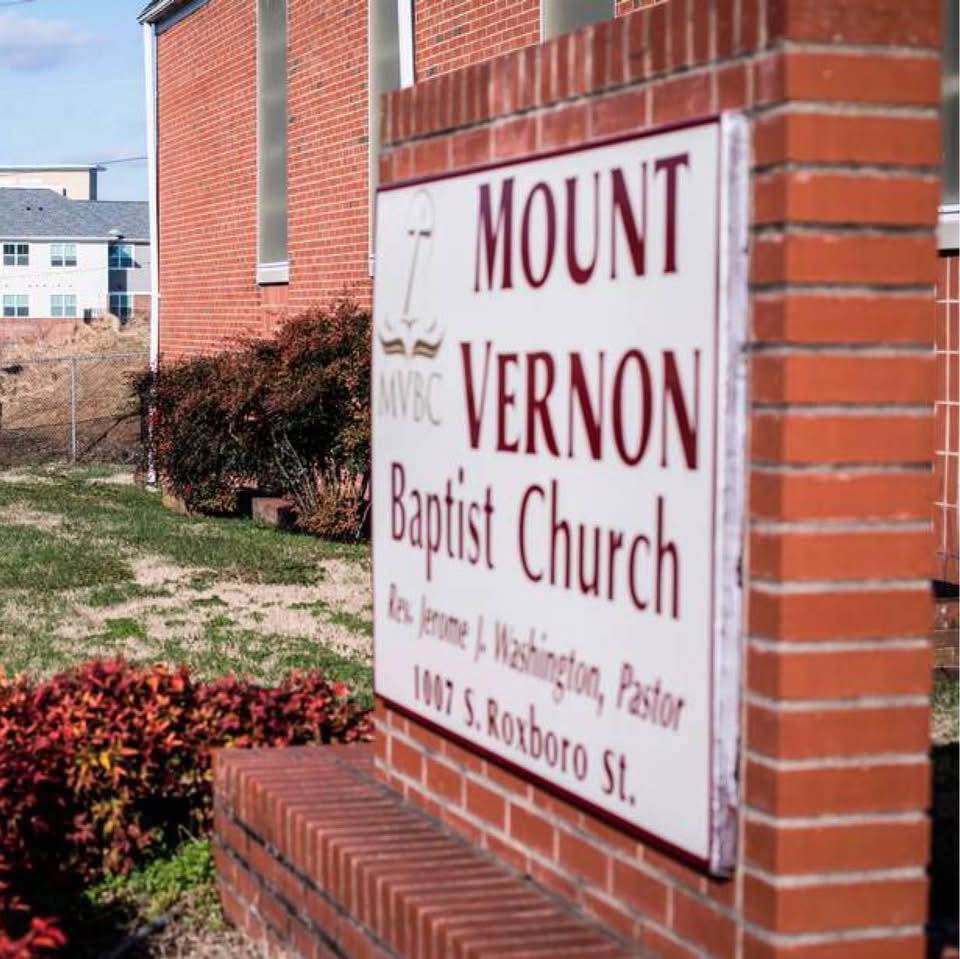
As the congregation grew through the early 20th century, its original wood-frame building could no longer accommodate the membership. Under the Rev. J.H. Thomas, who led the church through both the Great Depression and World War II, the congregation drew up plans for a larger home, completing a Colonial Revival masonry brick structure at 1007 S. Roxboro St. in 1940 and 1941. The original building at 504 S. Queen St. was eventually abandoned and demolished during mid-20th-century urban renewal projects that reshaped the Hayti neighborhood; the highway construction that followed paved over the original street grid entirely, and the footprint of the first church now sits beneath the parking lot of a local car dealership.
That Roxboro Street site remains the church's home today, in the heart of Durham's historic African American community, near the Durham Freeway that cut through Hayti during urban renewal and close to two other historically Black congregations, Gethsemane Baptist and St. Mark AME Zion.
The area has continued to face pressure from gentrification; downtown revitalization efforts since 2019 have not translated into growth for Black-owned businesses, which still make up less than 4% of local businesses both downtown and countywide.
During the civil rights demonstrations of the 1960s, the church served as a safe haven, coordinating meals and logistics for protesters marching against segregation, and it continues to host local NAACP chapter meetings today.
More recently, the congregation has taken direct action against displacement pressures in downtown Durham, engaging in strategic land banking by purchasing surrounding plots to shield them from aggressive commercial development rather than yielding to rising property values. The church has also partnered with Durham Habitat for Humanity, contributing its own historically held properties — including the site of its former parsonage — toward the construction of affordable single-family homes intended to keep working-class families anchored in the neighborhood.
The 140th anniversary celebration opening with a performance by the Michael Jones Trio, followed by a reception and a time capsule burial ceremony, and closing with an anniversary worship service held under the theme "For the Greater Glory!" Church leaders have said Mount Vernon has no plans to leave its Roxboro Street home even as gentrification and rising property values continue to close in around it.
