
By Jordan Meadows
Staff Writer
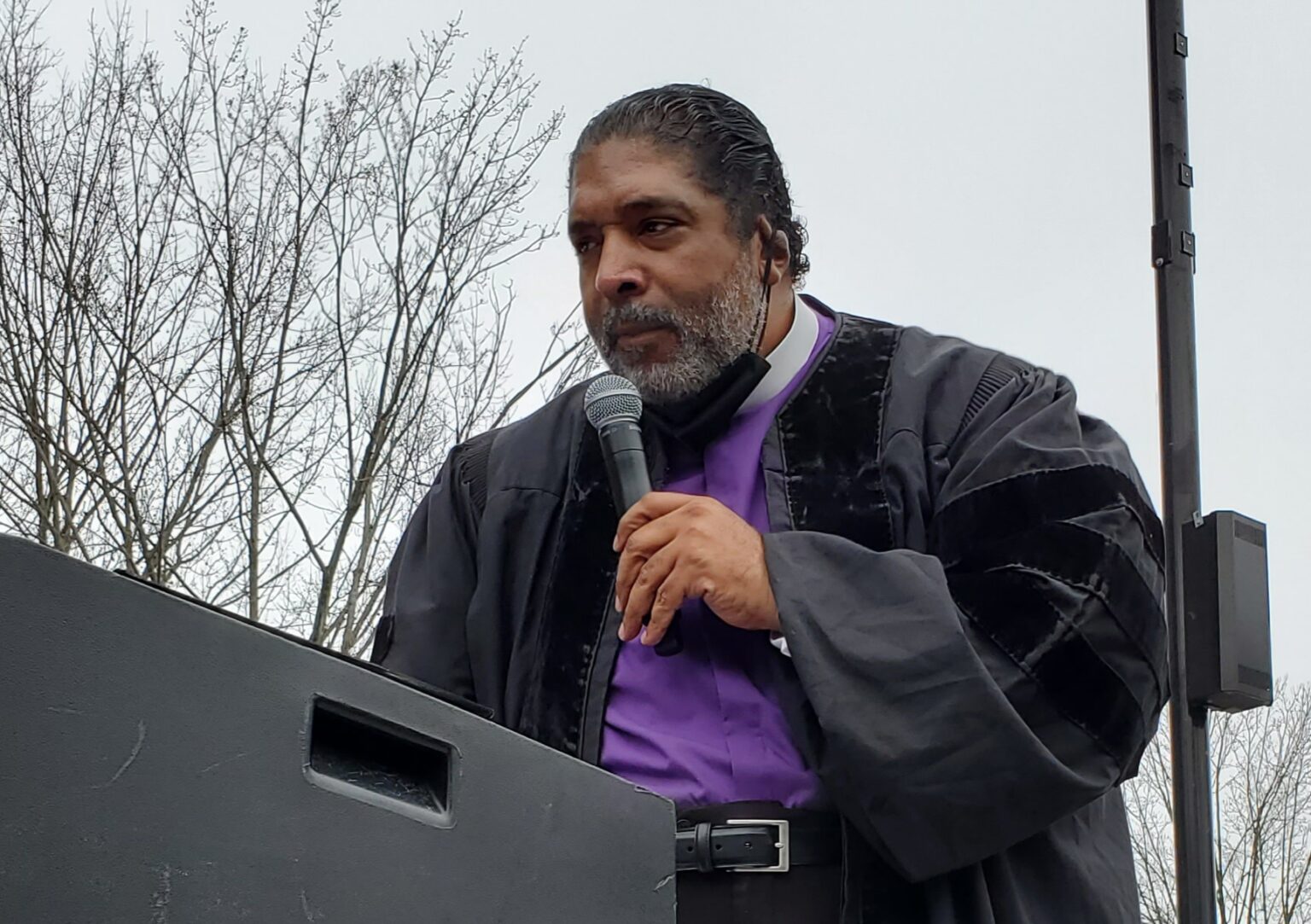
Bishop William J. Barber II, president of Repairers of the Breach, led clergy and North Carolinians of "every conscience" in a news conference Tuesday morning outside the North Carolina State Legislative Building in Raleigh, denouncing House Bill 958 as the legislature's latest attempt to suppress the vote.
House Bill 958 passed the General Assembly along party lines earlier this month and would cut the state's primary early voting period nearly in half, allow a citizen's ballot to be challenged for three days after an election concludes, and give the state auditor new authority over county election offices, machines and personnel after votes are cast.
Gov. Josh Stein vetoed the bill, and Barber told the crowd the reprieve was temporary.
"Governor Stein's veto buys us time, and time is all that it buys," Barber said, noting the General Assembly returns in November and that the House speaker has already promised an override attempt.
Barber connected the bill to Vance County, where a retired Baptist pastor, William Clayton, who joined him at the podium, said the legislation traced back a decade.
"House Bill 958 arrives 10 years later, in better clothing, and with the same measurements," Clayton said. He said more than 700,000 North Carolinians voted early in the March primary and argued the people who stood to lose that week of access were "hourly workers, people without a car, people who cannot take a Tuesday off" and congregations that "walk from the sanctuary to the polls on a Sunday afternoon."
He added, "Souls to the polls is not a slogan. It is a liturgy."
Barber framed the fight in constitutional terms, citing language from North Carolina's Reconstruction-era constitution establishing that elections belong to the people rather than to legislative leaders.
"The elections don't belong to politicians," Barber said. "They don't belong to the speaker. They don't belong to the Senate pro tem. They don't belong to whoever happens to have the majority."
He called the legislature's actions "unconstitutional," "morally indefensible" and, invoking the scripture that closed his remarks, "sin."
Tuesday's event doubled as the formal launch of Repairers of the Breach's 100 Days of Mobilization, 1,000 Marches to the Polls campaign, which Barber said had drawn commitments from more than 200 organizations, churches and community groups since it was first announced in July.
"We need the polling places to look like they did in South Africa when Mandela first got out," Barber said, calling for marches from barbershops, hair salons, churches, synagogues, mosques, lodges and college campuses on the first day of early voting "and beyond."
He said the campaign would include a two-week North Carolina tour through Asheville, Winston-Salem, Wilson, Greenville, Martin and Washington counties, Fayetteville and Bladen County. He pointed to a four-day march the group led from Wilson to Raleigh in February as evidence the strategy works, saying data afterward showed early voting turnout rose in the counties the march passed through.
Addressing reports that federal immigration agents might monitor the marches, Barber said, "Come watch us walk. Come watch us march. Come watch us be unafraid."
Rev. Dr. Nancy Petty of Pullen Memorial Baptist Church told the crowd that voting was "a sacred act" and "a sacrament," and said clergy across faith traditions bore a responsibility to treat the ballot box "not as a partisan battleground, but as a sacred instrument to uphold human dignity and protect the vulnerable."
A representative of the North Carolina Council of Churches, speaking on behalf of the group's 19 member denominations, led attendees in a call-and-response tying voting to church priorities including health care, child care, immigrant communities, public education and economic and ecological justice, telling the crowd, "We must be good stewards of our citizenship."
"We are of the mind that what we should be doing is expanding opportunities to vote," Barber said.
