
By Jordan Meadows
Staff Writer
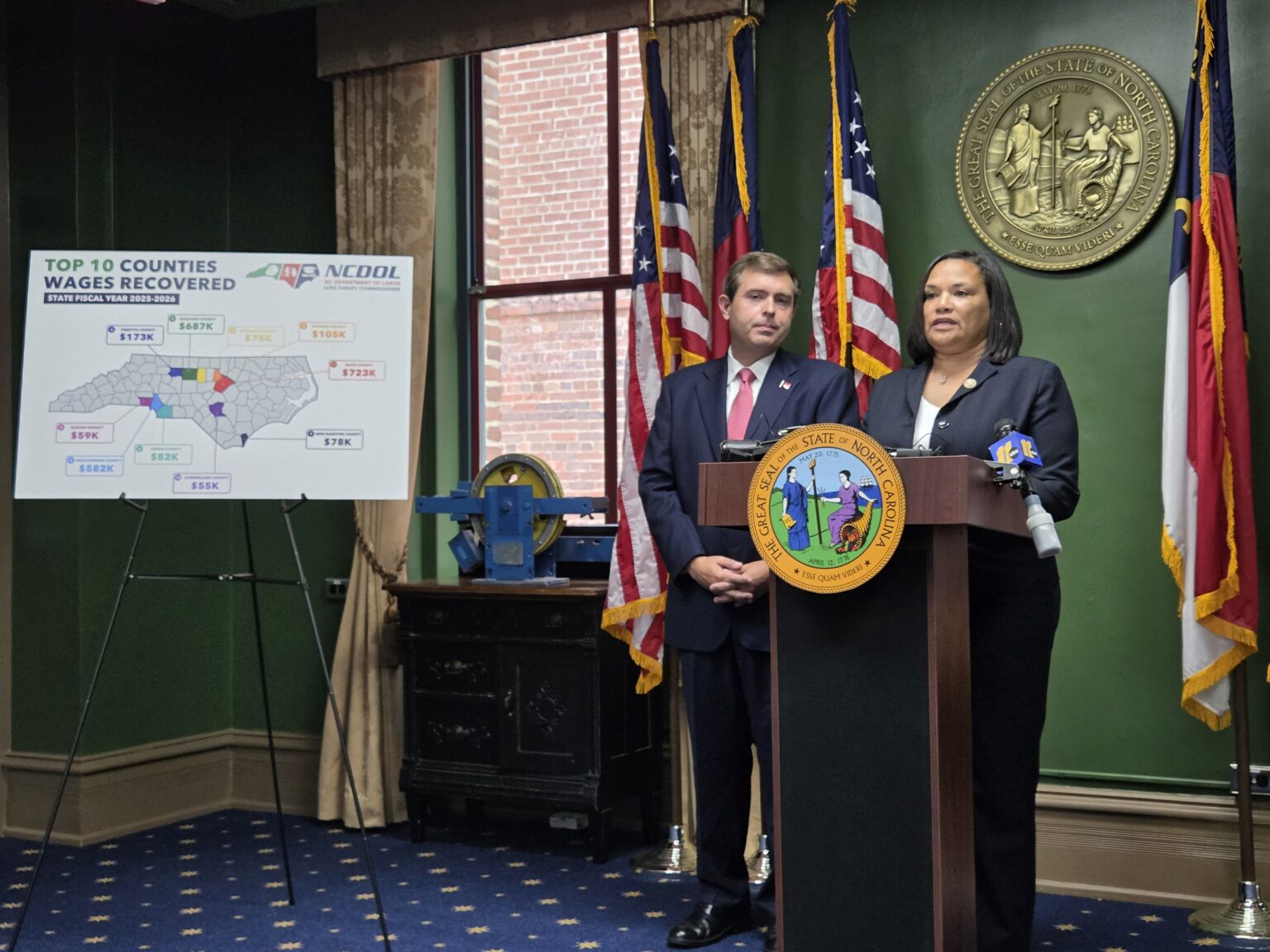
North Carolina Labor Commissioner Luke Farley announced Tuesday morning that his department recovered a record $3.7 million in unpaid wages for workers over the past year, calling it the Department of Labor's greatest annual impact to date in enforcing the state's wage laws.
Farley announced the Historic Labor Building in Raleigh, where he was joined by Kisha Scotton, administrator of the department's Wage and Hour Bureau and vice chair of the National Wage and Hour Committee.
The recovered wages came from 2,199 substantiated complaints handled by the bureau's eight case analysts and fifteen investigators, with more complex cases routed to investigators for deeper review.
"Most businesses want to comply with the law," Farley said, "but when workers are denied wages they've earned, we as a department will work on their behalf. Today's historic announcement is a reminder that the NC Department of Labor is committed to protecting workers, protecting responsible job creators, and that a full day's work receives a full day's pay."
Farley said the department's primary goal in wage disputes is not necessarily to fine employers but to correct the error, enforce the terms of the labor agreements in question, and get workers their money—though the department can and does file lawsuits when necessary to secure compensation. He encouraged workers who believe they haven't been paid properly to contact the department directly.
"The best way to get that help is to call us.”
Scotton said her bureau tries to intervene before a wage dispute escalates into a formal violation.
"The NC Department of Labor is here to help," she said. "Workers who believe they have not been paid properly should not assume there's nowhere to turn. The department is there to address issues even before they become violations."
The bureau enforces the North Carolina Wage and Hour Act, which governs unpaid wages, vacation pay, overtime, minimum wage compliance and youth employment protections. Investigators examine payroll deductions and other pay practices to confirm workers' gross wages comply with state law, cross-referencing actual hours worked, job responsibilities and scheduled shifts against compensation records, and rely on a combination of documentation, employer and employee interviews, and state law to determine whether wages were properly paid.
Farley's office said the extent of enforcement action in a given case often depends heavily on the employer's responsiveness once a complaint is filed.
North Carolina's minimum wage remains set at the federal floor of $7.25 an hour for standard non-exempt hourly employees, with a tipped minimum wage of $2.13 an hour, provided tips bring a worker's total hourly earnings up to at least $7.25. That trails well behind the state's average hourly wage of $24.79 across all occupations, according to federal labor tracking data, and behind an estimated living wage of $22.47 an hour for a single adult to cover basic local housing and food costs.
Farley, a Republican and a graduate of UNC-Chapel Hill and Wake Forest University School of Law, was sworn in as North Carolina's labor commissioner in January 2025 and is one of only four elected labor commissioners in the country. Tuesday's announcement builds on a wage-recovery effort that topped $2.5 million over a comparable period a year earlier, according to the department.
