
By Jheri Hardaway
Staff Writer
For decades, North Carolina’s political story was written in shades of deep red and classic blue. A traditional battleground defined by the push and pull between registered Democrats and Republicans. Today, the state's political map is being quietly reconfigured by a different group altogether: the unaffiliated voter. This voter is an unpredictable, often hard-to-read wild card.
Representing nearly 40% of the state’s total electorate, unaffiliated voters have solidified their position as North Carolina's largest voting bloc, outnumbering both registered Democrats and Republicans. New residents, upset youth, and disillusioned older voters fuel this movement. The Old North State has grown from a standard swing state into an uncontrollable loud wild child.
Fast-growing exurbs around the Triangle (Wake, Johnston, and Harnett counties) and the Charlotte metro area (Cabarrus, Union, and Iredell) serve as the epicenter of independent voter growth. In these locations, college-educated professionals and young families are migrating in record numbers, bringing ticket-splitting tendencies that make traditional suburban strongholds increasingly fluid.
According to the latest estimates from The University of North Carolina’s Carolina Demography, North Carolina has about 8 million citizen-voting-age residents, and as of September 28th, 2024, 7.6 million registered voters. Partisan affiliation splits roughly between three groups: unaffiliated, Democrat, and Republican, with a slight lead for unaffiliated. The data reads: 2,886,573 or 38% were registered unaffiliated; 2,413,469 or 32% were registered Democrat; 2,285,377 or 30% were registered Republican; and 72,300 or 0.94% were registered to another party.
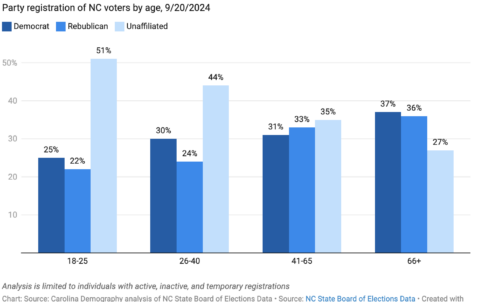
Another impactful data point from Carolina Demography states that young voters are more likely to register as unaffiliated than any other age group: 51% of 18-25 year-olds are registered unaffiliated versus 44% of 26-40 year-olds, 35% of 41-65 year-olds, and 27% of voters 66 and older.
As previously reported, there are efforts being put forth to make candidates and citizens pick a side. Revisions to House Bill 958 would require any candidate running in a partisan primary to have been registered with that party for at least a year. An important note: each party’s state executive committee could grant exceptions. This is designed to block efforts like those of Educators on the Ballot and Kate Barr Can’t Win, registered Democrats or unaffiliated voters who switched their registration to Republican to compete in the recent Republican primary. While none came close to winning, the tactic has been circulated widely on social media.
According to Carolina Demography, more than 55% of the state's unaffiliated voters were born outside North Carolina. Relocating from the Northeast, Midwest, and other Southern states, these new residents often leave their previous party affiliations at the state line, choosing to register as unaffiliated while they evaluate local political dynamics.
Under North Carolina law, the state operates a semi-closed primary system. Registered Democrats and Republicans are locked into their respective party ballots. Unaffiliated voters, however, hold a unique privilege: at the polling place, they may request a Democratic, Republican, or nonpartisan primary ballot without altering their independent registration status.
An interesting long-term thought: partisan mapmakers rely heavily on historical voter registration data and primary participation records to build "safe" partisan seats. Looks like the safety found in historic trends is treading water. This dynamic transforms independent voters into key players in primary contests, particularly in low-turnout election cycles.
Associate Professor of Political Science at the University of North Carolina, Greensboro, David Holian confirmed the share of unaffiliated voters has been rising. They now make up the largest single group of registered voters in the state. Holian says that the growth in unaffiliated voting shows a pattern over the years. “It's a sign of what we've increasingly been seeing in American politics, which is that it's sort of this paradox where we have a really increasingly partisan and polarized political space.”
